
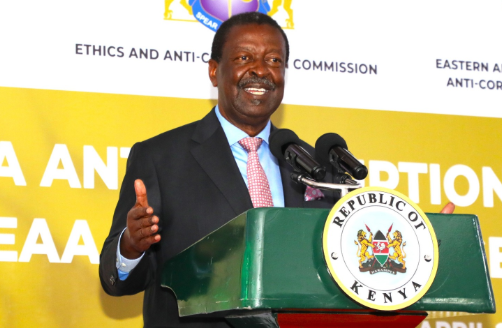
 Prime Cabinet Secretary Musalia Mudavadi / HANDOUT
Prime Cabinet Secretary Musalia Mudavadi has affirmed Kenya’s heightened vigilance and preparedness against Ebola and other emerging public health threats.
Mudavadi said recent regional developments had prompted intensified consultations within government, including high-level engagements convened by the President with development partners and the United Nations system to evaluate and reinforce Kenya’s preparedness framework in the event of Ebola-related risks.
Speaking during the State Department for Foreign Affairs Staff Wellness Day in Nairobi, Mudavadi noted that although Kenya has not recorded any confirmed Ebola cases, the country must remain alert owing to its strategic role as a regional gateway for diplomacy, trade, travel and international cooperation.
“Preparedness must remain continuous and deliberate. We cannot afford complacency in the face of evolving global health threats,” Mudavadi said.
The PCS observed that Ebola preparedness goes beyond the health sector and forms part of broader national security and foreign policy considerations, thereby requiring a coordinated whole-of-government approach.
He said Kenya continues to strengthen surveillance systems, emergency response mechanisms and health infrastructure to ensure rapid detection, containment and response to any potential public health emergency.
Mudavadi further disclosed that discussions are ongoing between Kenya and the United Nations aimed at positioning the country as a strategic humanitarian and logistical coordination centre within the global South.
“We are engaging the United Nations with a view to ensuring that Kenya is not only a host of international agencies, but also a strategic hub for humanitarian coordination and logistical support,” he said.
According to Mudavadi, achieving this ambition requires robust national preparedness systems capable of supporting both domestic priorities and international obligations.
He added that Kenya is expanding a network of emergency preparedness and response facilities as part of a broader strategy to strengthen national health security and institutional resilience.
“We are deliberately investing in preparedness capacity not only for national response, but also in recognition of Kenya’s responsibility within the international system,” he stated.
On staff welfare, Mudavadi described the annual wellness initiative as an important institutional programme that promotes resilience, cohesion and effectiveness within the foreign service.
He commended the State Department for Foreign Affairs under the leadership of the Principal Secretary for sustaining the annual Staff Wellness Day programme, noting that it provides an important platform for team building, stress management and institutional cohesion.
“This initiative contributes significantly to building a healthy, motivated and productive workforce, which is essential to the effective implementation of Kenya’s foreign policy mandate,” he said.
Mudavadi emphasised that the well-being of foreign service officers remains central to advancing Kenya’s interests globally, given the demanding and high-pressure nature of diplomatic work.
“Our foreign service officers remain at the forefront of advancing Kenya’s interests internationally, and their well-being directly influences institutional effectiveness,” he said.
The Prime Cabinet Secretary also highlighted mental health as an increasingly critical global concern, noting that stress, anxiety and burnout continue to affect workforces across institutions and countries.
“Work-related stress often manifests silently, affecting individuals who continue to serve with dedication despite personal challenges,” he observed.
He encouraged staff members to utilise available counselling and psychosocial support services while fostering a workplace culture anchored on openness, empathy and mutual support.
“Even a simple conversation or an act of empathy can make a meaningful difference in strengthening resilience within the workplace,” he said.
Mudavadi further stressed that seeking support should be viewed as a sign of responsibility and self-awareness rather than weakness.
“Seeking assistance reflects courage, maturity and a commitment to personal and professional well-being,” he said.
He cautioned that neglecting wellness considerations could undermine institutional performance and social cohesion through increased workplace strain and stress-related conditions.
