


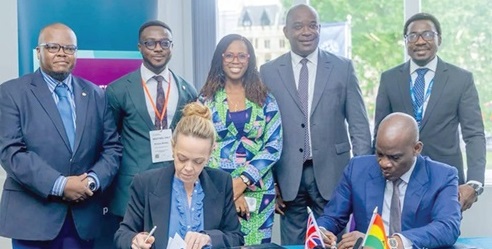
The Ministry of Education and the Cambridge University Press & Assessment (Cambridge) have signed a memorandum of understanding (MoU) to explore closer collaboration on strengthening the country’s education system.
The MoU provides a practical framework to support Ghana’s education reform agenda through targeted, collaborative initiatives.
They include system analysis, curriculum and assessment strengthening, teacher professional development, and the integration of cross-cutting priorities such as climate education and artificial intelligence (AI).
Signatories
The Minister of Education, Haruna Iddrisu, and the Managing Director of the Partnership for Education at Cambridge University Press & Assessment, Jane Mann, signed for their respective institutions.
The MoU, which was signed at the Education World Forum 2026 in London, sets out plans to look at joint work to analyse the education system, strengthen the curriculum, and support teacher professional development.
Under the agreement, through Cambridge’s Partnership for Education, the ministry would have access to world-class, internationally benchmarked expertise and a proven track record of supporting governments to design and implement evidence-based, scalable and sustainable education reform aligned to national priorities.
The agreement also creates a platform for sharing knowledge and driving innovation. It opens the door to future partnerships in areas such as foundational learning, digital transformation, and workforce development.
Partnership
Through the partnership, Cambridge will work closely with the ministry and Ghanaian organisations to identify practical ways to improve education outcomes.
The focus will be on programmes that respond to Ghana’s national priorities, drawing on global and local expertise to support key goals.
The collaboration would take a whole-system view.
It will consider how different parts of the education system work together, from curriculum and assessment to classroom teaching.
This will help ensure that reforms are aligned and effective.
Areas of focus will include climate education and the use of artificial intelligence (AI) in learning.
Witnesses
The MoU, which was witnessed by senior officials from the UK Government’s Department for Business & Trade, includes robust safeguards on confidentiality, intellectual property, safeguarding and publicity, ensuring alignment with Ghanaian policy, legal frameworks and values.
Formalising the MoU would enable the timely joint development of donor-funded and service-based opportunities that directly support Ghana’s strategic objectives and strengthen institutional capacity.
It will also improve learning outcomes and position Ghana as a regional leader in education innovation while allowing the ministry to retain full control over scope, pace and implementation.
Speaking after the signing of the MoU, Mr Iddrisu said the agreement provided a clear and practical framework to support Ghana’s education reform agenda.
He noted that the partnership would help build a more responsive, skills-focused system that would meet both national and global needs.
For her part, Ms Mann welcomed the agreement, highlighting the shared ambition to expand access to quality education.
“Ghana’s commitment to preparing every child for the future is one we strongly support.
We look forward to working together to help make this a reality,” she said.
