


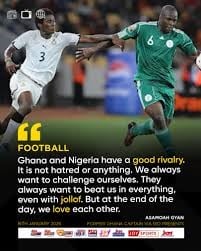

The banter is loud, the debates are endless, and the stakes often feel personal. Yet beneath the jokes, social media arguments, and football rivalries lies something far more meaningful: a relationship between Ghana and Nigeria built on kinship rather than division.
At its heart, the Ghana-Nigeria rivalry is healthy, vibrant, and deeply cultural. It thrives in music, sports, food, fashion, business, and the shared identity of being West African. Ghanaians proudly defend their jollof rice as the best on the continent, while Nigerians counter with the global influence of Afrobeats, Nollywood, and an impressive football legacy. The competition is intense, but it is rarely rooted in hostility.
The reason is simple: the two nations are connected by history, migration, and everyday human relationships. For decades, Ghanaians and Nigerians have lived, worked, studied, traded, and celebrated together. Markets across Accra and Kumasi are home to Nigerian entrepreneurs, while Ghanaian universities continue to attract thousands of Nigerian students. In entertainment, collaborations between Ghanaian and Nigerian artists have produced some of Africa’s most celebrated music, dominating playlists from Lagos and Accra to London and New York.
Beneath the teasing lies genuine mutual respect. When one nation succeeds, the other takes notice. When one faces challenges, the other understands. The rivalry is fueled by pride and ambition, not hatred. In many ways, each country pushes the other to become more innovative, competitive, and globally relevant.
What unites Ghana and Nigeria ultimately outweighs what divides them. Both nations carry the promise and responsibility of shaping Africa’s future. Both have contributed significantly to Pan-Africanism and regional integration, building on the legacies of leaders such as Kwame Nkrumah and the broader intellectual movements that inspired cooperation within ECOWAS. Both countries also face similar challenges, including youth unemployment, infrastructure gaps, and the need for economic diversification. Yet in confronting these challenges, they share a common strength: resilience and entrepreneurship.
The importance of this relationship extends beyond Accra and Abuja. When Ghana and Nigeria collaborate, they influence the cultural and economic direction of Africa itself. From cross-border trade and investment to music, film, technology, and fashion, their partnership demonstrates what African integration can achieve when driven not only by policy but also by people-to-people connections.
So yes, continue the debates about jollof rice. Argue over Highlife, Hiplife, and Afrobeats. Celebrate victories and compete passionately on the football pitch. But remember that beneath the rivalry lies a larger harmony. The Ghana-Nigeria relationship proves that competition and brotherhood can coexist — and that Africa becomes stronger when its biggest voices challenge and inspire one another.
By Frank Ayim Damptey
