


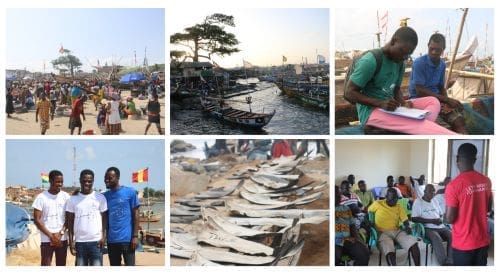
A Ghanaian marine conservationist has won one of the world’s most prestigious environmental prizes for his work protecting critically endangered guitarfish along Ghana’s western coastline, becoming the only Ghanaian among the six global winners of the 2026 Whitley Awards.
Dr. Issah Seidu, a lecturer at Kwame Nkrumah University of Science and Technology (KNUST) in Kumasi and the founder of non-governmental organisation AquaLife Conservancy, received the award on April 29, 2026, at the Royal Geographical Society in London. Charity Patron HRH The Princess Royal presented the prize, which comes with £50,000 in project funding. The Whitley Awards, often called the Green Oscars, are presented annually by the Whitley Fund for Nature (WFN), a UK charity that has channelled £26 million to more than 230 conservationists across 84 countries since 1993.
Seidu and his team will use the funding to expand their conservation work to four additional coastal communities in Ghana’s Ahanta West District, building on progress already made with five communities where more than 200 fishers have scaled back their harvest of guitarfish. The project will extend critical habitat mapping from 15 square kilometres to 25 square kilometres, a key step toward establishing Ghana’s first Locally Managed Marine Area.
Guitarfish, closely related to sharks and rays, are among the most threatened marine species on the planet. Globally, overfishing has driven a 71 percent decline in shark and ray populations, and the International Union for Conservation of Nature (IUCN) lists several guitarfish species as Critically Endangered. Demand for their white fins in international markets, primarily China, has intensified fishing pressure across Africa and Asia. In Ghana’s waters, sawfish have already gone extinct and wedgefish populations are severely depleted.
Seidu’s team has already trained local volunteers as fisher biologists, educated 83 fishers and boat captains on safe fish release, and introduced alternative income sources including soap making and snail farming. Some fishers involved in the programme now earn more from these alternatives than from fishing.
“Working with guitarfish revealed to me how easily a species can decline when it is poorly understood and undervalued,” said Seidu.
Seidu also serves as co-chair of the IUCN Shark Specialist Group for the African region and is leading the first comprehensive baseline study of sharks and rays in Ghana and West Africa. The first technical working group meeting of his expanded project is planned within 30 days of the award.
