


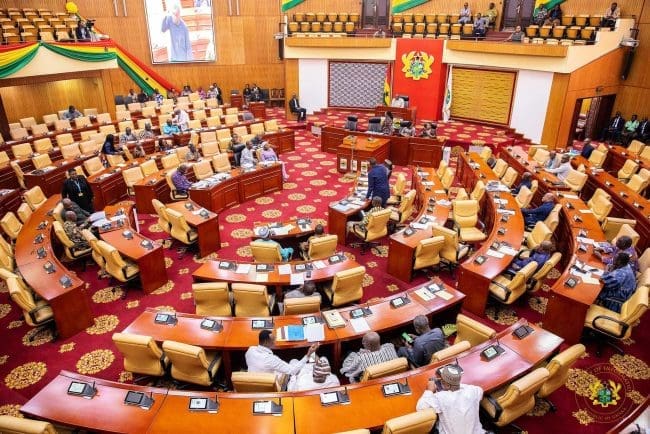
The Majority in Parliament has rejected the opposition’s characterisation of the Bank of Ghana’s (BoG) GH¢9.6 billion gold gain as a one-off accounting trick, arguing that the Minority’s assessment reflects a fundamental misreading of how central banks manage their balance sheets.
The rebuttal follows a press conference on Sunday by the Minority, led by Kojo Oppong Nkrumah, Ranking Member on Parliament’s Economy and Development Committee, in which the opposition declared the BoG “policy insolvent.” The Minority argued that stripping the GH¢9.6 billion gold gain from the Bank’s reported operating income of GH¢22.2 billion leaves only GH¢12.7 billion, producing a deficit of roughly GH¢4 billion against Open Market Operations (OMO) costs of GH¢16.7 billion.
Responding on behalf of the Majority, Atta Issah, Member of Parliament for Sagnarigu and a member of the Parliamentary Select Committee on Finance, said the opposition’s framing is misleading. “The characterisation of the GH¢9.6 billion as a falsehood simply because it arises from gold transactions is misleading. The Bank actively manages its reserve assets, including gold, as part of its core mandate. Central banks globally rebalance reserves between currencies, gold, and other instruments to optimise liquidity, safety, and returns,” he said.
Atta Issah added that gains from such portfolio management constitute legitimate income and are not invalidated by being non-recurring. He also pushed back against the Minority’s claim that the Bank is “not in the business of trading gold.” “The Bank is not a speculative trader. But it is fully engaged in reserve management. When gold prices rise significantly, it is standard central banking practice to rebalance holdings and realise gains. This is prudent management, especially in a period where Ghana faced external financing constraints and exchange rate pressures,” he said.
On the insolvency argument, he was direct. “Central banks are not commercial institutions. Policy solvency is not determined by a single year’s operating income minus expenses. It depends on the overall balance sheet, including reserves, revaluation buffers, and sovereign backing,” he stated, dismissing the Minority’s deficit calculation as an inappropriate application of commercial accounting logic to a public institution.
He further rejected claims that the BoG hastily sold 50 percent of its gold reserves to conceal financial distress, saying audited statements show no evidence of distress liquidation, only measured portfolio adjustment. He pointed to Ghana’s domestic gold purchase programme, under which the country accumulated approximately 111 tonnes of gold in 2025, as direct evidence against any narrative of reserve depletion.
Atta Issah placed the Bank’s actions within the broader context of a difficult macroeconomic period marked by debt restructuring, exchange rate pressures, and global financial tightening. “Active balance sheet management, including asset reallocation, is not a sign of weakness. It is a necessary tool of stabilisation. This is not evidence of collapse. It is evidence of management under pressure,” he concluded.
The BoG’s 2025 audited financial statements, released on May 1, 2026, show a net loss of GH¢15.63 billion, up from GH¢9.49 billion in 2024. The Bank has maintained it remains policy solvent and projects a return to profitability between 2026 and 2030 as interest rates continue to decline.
