


The coordinated attacks that swept across Mali on 25 April 2026 mark a turning point not just for Bamako and violent escalation in the Sahel, but for the wider West African region. They represent a critical inflexion point—one that exposes the fragility of Mali’s current security architecture and raises broader questions for West Africa, particularly Ghana, about the risks of overreliance on a single and external military partnership.
What unfolded was not a routine security breach. It was a synchronised offensive targeting multiple strategic locations in the AES member state. The scale and coordination of these attacks revealed a significant evolution in insurgent capability, while simultaneously highlighting gaps in intelligence, preparedness, and response within the Malian Armed Forces and their external partners.
Fighters linked to JNIM and the Azawad Liberation Front (FLA) struck Bamako, Kati, Gao, Kidal, Mopti, Bourem, and Sévaré simultaneously. A Russian Mi-8 helicopter was neutralised near Wabaria. Checkpoints north of the capital were captured. Armoured vehicles were destroyed. Mali’s Defence Minister, General Sadio Camara, was killed, while other senior military figures were wounded, including the Chief of Defence Intelligence. The scale and precision of the assault pointed to a serious intelligence collapse among both the Malian Armed Forces and their Russian-backed partners, the Africa Corps.
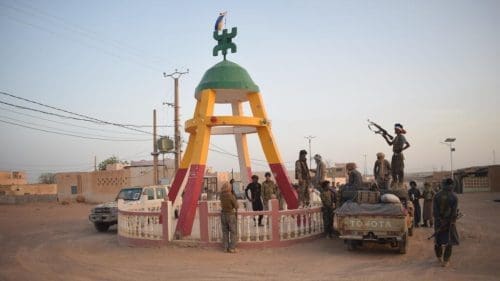
At the centre of this unfolding crisis lies the fall of Kidal. Long presented by Mali’s military leadership and its Russian partners as a symbol of regained sovereignty, Kidal’s collapse is both operational and symbolic. Reports indicate that Russian-linked forces, operating under the Africa Corps, withdrew after limited engagement, leaving Malian troops exposed and isolated. For a partnership built on the promise of restoring security, the optics—and implications—are difficult to ignore.
A Familiar Playbook
Moscow’s response followed a predictable script. The Africa Corps claimed 1,000 to 1,200 insurgents killed and 100 enemy vehicles destroyed. Russia’s Defence Ministry reframed the events as a thwarted coup, converting a damaging military setback into a narrative of decisive intervention. Affiliated outlets amplified the message. Neither the Russian Embassy in Mali nor the Foreign Ministry in Moscow issued a direct statement. By casting a coordinated rebel offensive as an externally sponsored plot, Russia shifted focus from its own failure to geopolitical conspiracy, with France, Ukraine, and the West as convenient villains. It is the same technique applied in Syria, in Ukraine, and wherever Russian forces have suffered reversals they cannot acknowledge.
The intelligence failure behind the attacks is equally significant. A senior Malian official told RFI that Russian forces had been warned of the impending assault three days in advance but took no action. The militants’ ability to bring down an Africa Corps helicopter further suggests they had anticipated and prepared for aerial responses, a level of counter-surveillance awareness that neither Moscow nor Bamako appeared to account for. These are not routine battlefield losses. They are indicators of a system under severe strain.
Why Ghana Must Pay Attention
It would be a strategic error to read these events as distant. Jihadist groups operating in Mali have already demonstrated the capacity to expand territorially, moving from northern Mali through central regions and into Burkina Faso. Northern Ghana lies along this evolving corridor. The risks are not theoretical. Porous borders facilitate infiltration by small, mobile cells. Conflict in the Sahel fuels the proliferation of illicit arms and transnational criminal networks. Disrupted trade routes and displacement ripple southward, eroding local resilience in ways that are harder to detect and reverse than a single dramatic attack.
What Mali’s experience also demonstrates is the danger of security dependence on a single external partner focused overwhelmingly on military solutions. Russia’s engagement has delivered arms, mercenaries, and narrative management. It has not produced investment in energy infrastructure, agricultural modernisation, or the economic conditions that reduce recruitment into extremist networks. A strategy that contains violence without addressing its underlying drivers does not resolve insecurity. It displaces it. A partner overstretched by its own war in Ukraine cannot indefinitely sustain the commitments it has made across the African continent.
Regional Cooperation Is Not Optional
Despite current political tensions, ECOWAS remains the critical platform for regional coordination. The Alliance of Sahel States, the grouping of Mali, Burkina Faso, and Niger, has proven unable to mount a meaningful collective response to this crisis. It exists, for now, more in declarations than in operational reality. Ghana and its ECOWAS partners must not allow political friction to erode what remains of the regional security architecture.
Joint intelligence cells linking military, police, and border agencies along high-risk corridors, particularly between Ghana and Burkina Faso, are no longer a long-term aspiration. They are an immediate necessity. Partners such as the European Union, the US, the United Kingdom and even China bring relevant technical capacity in surveillance and intelligence analysis. These relationships should be built on transparency, reliability, and long-term commitment, not on short-term expediency.
The lesson from Mali is clear. Security cannot be outsourced. External support can complement national efforts, but cannot replace them. A military model that wins territory without building governance, economic resilience, or community trust will always produce the conditions for its own reversal. Ghana’s security begins not at its own borders, but in the choices made today in Bamako, Ouagadougou, and Niamey.
The Sahel is not a buffer zone. It is a corridor. What travels through it does not stop at the borders of coastal West Africa. The challenge for Ghana and the region is to learn early, adapt quickly, and act together.
Joseph McCarthy is an analyst and researcher focusing on governance, security, and political transitions in the Sahel. He writes on geopolitics, development, and African diplomacy. Email: [email protected]
