


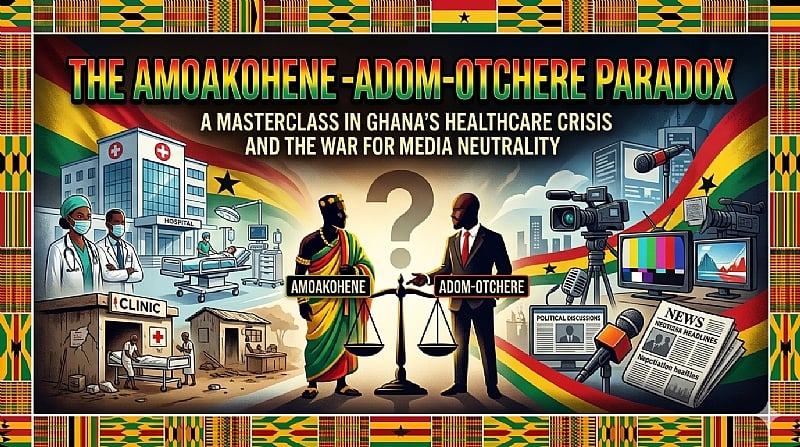
A Masterclass in Ghana’s Healthcare Crisis and the War for Media Neutrality
Disclaimer
The following article analyzes a matter of intense public interest based on claims broadcast during a live television program. At the time of publication, no formal evidence, forensic financial audit, or official statutory findings have been produced by any state institution to verify the allegations of financial malfeasance. All individuals mentioned are presumed innocent of any wrongdoing unless proven otherwise through proper legal and investigative channels.
The Core Paradox
The intersection of public health and media accountability in Ghana has created a stark dichotomy. On one side stands the pressing reality of a healthcare system under strain; on the other lies a media landscape frequently caught between political alignment and the ethical duty of absolute neutrality. This tension defines , serving as a critical lens through which we must examine the structures governing both our national health and our public discourse.
The War for Media Neutrality
– Gatekeepers of Truth: Media houses are entrusted with the sacred duty of informing the public, yet many struggle to balance political influence with journalistic integrity.
– Neutrality Crisis: Polarized narratives often obscure the lived experiences of ordinary citizens, especially those seeking basic medical care.
– Trial by Media: Allegations of corruption are broadcast without forensic documentation, creating reputational damage before due process can take its course.
– Selective Morality: The hypocrisy of Ghana’s media elite is stark. Paul Adom‑Otchere himself was embroiled in the Christmas tree procurement controversy at the Ghana Airports Company Limited (GACL), where questions were raised about inflated costs and opaque tendering. Citizens still recall the figures — ₵128,000 spent on imported Christmas decorations — as emblematic of elite detachment from everyday struggles. For many, his attack on Dr. Amoakohene over alleged misuse of funds felt like the proverbial pot calling the kettle black.
– Weaponized Airwaves: When investigative journalism devolves into personalized attacks, the Fourth Estate’s constitutional mandate to act as an unbiased arbiter of truth is eroded.
– Partisan Echo Chambers: Media houses amplify political point‑scoring rather than establishing objective facts, deepening polarization.
Ghana’s Healthcare Crisis (Numbers Tell the Story)
The Amoakohene‑Adom‑Otchere controversy is inseparable from the broader collapse of trust in Ghana’s healthcare system. Numbers and lived experiences tell a sobering story:
– Hospital Bed Density: Ghana has only 0.7–0.9 beds per 1,000 people, far below the WHO’s recommended 5 per 1,000.
– Overcrowding: Korle‑Bu Teaching Hospital handles 250 admissions and 1,500 outpatient visits daily, often exceeding safe capacity.
– Regional Imbalance: Greater Accra and Ashanti regions command ~5,000 beds each, while northern regions remain underserved, leaving rural patients dangerously exposed.
– Human Cost: In February 2026, Charles Amissah (29) died after being ferried between three hospitals, all of which declined admission due to lack of beds.
– Budget Allocation: Ghana devoted 11% of its national budget to health in 2021, below the 15% Abuja Declaration target.
– Brain Drain: Over 3,000 Ghanaian doctors and nurses are currently practicing abroad, draining critical expertise and leaving local hospitals understaffed.
The Irony of Leadership
That a medical doctor like Dr. Amoakohene—trained at the University of Ghana—would choose foreign childbirth care underscores the paradox: the very architects of policy distrust the institutions they oversee. This decision sends a devastating signal to ordinary taxpayers who cannot afford foreign care and must rely on overstretched local facilities.
The Mandate for Political Leadership (The New Imperial Standard)
– Investing to Foreign Standards: Leaders must upgrade diagnostic equipment, specialized centers, and training facilities to global tier‑1 standards.
– Universal Benefit: Elite‑level healthcare must be democratized, accessible to every Ghanaian regardless of class or affiliation.
– Ending Health Tourism: Building world‑class systems at home eliminates reliance on foreign medical travel and fosters public trust.
Key Recommendations for Systemic Reform
– Independent CHRAJ Audits: Investigate spending footprints of public officials against declared incomes.
– Ban Non‑Emergency Foreign Care: Redirect funds to expand hospital bed capacity.
– Mandatory Source Disclosure: Officials must submit verified financial statements for foreign medical procedures.
– GJA Enforcement: Penalize media houses that broadcast unverified corruption allegations.
– Elevating Local Centers: Target underserved northern regions to balance distribution.
A Dual Awakening
The unfolding drama between Dr. Frank Amoakohene and Paul Adom‑Otchere must not be dismissed as a fleeting distraction. It is a wake‑up call for structural reform.
True accountability cannot exist when leaders bypass the public services they manage, nor can democracy thrive when media platforms prioritize sensationalism over verifiable facts. For Ghana to progress, citizens must reject partisan defenses and demand systemic consistency.
Our leaders must consume the public infrastructure they build, and our journalists must hold them to account with unyielding objectivity, ironclad evidence, and total independence. Only when state resources are visibly bound to local institutional development will the Ghanaian taxpayer truly receive the governance they deserve.
✍️ Retired Senior Citizen
For and on behalf of all Senior Citizens of the Republic of Ghana 🇬🇭
Teshie‑Nungua
[email protected]
️⃣ Hashtags for Publication
#GhanaPolitics #HealthcareCrisis #MediaNeutrality #Accountability #PublicTrust #CHRAJ #NHIS #BrainDrain #KorleBu #KomfoAnokye #ChristmasTreeSaga
