
Here is a number that should stop every Kenyan taxpayer
cold, and it comes straight from the government’s own ledger. In the nine
months to March 2026, for every Sh100 the national government actually
paid out, nearly Sh46 went to debt servicing, about Sh40 to recurrent costs such as salaries and day-to-day operations, and less than Sh10 to development.
Fewer
than Sh10 in every Sh100 built anything new—a clinic, a classroom,
a kilometre of road. Almost half went straight to creditors.
These are not opposition figures. They are drawn from
the National Treasury’s own Statement of Actual Revenues and Net Exchequer
Issues as at March 31, 2026, the document the constitution requires it to
publish.
And they explain a contradiction that confuses many Kenyans: how a
country can tax its formal workers so visibly, and yet deliver so little that
anyone can point to.
The answer is that Kenya’s public money disappears down
two holes. The first is large and legal. The second is larger and is not.
Start with the legal one. The national budget this year
is roughly Sh4.3 trillion, and the great majority of it goes to running
costs rather than building anything—salaries, day-to-day operations, pensions and, above all, repaying old loans.
Debt servicing alone took nearly Sh46 of every Sh100 the government released in the nine months to March
2026. When the state picks up your shilling, close to half of it walks straight
back out to the banks and bondholders before it touches a single public
service. That is the legal hole, and it is the product of years of borrowing to
cover gaps that were never closed.
Now the larger hole, the one the state prefers not to
name.
The Ethics and Anti-Corruption Commission, in its 2024
report, estimated that Kenya loses Sh608 billion every year to
corruption. That is about Sh8 out of every Sh100 the entire economy
produces. The EACC is not a hostile witness. It is the state’s own institution,
established by law, reporting on its employer.
The African Development Bank, working independently,
puts outright corruption losses lower, at Sh194 billion a year. But it
adds two figures the EACC leaves out. General waste and inefficiency in public
spending, not theft as such but money that produces no value, costs at least Sh650 billion a year. And tax exemptions handed to politically
connected interests cost a further Sh105 billion in revenue never collected in
the first place.
The Auditor General supplies the details. Of Sh515 billion allocated to flagship projects between 2019 and 2024, the Auditor
found that Sh304 billion, nearly 60 per cent, was simply never spent. It sat idle
in accounts while the loans that funded it kept accruing interest. The IMF
reports that nearly half of the country’s more than 1,000 active
government projects are stalled, and that finishing them would now cost an
additional Sh1 trillion.
The individual cases are by now familiar. Kenya Power
sits under audit query for Sh49 billion in inflated, unexplained and
irregular payments. Wajir county was found by the Auditor General to have run
up over Sh1.5 billion in unaccounted expenditure and Sh825 million in
irregular procurement, including medical supplies bought from private firms in
breach of the law requiring them to be sourced through the public medical
agency.
The Mombasa Gate Bridge, announced in 2019 and budgeted at Sh49 billion to replace the Likoni ferry crossing, had spent under a billion of
that four years on, leaving more than Sh48 billion untouched while the project
sat as a hole in the ground.
These are not anecdotes. They are samples from an
audited record. The Auditor General flags the same categories of failure year
after year. Weak procurement. Money paid out without paperwork. Projects that
never finish. The pattern is built in, not occasional.
Now put the numbers side by side. The state says it must
borrow about Sh923 billion this year to cover the gap between what it
spends and what it collects. It has set aside Sh693 billion for development.
The
EACC’s corruption figure alone, 608 billion, is two thirds of the borrowing
gap. Add the AfDB’s separate waste figure of Sh650 billion and the leakage
exceeds the gap twice over. Recovering even one third of what is lost each year
would close the borrowing gap entirely. Recovering one half would double
development spending.
The
conclusion is unavoidable. Kenya does not have a revenue problem. It has a
leakage problem the size of its borrowing gap. Every new loan, every new tax,
every levy presented as unavoidable, is in effect financing the leak rather
than development. The state borrows because it leaks, not because it taxes
too little.
How does Kenya compare to the rest of the world? Badly.
The world loses about five per cent of its output to corruption. Kenya, on its own
institution’s count, loses eight. Transparency International’s 2024 index ranks
Kenya 121st out of 180 countries, scoring 32 out of 100, where higher means
cleaner.
The sub-Saharan African average is 33. The global average is 43. Kenya
scores below both, and over five years has moved a single point. Countries at
Kenya’s income level tend to score higher: Ghana 42, Vietnam 40, Indonesia 37,
the Philippines 33. Kenya, at 32, sits at or below the bottom of that group. On
the newer 2025 index, it slipped further still, to 30.
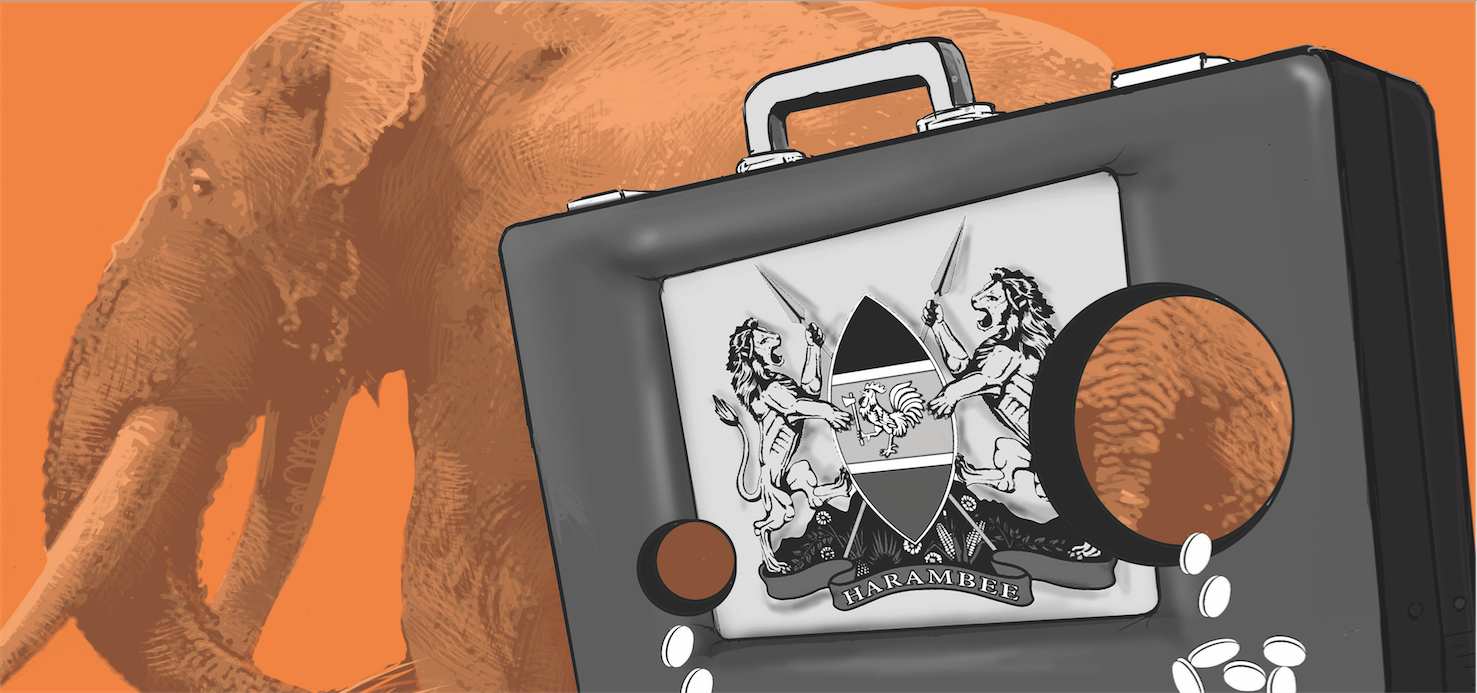
Three institutions, three methods, one elephant. The EACC
counts it. The African Development Bank benchmarks it. The Auditor General
catalogues it case by case. And Treasury’s own books confirm it, in the gap
between what is collected and the fewer than Sh10 in every Sh100 that reach development.
So strip the argument down to the transaction every
Kenyan can feel. You hand the state Sh100. Nearly Sh46 of that goes straight back out to creditors before anything happens. Most of the rest pays
salaries and keeps the lights on. Less than Sh10 is left to build anything you
could ever see, use or stand on.
Imagine any other transaction in your life on
those terms. You pay a builder Sh100,000 and almost half goes to
clearing his old debts, most of the rest to his wages, and he hands you a single
doorframe. You would not call that a price. You would call it a robbery.
That is the deal the citizen is being asked to fund more
generously. Not a slightly expensive state, but one where the borrowing
swallows nearly half before the building even begins, leaving less than Sh10 in every Sh100 to show for it.
The next time anyone in authority
explains that the country simply must raise more revenue, the honest reply is a
single question. Raise it to do what, when less than Sh10 of every Sh100
we already hand over ever comes back to us as anything we can see, use or stand
on?
The bucket is not too small. It is almost all holes. And no amount of new
water poured in at the top will ever fill a bucket that no one is willing to
repair at the bottom.
