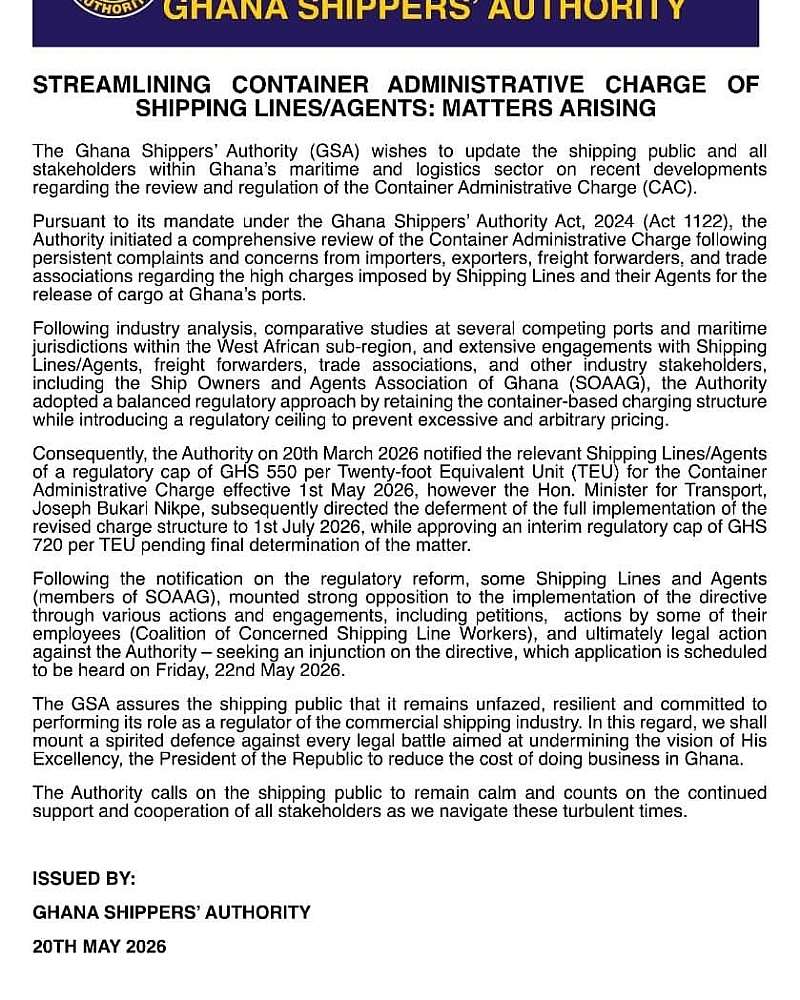
The Ghana Shippers’ Authority (GSA) has stated that it remains committed to enforcing a regulatory ceiling on the Container Administrative Charge (CAC).
This follows mounting opposition from some shipping lines and agents who have taken legal action to block the directive.
The Authority has announced a revised framework aimed at streamlining and controlling charges imposed by shipping lines and their agents for cargo clearance at Ghana’s ports.
The move, it says, follows widespread complaints from importers, exporters, freight forwarders, and trade groups over what they describe as excessive and arbitrary fees.
The CAC review was undertaken under the Ghana Shippers’ Authority Act, 2024 (Act 1122), after engagements with industry stakeholders and comparative studies across the West African sub-region.
The GSA says the objective is to reduce the cost of doing business and improve efficiency in the maritime and logistics sector.
As part of the reforms, the Authority initially set a regulatory cap of GH¢550 per Twenty-foot Equivalent Unit (TEU), but the implementation was later deferred to July 2026 following a directive from the Transport Minister.
An interim cap of GH¢720 per TEU has since been approved pending final determination.
However, shipping lines and their agents, including members of the Ship Owners and Agents Association of Ghana (SOAAG), have opposed the directive, filing legal action and mounting petitions against the implementation.
The case is expected to be heard on Friday, May 22.
The GSA, in response via a statement issued on Wednesday, May 20, said it will defend its position and ensure the policy is not derailed.
“We shall mount a spirited defence against every legal battle aimed at undermining the vision of His Excellency, the President of the Republic to reduce the cost of doing business in Ghana,” the Authority stated in part of the statement.
“The Authority calls on the shipping public to remain calm and counts on the continued support and cooperation of all stakeholders as we navigate these turbulent times,” it added.