


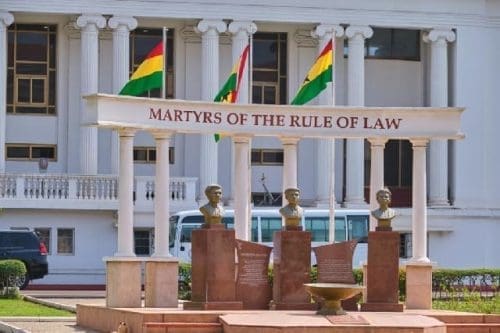
A Ghanaian citizen has invoked the original jurisdiction of the Supreme Court, seeking to strike down two long-standing provisions of the Criminal Offences Act, 1960 (Act 29) and key sections of the Electronic Communications Act, 2008 (Act 775), arguing they unconstitutionally restrict freedom of speech, expression, and the press.
The plaintiff, Austin Kwabena Brako-Powers, through his lawyer Michael Akosah of Adu-Gyamfi & Associates, filed the suit at the Supreme Registry in Accra this May, naming the Attorney-General as the sole respondent.
At the heart of the challenge is Section 208(1) of Act 29, which criminalises the publication of statements, rumours, or reports “likely to cause fear and alarm to the public or disturb the public peace.”
The plaintiff argues that the provision is “vague, overly broad, and imposes unjustifiable restrictions” on freedoms guaranteed under Articles 21(1)(a) and (b) and Article 162 of the 1992 Constitution.
He is also asking the court to strike down Section 208(2) of Act 29, which places the burden on an accused person to prove that reasonable measures were taken to verify the accuracy of a publication.
According to the plaintiff, that subsection violates the constitutional presumption of innocence enshrined in Article 19(2)(c).
“It expressly removes the defence of honest belief in the truth of a publication from persons charged under Section 208(1), thereby subjecting journalists, media practitioners, and members of the public to criminal liability for the publication of statements that are subsequently found to be inaccurate notwithstanding the absence of deliberate or reckless falsehood,” part of the relief states.
The suit further challenges Section 76(1) of Act 775, which criminalises the sending of a “false or misleading” electronic communication, arguing that the law does not define with sufficient precision the scope, meaning, and threshold of what constitutes “false or misleading.”
The plaintiff contends that the provision is inconsistent with Article 19(11) of the Constitution and should be declared void to that extent.
He is urging the Supreme Court to construe Section 76(1) narrowly to apply only to “knowingly false communications that are intentionally transmitted to endanger life or disrupt life-saving services” – and not to negligent, mistaken, or opinion-based electronic communications.
Similarly, Section 76(2) of Act 775 – which imputes knowledge of falsity to a person who fails to take reasonable steps to verify a communication – is being challenged as a violation of both the presumption of innocence and free speech protections under Articles 19(2)(c), 21(1)(a), and 162 of the Constitution.
The plaintiff argues that the subsection unlawfully reverses the burden of proof on the mental element of knowledge.
“It unlawfully reverses the burden of proof on the mental element of knowledge by deeming an accused person to have known that a communication was false or misleading solely on the basis that the accused failed to take reasonable steps to verify its accuracy, thereby violating the constitutional presumption of innocence,” the court documents read.
The suit also references Ghana’s obligations under international human rights law, including the International Covenant on Civil and Political Rights (ICCPR), to which Ghana is a state party. By virtue of Article 40 of the 1992 Constitution, the plaintiff argues, Ghana is obliged to uphold those rights.
Among the eleven reliefs sought, the plaintiff wants the Supreme Court to declare that the continued prosecution, threat of prosecution, or investigation of any person under Section 208 of Act 29 for the publication of any statement in the exercise of constitutionally guaranteed freedoms is unconstitutional and void.
He is also seeking an order striking down Sections 208(1) and (2) of Act 29 and Sections 76(1) and (2) of Act 775 as unenforceable.
DISCLAIMER: The Views, Comments, Opinions, Contributions and Statements made by Readers and Contributors on this platform do not necessarily represent the views or policy of Multimedia Group Limited.
DISCLAIMER: The Views, Comments, Opinions, Contributions and Statements made by Readers and Contributors on this platform do not necessarily represent the views or policy of Multimedia Group Limited.
