


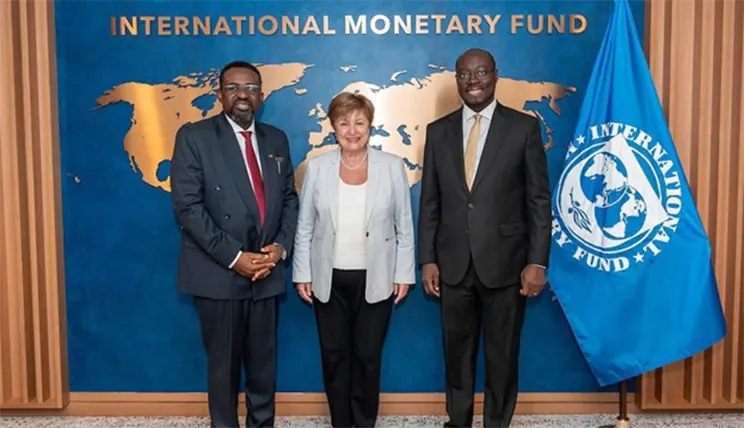
IMF Boss Kristalina Georgieva flanked by Dr. Cassiel Ato Forson and Dr. Johnson Asiama
The IMF
The cedi is the world’s best-performing currency. Reserves are at record highs. Inflation is in single digits. Gold is working for Ghana’s people for the first time in memory. With numbers like these, Ghana entering talks for an 18th IMF programme is not just a policy question – it is a question about who Ghana believes it is.
Not long ago, Ghana’s President stood before the Zambia National Assembly and held his country up as proof that something was changing in Africa. Inflation had dropped from over 23 percent to 3.8 percent. The cedi had appreciated by 32 percent and ranked among the five best-performing currencies on earth. Debt had been restructured. The economy was breathing again. “We are steadily exiting the IMF’s Extended Credit Facility with dignity,” he said, “as partners, not as supplicants.”
He was not wrong. The recovery was real. The numbers were real. Ghana had genuinely done something remarkable. Which is precisely why the reports now emerging – that Ghana is in talks to enter yet another IMF programme – deserve not outrage, but a very serious, very honest question: why?
Not as an accusation. As a genuine inquiry. Because if Ghana, with everything it has built in the past two years, still cannot make the case for standing alone, then something is broken that 18 programmes will not fix.
What Ghana Has Actually Achieved
To understand the weight of this moment, you have to understand how far Ghana has come. In 2022, the country was in freefall. Inflation peaked at 54 percent. The cedi was losing value weekly. Reserves had fallen to cover barely two weeks of imports. The government had lost access to international capital markets. The economy, as the President himself later described it, was “on its knees.”
What followed was a genuine, data-verified turnaround – one that the World Bank, the IMF, and independent economists have all confirmed. By the end of 2025:
Beyond the headline figures, Ghana built something structural. The GoldBod initiative – a programme to centralise gold purchasing and ensure that Ghana’s mineral wealth returned to Ghana rather than leaking abroad – exceeded every target it set. It mobilised over $10 billion in foreign exchange in its first year. Gold reserves at the Bank of Ghana climbed from 20 tonnes to over 38 tonnes. The trade balance swung to a surplus of $8.5 billion. The fiscal deficit shrank from 7.9 percent of GDP to just 1 percent.
These are not the numbers of a country in distress. These are the numbers of a country that has, for the first time in decades, started making its own natural resources work in its own interest. The President’s declaration in January 2026 – that this would be “the last time Ghana goes to the IMF” and that the country “will never again return” – did not feel like political bravado. Against those numbers, it felt earned.
Ghana built reserves with its own gold. It brought inflation to single digits on its own terms. It turned the cedi into the world’s best-performing currency. So what, precisely, does it still need the IMF to do?
The Case For. And Its Limits.
To be fair, there are legitimate arguments for why Ghana might consider further IMF engagement, and they deserve to be heard honestly rather than dismissed.
Ghana’s debt restructuring is not yet fully complete. A small but meaningful portion of external commercial debt – less than 5 percent of the pre-restructuring total – remains unresolved. The energy sector continues to run deficits that drain foreign exchange and create fiscal pressure. Non-performing loans in the banking sector remain elevated. And commodity prices – the gold and cocoa that have powered this recovery – can turn. Ghana has been here before: strong reserves, positive momentum, and then a global shock that undid years of progress.
There is also the question of signalling. The IMF’s presence – even in a non-financial, advisory capacity through instruments like the Policy Coordination Instrument – can reassure international investors and development partners that Ghana’s reforms are anchored. A country that has just completed a successful programme and chooses a voluntary, non-lending relationship with the Fund is making a different statement than one that is seeking emergency credit.
These are real considerations. They are not nothing. But here is what they are not: they are not a justification for a full lending arrangement, with conditionalities, prior actions, and quarterly reviews negotiated in Washington. And they are not an acknowledgment that Ghana’s own institutions – the GoldBod, the new Fiscal Responsibility Framework, the proposed Independent Fiscal Council – are insufficient to hold the line. The nature of what is being discussed matters enormously, and Ghana’s citizens deserve clarity on that distinction.
Eighteen Programmes. The Same Ending Every Time.
The number 18 is not just a striking fact. It is a diagnosis. Across six decades, 17 IMF programmes have ended, and the structural conditions that drove Ghana to the Fund have reasserted themselves each time. This is the central question that any honest analysis of this moment must confront: what has changed that would make the 18th different from the 17 that came before?
Academic research on Ghana’s IMF history is unsparing on this point. The programmes produce measurable short-term gains – inflation falls, deficits narrow, reserves build – but the effects consistently prove unsustainable after the programme ends. Ghana completed the HIPC process in the early 2000s, received significant debt relief, and within a decade was back at the Fund. The 2015 programme ended. The vulnerabilities it was designed to address – commodity dependence, a narrow tax base, a political budget cycle – were not resolved. By 2022, another crisis.
“Ghana must break from past governance failures marked by fiscal indiscipline. The country needs to be intentional and bold about breaking away from its repeated reliance on external assistance.” – World Bank, Policy Notes on Ghana, September 2025.
The World Bank said this not in a moment of crisis, but in September 2025, while Ghana was performing ahead of IMF targets and being praised for its recovery. The timing is significant. The warning was directed not at a failing Ghana, but at a succeeding one – because success is precisely when the temptation to return feels most harmless, and when the cost of doing so is least visible.
President Mahama himself, speaking at an African leaders forum in May 2025, framed the problem with striking clarity. He noted that 22 African nations were at high risk of debt distress, that debt-to-GDP ratios across sub-Saharan Africa had surged from 40 percent in 2015 to over 60 percent in 2025, and that “debt can be a catalyst for transformation, but it can also be a source of fiscal fragility and lost sovereignty if not well managed.” He said those words about Africa. They apply, with particular force, to the country he leads.
Source: Edward Ngamau
