


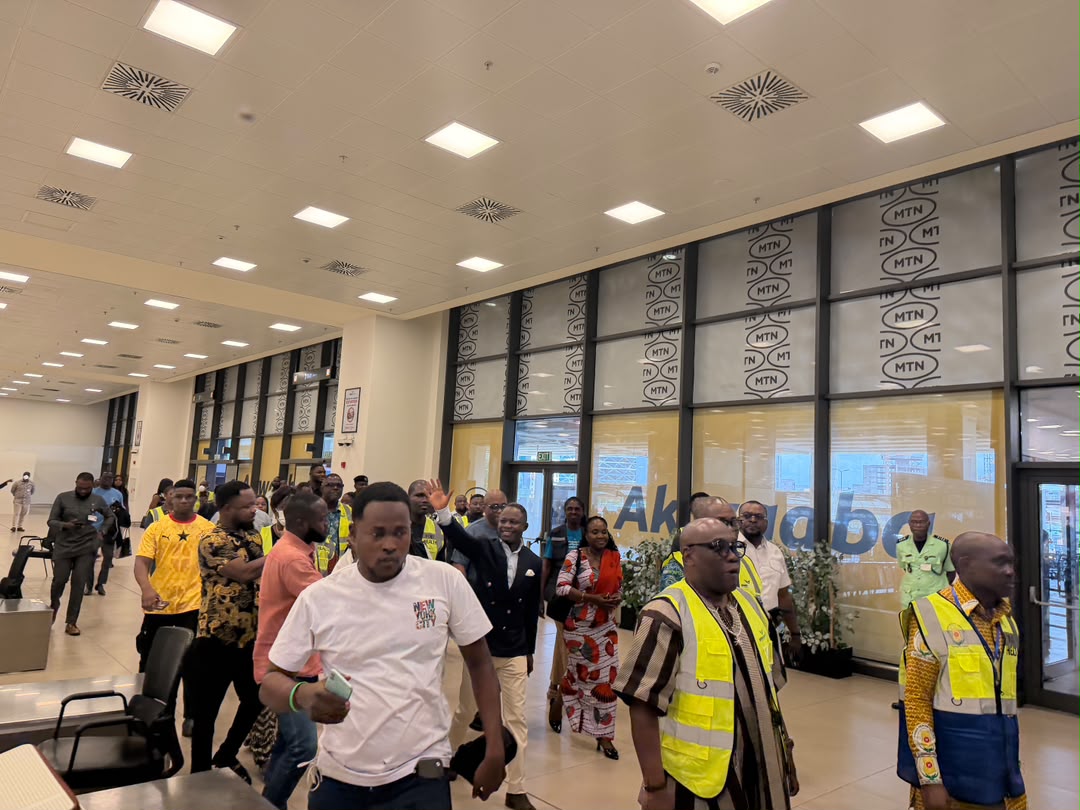
The Minister for Health, Kwabena Mintah Akandoh, has announced the immediate activation of national emergency health protocols across Ghana to safeguard the country against a potential outbreak of the Ebola virus.
The declaration follows an extensive operational tour by the minister to assess the state of surveillance and emergency preparedness at the nation’s primary gateways.
The multi-site working visit, which took place on Friday, May 29, saw the health minister inspecting critical screening installations at the Accra International Airport before touring the Noguchi Memorial Institute for Medical Research (NMIMR) and the Ghana Infectious Disease Centre (GIDC).
The high-level assessment was designed to stress-test the state’s readiness and cross-border surveillance capabilities. This comes on the heels of the World Health Organisation declaring the rare Bundibugyo Ebola strain a Public Health Emergency of International Concern.
At the Accra International Airport, the minister scrutinised passenger screening points and holding bays, acknowledging that while initial checks are functional, the state must transition to advanced digital detection mechanisms to prevent human error.

Health Minister Kwabena Mintah Akandoh underscored that institutional readiness alone cannot avert an outbreak without absolute public cooperation.
He directed all public institutions, local government authorities, and event organisers to immediately reintroduce strict hygiene mandates across the country.
“It’s very important for all of us to cooperate. We are taking activities at the land borders seriously; if there’s any case, we’re ready. There’s no cause for panic; nobody should panic. All should adhere to the safety measures. From today [May 29], there should not be mass gatherings. We have issued that advisory, and we still stand by it,” he warned.
The team inspected the diagnostic infrastructure at the nation’s premier biomedical laboratory, the Noguchi Memorial Institute for Medical Research.

The Director of the Institute, Professor Dorothy Yeboah-Manu, assured the delegation that the facility’s biosafety laboratories have been fully resourced and are structurally prepared to handle accurate, high-speed differential testing for suspected Ebola cases.
Accompanying the minister on the tour was the World Health Organisation (WHO) Country Representative to Ghana, Dr. Fiona Braka. Dr. Braka.
Dr. Braka highlighted the scientific challenges presented by this particular outbreak, but highly commended Ghana’s preemptive infrastructure mobilisation.
