


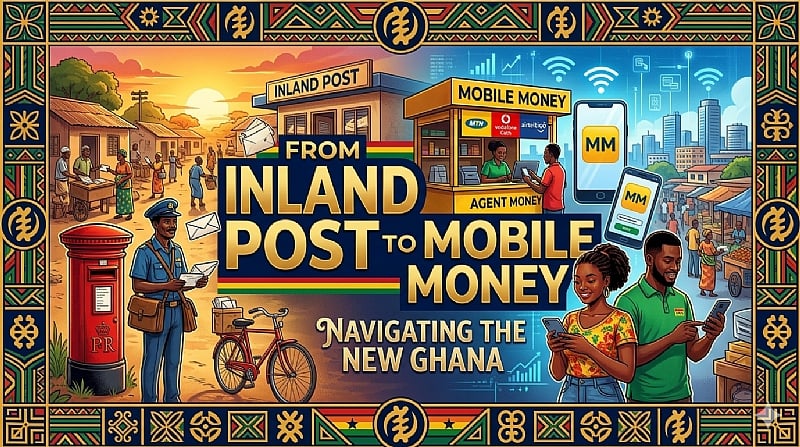
This article explores Ghana’s rapid transition from the agonizingly slow communication systems of the 1970s—characterized by blue inland letters, trunk calls, and the socio-economic realities of the Acheampong regime—to the instant gratification of WhatsApp, Mobile Money, and ride-hailing applications. Through humorous personal anecdotes of navigating modern technology and reflections on historical national endurance, the piece offers Ghanaian youth actionable advice on balancing digital convenience with the irreplaceable value of face-to-face community interaction.
Before the era of instant WhatsApp blue ticks and instant Mobile Money (MoMo) alerts, communication in Ghana was a test of holy patience. In the 1970s and 1980s, connecting with a loved one abroad or even in another region required strategy, endurance, and days of waiting. Today’s Ghanaian youth, born into the comfort of high-speed internet and digital banking, inherit a world their grandparents could scarcely imagine. Understanding this historical shift is not just a history lesson; it is a blueprint for appreciating modern convenience while guarding our rich culture of human connection. As the Akan proverb wisely states, “Tete wo bi ka, tete wo bi kyerɛ” (The past has something to say; the past has something to teach).
The Days of the Inland Post, Trunk Calls, and National Mobilization
To appreciate the present, we must unearth the patience and socio-political realities of the 1970s under General Ignatius Kutu Acheampong’s NRC/SMC regime.
- The Blue Inland Letter: Writing a letter involved buying a blue aerogramme paper, pouring your heart out, and waiting three to six weeks for a reply.
- The Post Office Box (P.O. Box): Families shared a single metallic box. Checking the mail was a weekly ritual filled with anticipation or deep disappointment.
- The Telegram: Reserved for extreme emergencies like births or funerals. It was priced per word, leading to ultra-short, often terrifying messages like: “FATHER SICK COME HOME NOW.”
- The “Trunk Call” Lines: To speak to a relative in London or even Kumasi, you queued at the Post and Telecommunications (P&T) office for hours just for an operator to manually connect your line.
- Operation Feed Yourself (OFY): Launched in 1972, this massive agricultural campaign forced backyards in Accra and school compounds nationwide to become farms to achieve food self-reliance amidst global economic shocks.
- The “Unigov” Crisis & Closures: The late 1970s saw intense political instability over the “Union Government” proposal, leading to frequent university closures, strikes, and severe shortages of basic goods like milk and soap.
The Modern Digital Shock: A Firsthand Confession
Transitioning from that slow world into the digital age has brought hilarious struggles for the older generation trying to keep up with Gen Z.
- The WhatsApp Warfare: My first week on WhatsApp involved accidentally sending a “thumbs up” emoji to a solemn family funeral page. I also thought the typing notification (“typing…”) meant the person could see me looking directly at my screen, making me fix my shirt every time I saw it.
- The MoMo Misconceptions: The first time I used Mobile Money, I stood by the agent waiting for physical cash to magically drop out of my phone’s charging port. I also screamed at a teller because I thought a “network timeout” meant my money had flown into the clouds.
- The Ride-Hailing Roulette: Ordering an Uber or Bolt for the first time felt like magic, but I spent ten minutes arguing with the app because the little digital car icon on the map was “driving over people’s houses.” When the driver called to ask “Where are you?”, I told him to look for the third goat standing near the plantain seller.
- The Voice Note Vortex: I did not know you had to hold the microphone icon down. My first five voice notes to my son were just two seconds of heavy breathing followed by absolute silence.
Key Historical Lessons for Today’s Youth
The technology has changed, but the core human values required to build a nation remain the same.
- Patience is a Resource: The 1970s taught us that good things take time. Modern instant gratification can ruin long-term career planning and personal growth.
- The Weight of Words: When letters took weeks, every word mattered. Today’s youth must remember that digital footprints last forever; speak and type with intention.
- Resilience Through Disconnection: True independence was birthed when people solved problems without relying on a Google search or an immediate phone call.
Actionable Recommendations for the Digital Generation
As the Bible notes in Proverbs 4:7, “Wisdom is the principal thing; therefore get wisdom: and with all thy getting get understanding.” Here is how the youth can bridge the gap:
- Adopt the 24-Hour Digital Sabbath: Dedicate one day a week or a few hours each Sunday to put down the phone and talk to family face-to-face.
- Verify Before You Forward: Stop the spread of fake news on WhatsApp. Treat information with the same scrutiny our ancestors used when waiting for official gazettes.
- Use Tech for Financial Literacy: Mobile Money should not just be for spending on food and fashion; use modern fintech apps to save, invest, and build capital.
- Document Oral History: Use your smartphones to record your grandparents’ stories. Do not let their historical wealth die with them.
Finding Balance in a Fast World
The international writer Jean de La Fontaine once wrote, “Patience and time do more than strength or passion.” Ghana has moved swiftly from the physical post box to the digital wallet, and this evolution is worthy of high praise. Technology has democratized wealth, business, and education across Accra, Kumasi, and our rural communities.
However, as we embrace the speed of the fiber-optic cable, we must not lose the warmth of the Ghanaian handshake. A WhatsApp voice note cannot replace the comfort of looking into a friend’s eyes over a bowl of fufu or a cup of tea. Let us use the tools of the future to preserve the communal soul of our past.
✍️ Retired Senior Citizen
For and on behalf of all Senior Citizens of the Republic of Ghana 🇬🇭
Teshie-Nungua
[email protected]
