


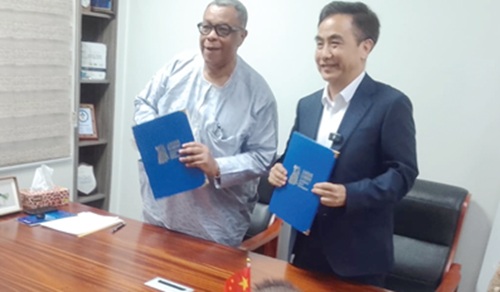
The 24-Hour Economy and Accelerated Export Development Secretariat has signed a Memorandum of Understanding (MoU) with the Hunan Provincial Architectural Design Institute Group Co., Ltd. (also known as Hunan Design or HNADI), to convert over two million hectares of arable land into an agroecological hub to reduce Ghana’s dependence on imported goods.
It is to be connected to industrial parks, linking both to multi-modal transport infrastructure, and financing the whole system through structured private investment.
The cooperation is to build a whole new city under the Volta Economic Corridor stretching from the port of Tema through Akosombo, across the Afram Plains, through Yeji, Buipe and Yapei, all the way to Tamale.
It is designed to be Ghana’s first net-zero green economic corridor.
The 24-hour economy policy is a strategic initiative by the government aimed at transforming the nation into a round-the-clock production-led economy to boost growth, create jobs and increase productivity.
MoU
The Presidential Advisor on the 24-hour Economy, Augustus Goosie Tanoh, signed on behalf of Ghana, while the legal Chairman of HNADI, Xia Xinhong, signed on behalf of the Chinese private firm.
The MoU followed a high-level engagement in China in January on how to transform Ghana’s productive economy and help restructure how the country produces, processes, and trades.
It is projected to create over half a million direct jobs.
Under the MOU, the two parties agreed to work together on master planning and spatial layout for the corridor’s key development zones.
A joint working group is to be formed to pilot the project in parts of the corridor before it is fully rolled out.
Funding
Mr Tanoh said the secretariat had secured funding from the African Development Bank for the feasibility studies of the multi-modal transport component.
“We need a comprehensive master plan that defines the land use, the zoning, the infrastructure networks, the road and pipe layouts, the positioning of each park in relation to the water systems, the energy grid, and the transport nodes.
“That is detailed, technical planning work, and it is precisely the kind of capability that Hunan Architectural Design Institute brings to this partnership,” he said.
Mr Tanoh said the Hunan group would assist Ghana with park layout, infrastructure network design for the agroecological and industrial parks, including park layout, roads, water supply, pipe networks, and sewage treatment systems.
“Before we ask anyone to produce, we secure affordable power. We are putting in place renewable energy installations along the corridor that will bring power costs below seven cents per kilowatt hour, making manufacturing genuinely competitive.
“The building blocks are there. What we now need is the detailed spatial planning and engineering design to move from concept to construction,” Mr Tanoh said.
Mr Tanoh said the secretariat had in mind two industrial parks and three agroecological parks along the corridor, where it could start the conceptual design work immediately.
“This allows us to demonstrate the model, refine the approach, and build the technical understanding on both sides before scaling across the full corridor,” he said.
He said beyond the design, the MOU also covered training and technical exchanges.
Chairman
Mr Xinhong expressed excitement about the opportunity to help to contribute to Ghana’s new economic drive and to reduce importation.
He said with this arrangement, economic development would speed up through high technology and make the Corridor “a big economic hub.”
The chairman said while promoting industrialisation, the country’s cultural heritage must not be lost, which was why the joint working group was necessary.
