


Artificial intelligence is rapidly transforming the landscape of programming education. Tools can now generate syntactically correct code within seconds. The central question for computing education is therefore no longer whether students can produce executable code, but whether they can reason about systems: conceptualise them, construct them, explain their behaviour, defend their design decisions, document their logic, and refine them through disciplined engineering practice. In this environment, programming instruction must place greater emphasis on reasoning, traceability, and verification rather than code output alone.
In response to this shift, the Programming course delivered during the first semester of the 2025/2026 academic year to Level 300 BSc Information Technology students (IT4 and IT5) at the University of Professional Studies, Accra was organised around a project-centred instructional model designed to strengthen disciplined programming competence. The instructional architecture combined multiple reinforcing mechanisms, including continuous assessment embedded within lectures, incentive-based performance reinforcement tied to correctness and quality thresholds, instant evaluation of task execution, live technical defence of implementation logic, and iterative mini-project development, complemented by demonstration-based verification and repository workflows that introduced students to disciplined software engineering practice. Together, these mechanisms created an instructional environment in which conceptual clarity, implementation discipline, and technical accountability were continuously reinforced throughout the semester.
This approach reflects Seymour Papert’s observation that effective computing education must create conditions in which learners actively construct knowledge rather than merely receive it. Consistent with this principle, the course prioritised conceptual competence, structured analytical reasoning, and disciplined problem-solving. Students were therefore required not only to implement programs, but also to articulate their reasoning, explain architectural decisions, and defend their solutions under live technical questioning.
Instructional Architecture: Moving from Code Writing to Systems Thinking
The course began with a deliberately sequenced hybrid model in which students initially compiled and executed programs through the command line before progressing to IDE-supported environments. This sequencing strengthened conceptual clarity about program structure, compilation processes, and runtime behaviour while reducing premature dependence on development tools.
Each instructional session concluded with an applied programming task requiring immediate implementation. Assessment was embedded directly into classroom interaction. Students responded to live technical questioning during individual and group-based engagements, and performance was evaluated instantly. Individual contributions influenced group outcomes, reinforcing accountability while encouraging disciplined collaboration.
Performance incentives were introduced to strengthen commitment, speed with correctness, and consistency. Students were informed that the first correct implementation, the first group of students to meet defined time thresholds, or those achieving established quality standards and could defend their work could earn continuous assessment advantages. The objective was not competition for its own sake, but the cultivation of disciplined performance within defined time, quality, and verification constraints.
Collaborative learning structures were also designed to minimise passive participation. Groups were assigned technical topics and subsequently examined when the class reconvened. Each member was questioned and graded individually, with performance affecting the group’s overall standing. This approach reinforced preparation, shared responsibility, and peer accountability.
Given the increasing ability of artificial intelligence tools to complete routine programming tasks, additional verification mechanisms were introduced. Students submitted short video recordings demonstrating their applications and explaining the logic of their code during execution. These demonstrations strengthened authorship verification, conceptual articulation, and the ability to communicate system behaviour clearly. Feedback was provided as early as practicable to sustain momentum and enable rapid refinement of student work.
Targeted Student Support: Planned Individual Counselling
A further component of the instructional model involved targeted academic intervention. Toward the end of the semester, a counselling session was scheduled for students who had missed the first three lectures. Those who made themselves available during the scheduled period were counselled individually. The purpose of the intervention was diagnostic and corrective rather than disciplinary. Discussions focused on identifying barriers to participation, restoring academic consistency, and preventing early attendance gaps from developing into sustained confidence and performance limitations. The process also encouraged the development of stronger academic habits for subsequent semesters.
This intervention reflects well-established findings in learning sciences indicating that early conceptual gaps, when left unaddressed, tend to compound and produce persistent performance differences. By intervening before such gaps widened, the counselling sought to stabilise student progression, safeguard academic outcomes for the semester, and reinforce continuity in learning.
Mini-Project Pedagogy: Design, Constraints, and Defence
Structured mini-projects formed a central component of the mid-semester assessment. Development was not treated as an exercise in imaginative coding. Instead, students were required to interpret clearly defined problem statements, determine expected system behaviour, implement core logic, and demonstrate correctness through live program execution.
The project requirements emphasised disciplined development practice and conceptual ownership of systems. Groups were encouraged to organise their work using Git-based repository workflows, introducing professional version-control discipline, contribution traceability, and incremental system evolution. In addition to functional implementations, students produced supporting artefacts that articulated system intent, structural logic, and design rationale. These artefacts included concise problem interpretation notes, algorithm and logic breakdowns, flow representations, interface sketches where relevant, and short design summaries aligned with the implemented behaviour.
Evaluation concluded with defence sessions in which students executed their applications live, responded to technical questioning, debugged when necessary, and justified design decisions. This process assessed dimensions of competence that written submissions alone rarely capture: quality of reasoning, clarity of technical explanation, and operational control of implemented systems.
This approach reflects a foundational insight articulated by Donald Knuth: “Programs are meant to be read by humans and only incidentally for computers to execute.” Students were therefore expected to make their systems intelligible, explainable, and defensible, rather than merely functional.
Recognition Through Continuous Assessment: Awards with Academic Purpose
At the conclusion of the semester, outstanding performance was formally recognised on the basis of cumulative evidence from continuous assessment activities conducted throughout the course. These included structured programming tasks, instant assessments embedded within lectures, group-based examinations, and outcomes from the mini-project design and defence sessions.
Award categories included Best Programming Team, Best Male Programmer, Best Female Programmer, and recognition of Course Representatives for Exemplary Leadership. The recognition served a deliberate instructional purpose rather than a purely ceremonial function. It reinforced the course’s emphasis on disciplined practice, sustained engagement, collaborative responsibility, and demonstrable technical competence.
In doing so, the awards communicated an important pedagogical signal: performance in computing is best evaluated through consistent problem-solving ability, clarity of implementation logic, and systems that function reliably under technical scrutiny rather than through last-minute examination preparation.
The Hospital Management System (HMS) project, developed by the Best Programming Team, distinguished itself through architectural coherence, functional integration, and the quality of its supporting documentation. In view of its technical promise, the system was selected to progress into a supervised refinement pathway extending beyond the course.
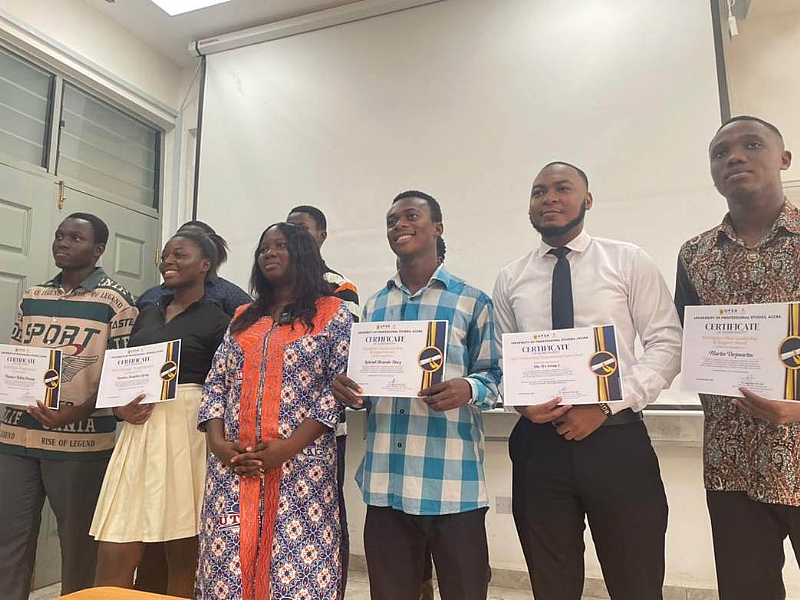
Dr. Augustina Dede Agor with the awardees, including the Best Programming Team, Best Female Award, Best Male Award, and Course Reps for Exemplary Leadership Award recipients, celebrating their exceptional performance and dedication to excellence in programming on 27 November 2025.
Progression at the End and Beyond the Semester: Hub Pathway, Prototype Advancement, and Industry Exposure
Toward the end of the semester, an industry software developer was engaged as a mentor within the instructional pathway to establish a sustained industry interface for the class. This mentorship arrangement provides students with continuing access to professional guidance on software development practice, project progression, and technology entrepreneurship beyond the formal instructional period. Through this arrangement, students are able to seek direction on architectural decisions, implementation strategy, and broader considerations related to translating technical competence into viable technology initiatives.
Selected high-performing students, including some members of the Best Programming Team, progressed into the UPSA Developers Hub, a departmental initiative established to support supervised academic prototypes and structured academic–industry engagements. Within this pathway, the Hospital Management System (HMS) team continued development of the HMS initiative. Participation was determined by commitment, technical maturity, and readiness to operate within a supervised project structure. The transition represented a progression from course-based mini-project work to prototype refinement under defined technical responsibilities.
Through this pathway, the HMS team undertook academic–industry engagements in two distinct forms. The first consisted of benchmarking visits to Focus Orthopaedic Hospital, the University of Ghana Medical Centre, and Motherlove Hospital. These visits enabled the project team to observe how hospital information systems support operational workflows and to examine variations in institutional governance and technology integration across healthcare environments. The objective was analytical: to understand existing implementations and derive insights relevant to system design and refinement.
The second engagement differed in scope and purpose. The HMS team conducted a formal academic–industry requirements engineering engagement with the UPSA Medical Directorate. Unlike the benchmarking visits, this session functioned as applied practice in stakeholder-based requirements elicitation. Students engaged unit by unit with operational staff, conducted guided inquiry into institutional processes, translated operational dialogue into formal requirement statements, and reconciled organisational constraints with system-level representations. The engagement was situated within a software lifecycle context consistent with ISO/IEC 12207 and applied requirements principles aligned with ISO/IEC/IEEE 29148. Beyond its value as professional practice, the exercise provided a validated institutional reference context for the continued refinement of the HMS prototype.
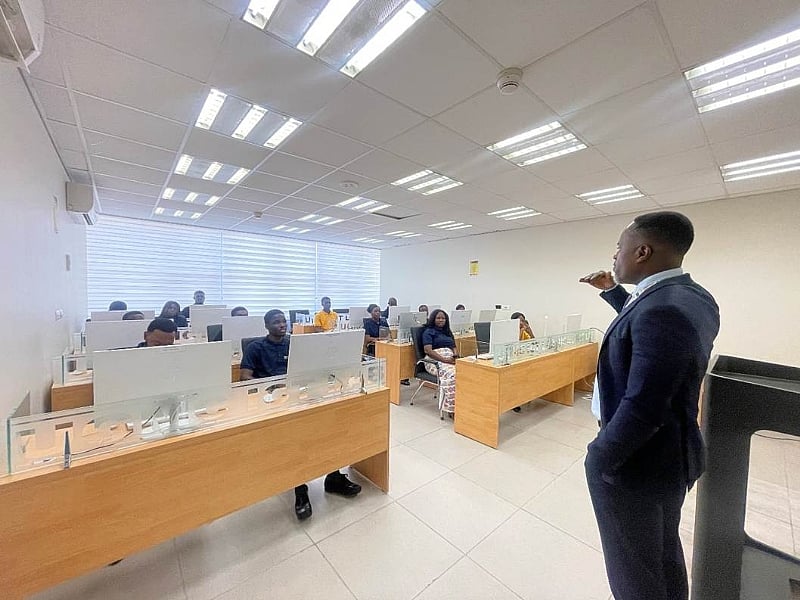
HMS Team engagement with the Information Technology Department of the University of Ghana Medical Centre on hospital information systems governance and architecture.
To strengthen the technical and operational soundness of the prototype under refinement, selected domain professionals consented to provide advisory guidance. Their role remains consultative, offering practical insight into institutional workflows, operational constraints, and governance considerations while ensuring that the evolving system remains aligned with real organisational environments under academic supervision.
Engagement at the Google Accra AI Community Centre further extended the team’s professional exposure. During this session, the UPSA team presented elements of their work, interacted with peers from Academic City University and other participants, and engaged in technical discussion around system architecture and design reasoning. The interaction provided an external context in which students could observe how system ideas are questioned, analysed, and compared within broader technical communities.
In parallel, students seeking to extend their programming competence beyond the course are guided toward internationally recognised certification pathways, including Oracle’s Java certification track. This dimension reinforces disciplined preparation, conceptual clarity, and technical accountability, while encouraging students to align their skills with globally recognised professional standards beyond the immediate requirements of the course.
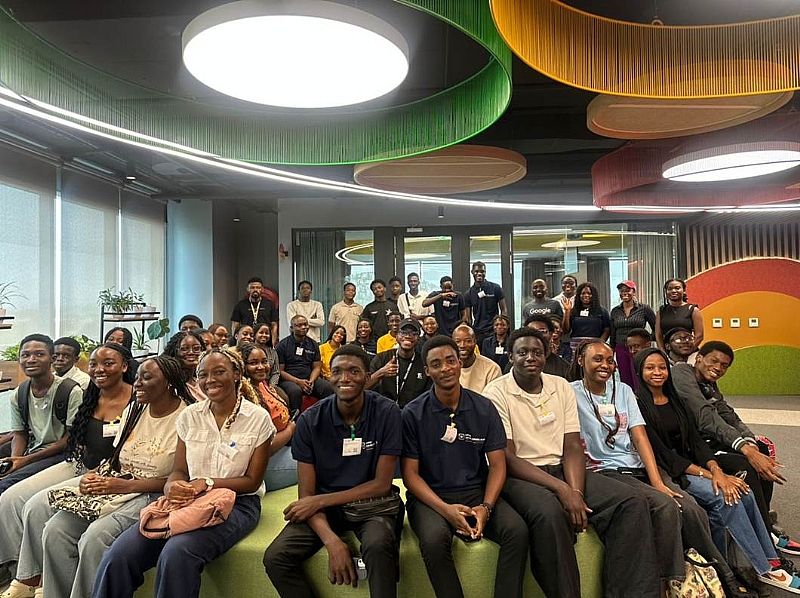
Some Staff of the Google Accra AI Community Centre with participating students from the University of Professional Studies, Accra and Academic City University at the conclusion of the academic engagement.
Academic Direction: From Build-and-Shelve to Responsible Deployment
A persistent weakness in many academic computing programmes is the “build-and-shelve” pattern in which student systems conclude at submission and are rarely revisited. Such outcomes diminish motivation and deprive students of exposure to the realities that shape operational software systems, including user feedback, maintenance demands, performance evaluation, and iterative refinement.
Through the UPSA Developers Hub, a longer-term direction is being strengthened to move, where appropriate and institutionally permitted, from classroom prototypes toward deployment-oriented system development. The objective is not rapid deployment, but the cultivation of responsible engineering practice. Students must understand what it means to design systems that real users can adopt, observe how systems evolve through structured feedback and monitored use, and appreciate the governance considerations that accompany operational software environments.
This progression represents a maturity pathway rather than a claim of immediate deployment. It emphasises disciplined system evolution and responsible development practices that extend beyond the scope of a single semester course.

UPSA Developers Hub HMS Team with some staff of the Pharmacy Department, UPSA Medical Directorate, following the stakeholder requirements engagement.
Recommendation: Strengthening Project-Based Evaluation in Computing
While end-of-semester written examinations remain an established component of university assessment structures, the experience from this course reinforces an important academic observation for computing education. Programmes benefit when evaluation frameworks extend beyond final written answers to include project-centred assessment that captures how students interpret requirements, respond to feedback, and progressively refine system behaviour.
Software engineering practice rarely unfolds as a single correct answer produced at one moment in time. Instead, it evolves through iteration, testing, correction, and improvement. Assessment structures that recognise this process provide stronger evidence of genuine technical competence, revealing how students reason about systems, repair design weaknesses, and strengthen implementation logic through successive refinement.
For computing programmes seeking to align academic preparation with the realities of contemporary software development, strengthening project-based evaluation alongside traditional examinations can therefore provide a more accurate measure of engineering readiness, creativity, and responsible technical practice.
Closing Note
The Programming course described here was intentionally structured as an academic intervention designed to strengthen both coding confidence and disciplined systems thinking within an AI-accelerated computing environment. Through a project-centred instructional architecture that combined continuous assessment, live technical questioning, mini-project design and defence, verification mechanisms, targeted academic support, and structured recognition of performance, the course sought to make engineering reasoning visible throughout the learning process. The progression of some high-performing students into supervised post-semester project engagement through the UPSA Developers Hub, together with mentorship and external technical exposure, further extended this formation beyond the classroom.
The broader lesson is that programming education becomes more meaningful when instructional design moves beyond isolated code production toward sustained system development practice. When students are required to interpret problems carefully, justify implementation decisions, document design reasoning, respond to technical scrutiny, and refine systems through feedback, they begin to experience software engineering as a disciplined intellectual activity rather than a sequence of coding tasks.
Such models do not replace traditional assessment structures, but they complement them by cultivating habits of accountability, technical clarity, and responsible system construction. In doing so, they position students not only to succeed academically, but also to mature into developers capable of building, explaining, improving, and sustaining systems that can operate reliably in real institutional environments.
Related Media Coverage and Documentation
The activities described in this article have been documented in the following media publications:
• Graphic Online: Programming Education Beyond Code Generation: Recalibrating Engineering Reasoning in the AI Era
• Graphic Online: UPSA Developers Hub undertakes academic–industry engagements to deepen systems design competence
• Modern Ghana: Department of Information Technology Studies establishes UPSA Developers Hub
https://www.modernghana.com/news/1470184/department-of-information-technology-studies-estab.html
• Modern Ghana: UPSA Developers Hub Lead showcases working application at Google Accra AI Community Centre
https://www.modernghana.com/news/1470763/upsa-developers-hub-lead-albert-siaw-yeboah-kay.html
• Modern Ghana: Award-winning hospital management system under prototype refinement
https://www.modernghana.com/news/1471823/award-winning-hospital-management-system-under.html
• Modern Ghana: UPSA Developers Hub Demonstrates Academic–Industry Model Through Requirements Engineering Engagement
https://www.modernghana.com/news/1473209/upsa-developers-hub-demonstrates-academic-industry.html
Dr. Augustina Dede Agor, PhD (Computer Science), is a Lecturer in the Department of Information Technology Studies at the University of Professional Studies, Accra, with over a decade of experience in research and tertiary instruction. Her scholarly research, published in international peer-reviewed journals, spans artificial intelligence, optimisation and metaheuristics, computer networks and communications, biometrics and automated fingerprint identification systems, neural architectures, security, and algorithmic design and analysis. She has instructed at diploma, undergraduate, and postgraduate levels across institutions in Ghana and the United States, delivering courses in programming, design and analysis of algorithms, systems analysis and design, data structures, databases, mobile computing, online education strategies, and related computing disciplines.
She serves as Patron of the UPSA Developers Hub, an academic initiative supporting supervised system development and structured academic–industry engagement designed to strengthen practical computing competence. In addition to her research contributions, she writes on computing education and engineering reasoning, contributing to national discourse on technology-driven institutional development and the evolving role of computing education in the AI era.

