
Monday 08th June, 2026 08:58 AM|

Kenya’s Budget and Appropriations Committee tabled its report on the 2026/27 national budget on June 2, 2026, setting total expenditure at Ksh4.82 trillion.
The figures point to a government under growing fiscal strain, where rising debt repayments and election preparedness are increasingly crowding out development spending.
Interest payments alone are projected at Ksh1.25 trillion, an 11.3 per cent increase from the previous year. When combined with pensions and other statutory obligations, Consolidated Fund Services rise to Ksh1.50 trillion, up 9.9 per cent. The figures underline how debt servicing continues to absorb a growing share of public revenue, limiting fiscal space for development.
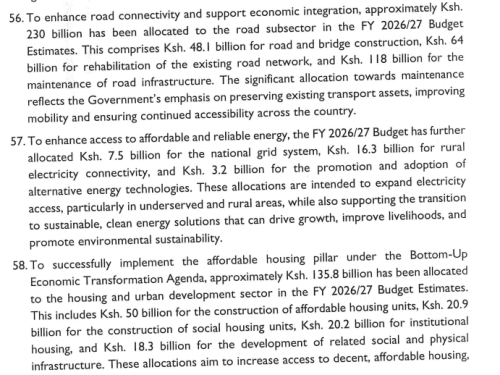
Capital expenditure is set to decline by 3.9 per cent to Ksh845.2 billion, with major cuts recorded in energy, infrastructure and ICT. The sector loses over KSh 72 billion, raising concerns about delays in critical projects, including electrification and transport infrastructure.
Debt burden dominates fiscal outlook
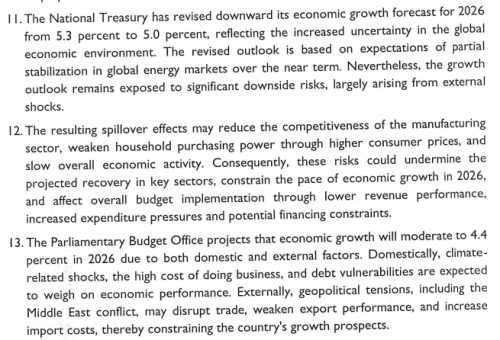
Kenya’s public debt now exceeds Ksh13 trillion, reinforcing concerns about long-term sustainability. The report projects a fiscal deficit of 5.4 per cent of GDP, down from 6.4 per cent, as the government pushes fiscal consolidation.
However, financing remains heavily tilted toward domestic borrowing, which accounts for about 90 per cent of deficit funding, compared to 10 per cent external borrowing. This shift increases reliance on local financial markets and raises concerns about crowding out private sector credit.
The Parliamentary Budget Office projects economic growth to moderate to 4.4 per cent in 2026, below the Treasury’s 5.0 per cent forecast, citing climate risks, high business costs, and debt pressures.
Election spending receives a clear boost
The budget also reflects early preparations for the 2027 general election. The Independent Electoral and Boundaries Commission receives additional funding for voter registration, ICT systems, boundary delimitation, and civic education.
The total cost of the 2027 election is estimated at Ksh74.4 billion, making it one of the most expensive electoral cycles in the country’s history.
Security and governance allocations also rise, partly driven by election preparedness and intelligence operations, even as development spending is tightened elsewhere.
Winners and losers in the budget
Education remains the biggest winner, receiving Ksh781.4 billion, supporting teacher recruitment, capitation for basic education, and higher education financing. Health follows with Ksh175.5 billion, focused on Universal Health Coverage and primary healthcare.
Agriculture receives Ksh106.8 billion, including fertiliser and seed subsidies, while social protection programmes are allocated Ksh25 billion for elderly cash transfers.
However, infrastructure and energy face notable cuts. Road maintenance is prioritised over new construction, while energy development declines sharply, with some programmes cut by more than 60 per cent. Last-mile electricity and off-grid expansion projects are particularly affected.
Affordable housing continues to receive strong funding at Ksh135.8 billion, though much of it depends on securitisation and property sales to close financing gaps.
Youth programmes such as NYOTA, KJET, and the National Youth Service receive allocations, but the Youth Enterprise Development Fund remains constrained, despite an additional Ksh300 million top-up following public input.
Fiscal consolidation meets political reality
The government highlights improved revenue performance, projected to grow by 7 per cent to Ksh2.99 trillion, alongside efficiency gains from digital procurement systems. A primary balance surplus of 0.7 per cent of GDP signals progress in fiscal consolidation.
Yet public participation across 16 counties revealed strong demand for higher investment in agriculture, water, health, and youth employment. Stakeholders also raised concerns about debt sustainability and shrinking development budgets.
Political criticism has already emerged, with opposition leaders arguing that the budget prioritises state machinery and borrowing over household economic relief.
Parliament will now debate the Appropriation Bill before final approval. Implementation will depend heavily on whether revenue targets are met and whether planned domestic borrowing is absorbed without destabilising credit markets.
Kenya enters the 2026/27 fiscal year balancing three competing pressures: a heavy debt burden, early election spending, and shrinking development investment. Whether this mix delivers stability—or delays deeper fiscal adjustments—will define the country’s economic outlook heading into 2027.
Kenneth Mwenda
Kenneth Mwenda is a digital writer with over five years of experience. He graduated in February 2022 with a Bachelor of Commerce in Finance from The Co-operative University of Kenya. He has written news and feature stories for platforms such as Construction Review Online, Sports Brief, Briefly News, and Criptonizando. In 2023, he completed a course in Digital Investigation Techniques with AFP. He joined People Daily in May 2025. For inquiries, he can be reached at [email protected].
View all posts by Kenneth Mwenda
