
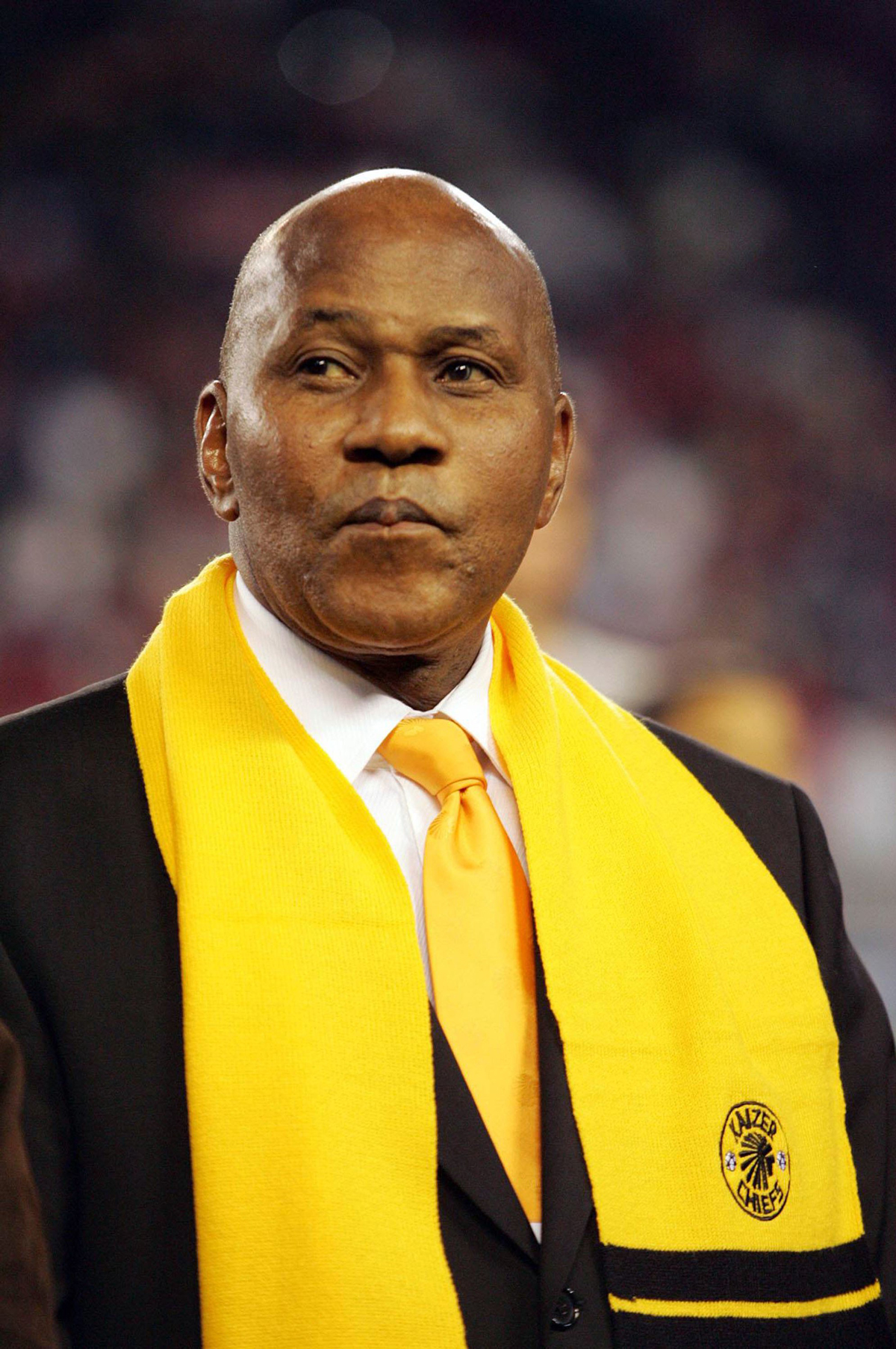
Photograph by Touchline/Getty Images
On June 18, a World Cup match will be played in downtown Atlanta between Czechia and the team nicknamed “Bafana Bafana”—“the Boys”—South Africa. It’s more than fitting that South Africa will play a group stage match in Atlanta, as a legendary soccer player serves as a connection between our city and the Republic, even if many Atlantans today might not recognize his name.
In apartheid South Africa, rugby and cricket were the most popular sports, as they were the “white man’s games.” Soccer was the sport of oppressed Black South Africans, centered in the poverty-stricken townships of Johannesburg, especially the largest, Soweto. In any of the dozens of tribal languages spoken in the Soweto slums, the men whom apartheid had rendered into oblivion spoke about and obsessed over soccer; indeed, many used it as an escape from the hopelessness of everyday life under the brutally racist strictures.
For years, the most popular club in the nation was the Orlando Pirates, so-called because a group of players from the Orlando neighborhood of Soweto went to see the Errol Flynn swashbuckler, The Sea Hawk. The slice of exotic Americana for some lads who knew they would never see the real thing became totemic on the football pitch.
However, one man did see the States—specifically, Atlanta—thanks to his soccer prowess. He was a 24-year-old striker named Kaizer Motaung.
The Atlanta Chiefs were the city’s first soccer team, playing in the North American Soccer League long before the advent of Atlanta United and Major League Soccer. They began play in 1967 (in that first year the league was called the National Profession Soccer League, or NPSL, before becoming the NASL in 1968), and were led by player-manager Phil Woosnam, a legendary Welsh International and future commissioner of the NASL.
In 1968, Woosnam was desperate to recruit some good international players. He put out a distress call to his contacts in Africa. One, a Johannesburg sportswriter named Ali Twala, recommended a dazzling striker on the Pirates. Kaizer Motaung was nicknamed “Chincha Guluva,” which roughly translates to “game changer” in Soweto slang. Woosnam convinced Motaung to cross the ocean and play for the Chiefs at Atlanta Stadium, whose other occupant, the Braves, inspired the soccer team’s logo and nickname. (The stadium would add “Fulton County” to its name in 1975.)
Motaung immediately paid dividends, scoring twice in his debut on May 26, 1968, in a shocking upset of Manchester City of the British First Division (now known as the Premier League). To prove it was no fluke, the Chiefs beat City a few weeks later as well. In his rookie campaign Motaung, using the flashy ball-control style predominant in South Africa, befuddled his markers and led a powerful offense. Kaizer was named Rookie of the Year, and the Chiefs won the inaugural NASL championship over San Diego, the only one they captured before folding in 1973.
After two seasons in Atlanta, Motaung returned to his native townships a hero. He tried to bring American-style branding and concepts to his old club, the Orlando Pirates, but they ignored him. Instead, Kaizer formed his own club, named for himself and his former team—the Kaizer Chiefs.
As renowned soccer writer Simon Kuper, who was born in South Africa, put it, “The only realm where an ambitious Black man could accumulate power in apartheid South Africa was football.”
Kaizer went to work, outfitting his new team in yellow-and-black uniforms, and blatantly stealing the Atlanta Chiefs logo to use for his Soweto club. “We wanted to model ourselves against what my experiences were in Atlanta,” Motaung said at the time. The Kaizer logo would soon become iconic in the Republic as the Chiefs battled the Pirates for local supremacy. Led by Motaung’s celebrity, on-field brilliance, and canny off-pitch marketing, his eponymous Chiefs in short order matched and then outstripped the Pirates as the nation’s top club team, akin to a start-up flag football team becoming more popular than the Dallas Cowboys.
As South African historian Leslie Witz put it, “You could say that the Kaizer Chiefs are the national team.”
The Chiefs didn’t really have its own home stadium for many years—their immense and immediate popularity demanded they play at whatever stadium could hold their large fanbase, even ones outside the townships. It is often said that Kaizer never plays an away match, as their fans always outnumber those of the “home” side, even Orlando.
Kaizer vs Orlando has become the South African version of Georgia vs Georgia Tech, a local derby made even more intense due to familiarity and the many tendrils that cross between the two sides. In 1991 and 2001, the intensity of the Chiefs-Pirates rivalry led to tragedy when huge throngs stampeded and led to the crushing deaths of 42 and 43 people, respectively.
In 1996, Motaung helped further professionalize the sport in the Republic by co-forming the South African Premier League. The modern version of Chiefs plays most, though not all, of its home games at the massive, 95,000-seat FNB Stadium, aka “The Calabash,” a sign of the club’s enduring popularity. Motaung, now 81 years old, remains as the active chairman of the club. His son, Kaizer Jr., played many seasons with the Chiefs as well.
Motaung has been widely celebrated throughout South Africa and the soccer world, and he was a key element in bringing the 2010 World Cup to the Republic, a tournament remembered more for the deafening din of the vuvuzela rather than stellar football. This summer’s Cup marks South Africa’s return to the Mundial after 16 years.
Through it all, Motaung never forgot the man who made it all possible. In the 1980s, he gave a gift of an electric typewriter to Ali Twala, the sportswriter who recommended Kaizer to the Atlanta Chiefs and inadvertently set in motion a revolution in South African soccer.
Advertisement
