
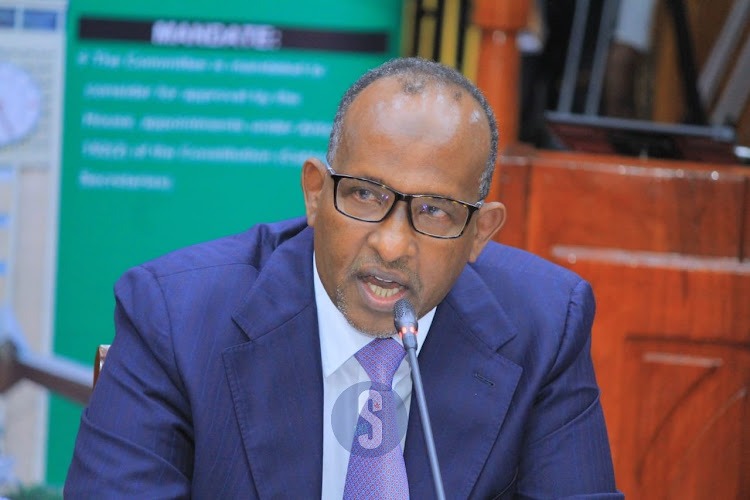
Health Cabinet Secretary Aden Duale has said the State will formally declare Ebola a formidable epidemic disease through a Kenya Gazette notice should any case be confirmed in the country, as Kenya strengthens surveillance following a regional outbreak.
Duale said the move is anchored in the Public Health Act (Cap. 242), which empowers the government to swiftly escalate response measures in the event of an outbreak to protect public health.
“The health security of Kenyans is a priority to the Kenyan Government. The Ministry of Health has a mandate of safeguarding the health of our people,” he said.
He explained that Sections 35 and 36 of the Act provide legal provisions for managing formidable epidemic, endemic or infectious diseases, including the authority to issue formal declarations.
“Section 35 grants the Cabinet Secretary power, by order, to declare any disease to be a formidable epidemic disease in accordance with the Public Health Act,” Duale said.
“As such, in the event of an occurrence of Ebola, I shall exercise my power under this section to declare the outbreak through an order published in the Kenya Gazette,” he added.
Despite the heightened alert, the ministry reiterated that Kenya has not recorded any confirmed Ebola cases as of 21st May 2026, even as regional infections in Uganda and the Democratic Republic of Congo continue to drive concern.
Officials said all suspected cases detected through surveillance have so far tested negative, including three travellers who had recently arrived from the Democratic Republic of Congo and were isolated after presenting with unrelated illnesses. Four contacts linked to them were also tested and cleared.
“As of now, all suspected cases have returned negative results,” the Ministry of Health said.
The government has intensified screening at all points of entry, including airports and land borders, where thousands of travellers continue to be monitored under enhanced surveillance systems.
“As of 21 May 2026, a total of 42,447 travellers had been screened, including 2,965 within the last 24 hours,” the ministry said.
Kenya has activated the Incident Management System and Public Health Emergency Operations Centres at national and county levels to coordinate preparedness and response efforts.
Rapid response teams have been placed on standby, with 22 high-risk counties identified for heightened surveillance and monitoring.
More than 880 healthcare workers have also been trained on Ebola preparedness and response, while 118 rapid response personnel remain on standby for immediate deployment.
Laboratory capacity has been reinforced through four designated testing facilities, including KEMRI Nairobi and Kisumu, the National Public Health Laboratory, and a mobile testing unit for rapid deployment.
The ministry urged the public to remain calm but vigilant, advising Kenyans to seek immediate medical attention if they develop symptoms such as fever, vomiting, severe fatigue or unexplained bleeding, especially after travel to affected areas.
Duale also cautioned against misinformation, urging citizens to rely only on official updates from the Ministry of Health, WHO and Africa CDC.
Despite the regional outbreak, the government maintained that Kenya remains safe and open for travel, business and tourism, while advising against non-essential travel to affected areas until the situation is fully contained.
