


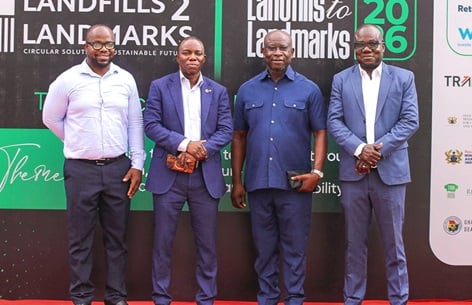

The co-founder of Landfills2Landmarks — the global working summit for the secondary textile sector — Henry Treku, has called for a comprehensive, system-wide review of Ghana’s second-hand clothing trade, urging stakeholders to fix failures in the value chain rather than push for blanket bans.
“I think we need to go back and look at systems and look at the failures that exist, and come together to see how we can mitigate these failures and ensure that the trade is legitimate with outcomes that really support,” Mr Treku said.
He made the call in an interview with the Daily Graphic in Accra yesterday, on the fourth day of the five-day summit.
The Landfills2Landmarks Summit, held in Accra from May 18–22, was themed “Trace, Account, Rebuild.” It brought together government officials, regulators, standards bodies, industry leaders, investors, and downstream market actors to advance governance, accountability, and practical innovation in textile reuse.
The summit emphasised that upstream decisions — from reuse and repair to rejection and disposal — directly shape environmental and economic outcomes downstream.
Balancing livelihoods and regulation
Addressing concerns over the importation of second-hand clothing, Mr Treku cautioned against calls for an outright ban, stressing that the trade supports an estimated 2.5 million livelihoods nationwide.
“The question that I have is, if we cease the importation of textiles into the country, do we have a robust national framework that can produce enough to meet the demands? We need to ask ourselves practical questions,” he said.
He argued that banning imports without viable domestic production capacity would displace millions at a time when government cannot absorb them into formal employment.
“I don’t think banning or stopping importation is the solution. It’s very important we are practical about the conversations we have and find relevant solutions that serve not just short-term purposes but long-term benefits for all,” he added.
Responding to claims that 40 per cent of imported second-hand clothing arrives as waste, Mr Treku questioned the economic logic behind such assertions.
“If you have any business and you are making a 40 per cent loss, why would you go back to the market to keep buying the same product? Is this a sustainable business module?” he asked.
Summit outcomes
The summit, which convened all actors in the textile value chain — brands, charities, exporters, importers, retailers, and policymakers — aimed to address issues linked to the flow of used textiles from the Global North into downstream markets.
A key outcome, Mr Treku noted, was the unveiling of Landfills2Landmarks’ traceability tool, which is already generating data being used in boardroom discussions on Extended Producer Responsibility and in designing frameworks to support downstream livelihoods.
“We’ve seen a lot of partners come on board, the conversations have expanded into multiple boardrooms, and we’ve seen real commitment,” he said.
Call for coordinated global action
Jonathan Sait, CEO of Sait Recycling and a participant at the summit, called for coordinated global action to tackle textile waste, stressing that the solution lies in building infrastructure and making waste processing commercially viable.
He said the scale of waste generated by fast fashion demands collaboration across the entire value chain.
“We need to act together. I understand the problem because of the waste streams that are coming into the business. So, we need to act together,” he said.
Mr Sait, a fifth-generation textile trader who has visited Ghana for 20 years exporting used clothing, said he had witnessed the transformation of the trade first-hand.
“I love to trade. I was born into the trade. But I understand the problem. Fast fashion and the waste streams that are coming into the business require a response.”
Growing global interest
Mr Sait, who supported the inaugural Landfills2Landmarks summit last year, said he returned this year to assess progress and was impressed by the expanded participation.
“I’m so happy that this year we’ve got people from all over the world — Denmark, Canada, Italy. Politicians are involved. The brands are looking at what we’re doing. Some really good speeches, some really good policy information coming out,” he said.
He noted that while Sait Recycling does not process textile waste in Ghana, it handles large volumes in the United Kingdom and aims for zero waste in the materials it exports to West and East Africa.
“What we understand is that any clothing that gets sold anywhere in the world one day becomes waste. The biggest problem in Africa as a whole is the fact that there’s no infrastructure for dealing with that item when it does become waste,” he said.
Mr Sait added that his company is in discussions with multiple stakeholders, funders, and green finance institutions to explore ways of making waste processing commercially viable in Africa.
—Graphic Online
