


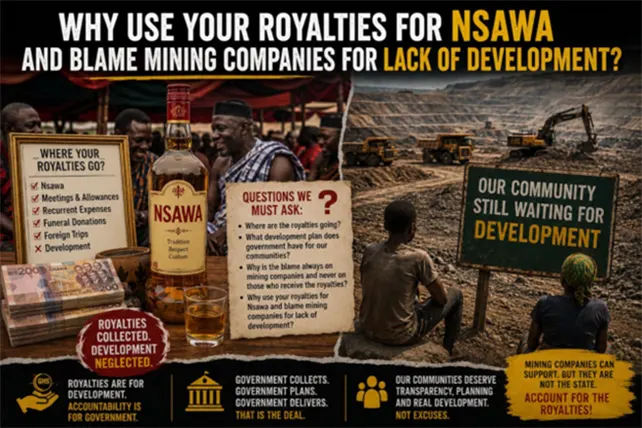
In Ghana today, one of the easiest ways to trend on radio, television, or social media is to blame mining companies for underdevelopment in mining communities. According to the growing public narrative, mining firms are not doing enough. They are accused of taking the gold, making profits, and leaving communities poor.
It is an argument that gets applause almost instantly. But while everyone is busy pointing fingers at mining companies, there is one awkward question nobody seems eager to ask:
What exactly has the State done with the billions of cedis in mining royalties and taxes it has already collected? That question rarely enters the conversation.
And perhaps it is because asking it would force us to confront a very uncomfortable truth: maybe the bigger issue is not simply whether mining companies are doing enough, but whether the State itself has failed in its own developmental responsibilities.
Because, let us be honest for a moment, when a community lacks roads, hospitals, schools, water systems, or jobs, why is the first instinct always to call the mining company instead of the Assembly, Parliament, or the government ministries that receive mining revenues every year?
Somehow, we have slowly normalised the idea that mining companies should function like district assemblies with excavators.
If the road is bad, call the mine. If the school has no roof, call the mine. If there is unemployment, call the mine.
At this rate, if the community football team starts losing matches, somebody may soon organise a press conference demanding that the mining company buy a new striker.
Yet these same mining companies already pay royalties, corporate taxes, PAYE taxes, levies, fees, and other statutory obligations to the State. Those revenues are specifically intended to help government undertake national and local development.
So the obvious question remains: Where has the money gone? This is the question the national conversation keeps avoiding.
Year after year, governments receive significant revenues from the mining sector. Portions of mineral royalties are allocated to local assemblies and development structures specifically to support mining communities. But in many places, the developmental transformation citizens expect is still absent.
And here lies the irony. Some assemblies reportedly use portions of these funds on recurrent expenditures, administrative costs, allowances, and sometimes even funeral donations. Yet when communities remain underdeveloped, the anger somehow bypasses the institutions directly responsible for public development and lands squarely on mining companies.
It is almost as if we have collectively decided that government’s role is to collect the royalties while mining companies perform the actual governance.
That arrangement may sound emotionally satisfying, but economically and institutionally, it makes very little sense.
Mining companies are businesses, not substitute governments. Their job is to invest capital, create jobs, pay taxes, comply with regulations, and generate returns for shareholders. Community support and corporate social responsibility are important, but they cannot replace the State’s constitutional responsibilities.
Some commentators now argue that government should stop renewing leases for foreign mining companies and instead hand concessions over to Ghanaians because “the money will stay in Ghana.”
It sounds patriotic. It also sounds wonderfully simple. Until one asks a few inconvenient questions.
Will Ghanaian-owned mining companies suddenly stop making profits? Will they ignore operational costs? Will they employ every unemployed person in the host community? Will they distribute all revenues freely to local residents instead of paying shareholders and investors? Of course not.
Whether foreign-owned or Ghanaian-owned, mining remains a business. No company, regardless of nationality, can sustainably operate as a replacement for the State.
And if we continue to push this dangerous expectation that private companies must compensate for public-sector failures, we may unknowingly damage the very sectors that keep the economy alive.
Today, mining companies are under pressure. Tomorrow it could be telecom companies. Next week, banks. Soon, every profitable private institution may be expected to fix roads, solve unemployment, build schools, sponsor youth programmes, provide water, and possibly repair broken hearts, too.
Meanwhile, the institutions constitutionally mandated to drive development quietly escape scrutiny.
This is not an argument against holding mining companies accountable. Far from it. Mining companies must operate responsibly, protect the environment, engage communities meaningfully, and contribute positively to local development. Many already spend millions annually on scholarships, roads, clinics, water systems, and social investment programmes.
But those efforts should complement government development, not replace it.
The real issue Ghana must confront is whether the country has a coherent, transparent development plan for mining communities and the nation as a whole.
Because if billions in mining revenues have been collected over decades and communities still feel abandoned, then citizens deserve more than emotional speeches blaming mining companies.
They deserve accountability. They deserve transparency. And they deserve clear answers on how mineral royalties have been utilised.
The debate, therefore, cannot continue as a one-way moral lecture directed only at mining firms while government accountability remains largely untouched.
If the State has genuinely failed in transforming mining revenues into visible development, then let us have the courage to say so openly.
But let us not pretend that the solution is to transfer government responsibilities to private companies, or to blame foreign companies simply because they are profitable and visible.
Mining companies can support development. They cannot become the government.
And until Ghana begins demanding the same level of accountability from the State that it demands from mining companies, we may continue shouting at the wrong people while the real questions remain buried deeper than the gold itself.
Source: Albert Amekudzi
