


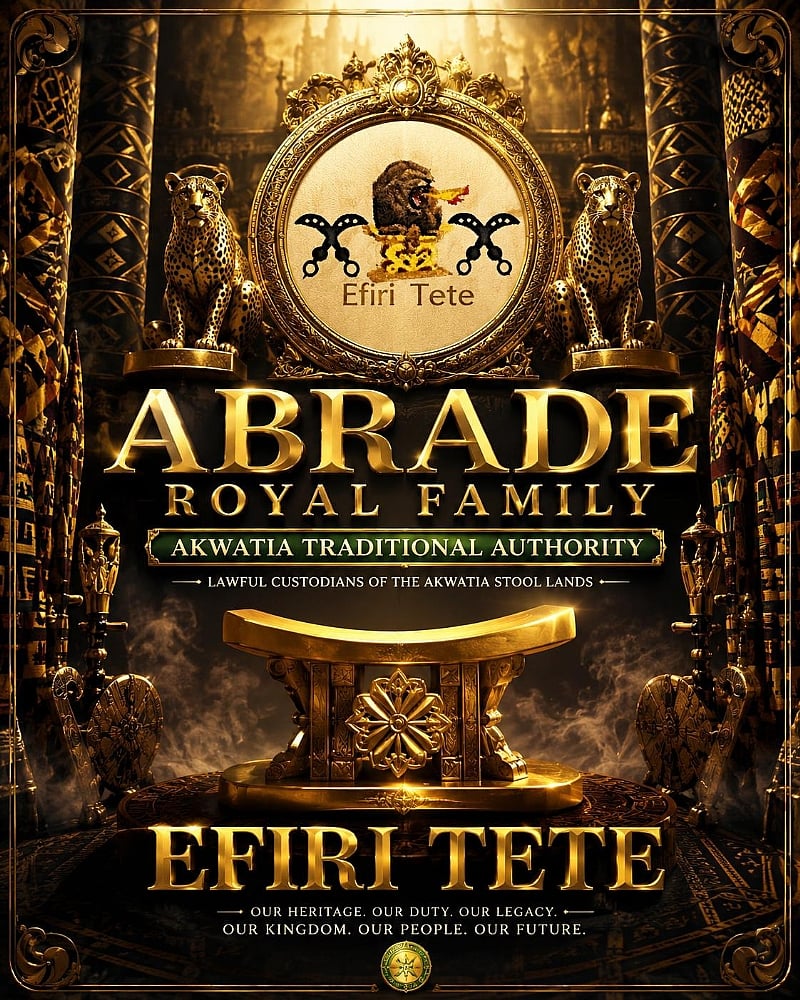
A formal chieftaincy dispute is currently unfolding in Akwatia, a historic diamond-mining town in the Eastern Region of Ghana, and it has drawn the attention of many who care about traditional governance, community development, and the rule of law. This article does not take sides in a matter that is properly before the legal and customary institutions of Ghana. It would be both improper and legally impermissible to comment on the merits of any pending proceeding. What it seeks to do is place the dispute in its factual, legal, and community context — because the questions it raises concern every Ghanaian community that has ever asked whether its leaders are truly serving it.
The facts on the public record are these. Osabarima Kofi Boateng III, Chief of Akwatia, is the plaintiff in a matter heard before the Judicial Committee of the Akyem Abuakwa Traditional Council at Kyebi, Eastern Region. The defendants are the Abusuapanin of the Abrade Royal Family of Akwatia and elderly members of the said Royal Family. A judgment was delivered on May 20, 2026, in favor of the plaintiff. The defendants, dissatisfied with that outcome, filed a Petition of Appeal before the Judicial Committee of the Eastern Regional House of Chiefs at Koforidua on the same date, and simultaneously obtained a Stay of Execution pending the determination of that appeal. The stated ground of appeal is that the judgment is against the weight of evidence. The matter is active, and its outcome rests entirely with the appropriate judicial forum.
The significance of who the defendants are deserves to be clearly understood. The Abusuapanin is the family head of the royal lineage — the highest custodial authority within the family. Under Ghanaian customary law, as affirmed consistently by the courts, elders and family heads are the primary guardians of the stool and are specifically vested with the duty to protect its integrity. When persons occupying these roles initiate a formal chieftaincy dispute, the customary law does not treat this as rebellion. It treats it as the proper exercise of custodial responsibility. The courts of Ghana have held that a valid destoolment process requires elders to have first brought their concerns to the chief’s attention before formal charges are laid — a process designed to ensure that legal action is always a last resort, never a first response.
Under the Chieftaincy Act, 2008 (Act 759), and the 1992 Constitution of Ghana, any party aggrieved by the judgment of a Traditional Council in a chieftaincy matter has the right to appeal to the Regional House of Chiefs. That right has been exercised here. A Stay of Execution, once granted, is a court’s formal recognition that the appeal raises substantive questions worth determining before any judgment is enforced. The appellate hierarchy — from Traditional Council to Regional House of Chiefs, and where necessary to the National House of Chiefs and the Supreme Court — exists as a deliberate safeguard, ensuring that chieftaincy disputes are resolved fairly at every level. Each forum operates independently. The system is working exactly as the law designed it to work.
What brought matters to this point is, in part, a question of community development. Akwatia has been the epicenter of diamond production in Ghana since the mid-1920s and sits atop one of the richest diamondiferous belts in West Africa. It was once among the most economically significant towns in the Eastern Region. Yet academic research, documented in peer-reviewed publications, has described Akwatia’s economic decline with painful consistency — a community whose mineral wealth was extracted without commensurate reinvestment, leaving behind unemployment, deteriorating infrastructure, and unrealized potential. A senior traditional ruler publicly lamented that Akwatia, given its natural endowments, should by now be a modern city. A former Vice President of Ghana, speaking at a mining investment event in the town, expressed hope for its transformation. These are matters of documented public record. The community’s desire for development is not new, and it is not unreasonable.
When news of the May 20 judgment circulated, there were reports of celebrations in some quarters, with some apparently believing the matter had been resolved conclusively. What those reactions overlooked is that the legal process was far from complete. A Stay of Execution is not a minor procedural step. It is a substantive legal recognition that an appeal with arguable merit is underway, and that enforcement before that appeal is heard would be premature. The matter has appropriately moved to its next lawful stage.
Whatever the outcome of the current proceedings, there is a broader conversation to be had — one that belongs not only to Akwatia but to every Ghanaian community that depends on its traditional institutions for governance and stewardship. The recognized grounds under which a chief may be called to account under Ghanaian customary law include misappropriation of stool resources, disrespect to elders, and failure to fulfill the obligations of the office. The courts have consistently upheld that these processes, when properly conducted, are legitimate exercises of customary authority — not attacks on the institution of chieftaincy, but expressions of its internal accountability mechanisms. Any community has the right to invoke these processes through its legitimate institutions. Any chief has the right to a fair hearing at every level of the hierarchy. Both of these are equally true.
Akwatia’s potential remains very much unrealized. The town deserves leadership equal to its endowments — a chief, whoever that ultimately may be, with the vision to attract institutional investors, partner with government and the private sector, develop the town’s infrastructure, build schools and health facilities, create employment, and harness Akwatia’s natural wealth for the lasting benefit of its people. It deserves a leader with the humility to listen to elders, the courage to serve the community over personal interest, and the selflessness to measure success not by private comfort but by the welfare of ordinary people. These are not partisan expectations. They are the foundational obligations of the office, embedded in both customary tradition and the broader purpose for which the institution of chieftaincy exists.
The Abrade Royal Family of Akwatia is, by historical reputation, a family committed to peace, order, and the preservation of the traditions that have held Akwatiaman together across generations. Their decision to pursue this matter through the proper channels of customary law and the chieftaincy hierarchy reflects, at minimum, a belief that those channels exist for exactly this purpose. The appellate system will determine what the law and evidence require. In the meantime, the community of Akwatia watches, and waits, and hopes — as it has long hoped — for the kind of outcome that puts the welfare of its people first.
As a physician, I understand what happens when the body’s natural mechanisms of self-correction are suppressed: the result is not stability, but a slow and irreversible decline. Communities too require these mechanisms — the capacity to raise concerns, to hold leaders accountable through legitimate processes, and to seek, through their own institutions, the kind of future they deserve. The people of Akwatia, through their royal family and their elders, are exercising exactly that capacity. The law permits it. The constitution protects it. The customary tradition demands it. What remains now is for the proper forums to complete their work — and for every Ghanaian who cares about development, accountability, and the dignity of traditional institutions to pay close attention to what this case teaches us about all three.
