


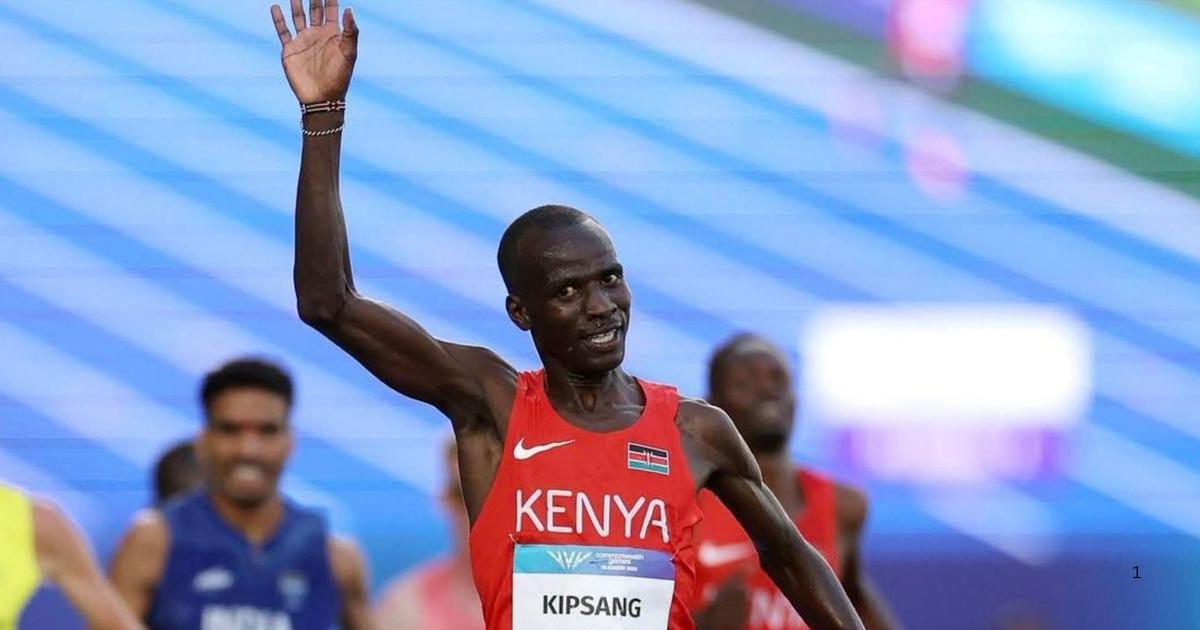
The 2026 Commonwealth Games in Glasgow delivered another historic moment for Kenya’s track and field dominance, as Mathew Kipsang executed a calculated, high-stakes strategy to claim the men’s 5,000 meters gold medal—securing the country’s third gold of the Games. The victory, achieved through tactical brilliance rather than brute speed, underscored Kipsang’s reputation as one of Africa’s most astute endurance runners.
A Race of Cunning and Endurance
From the outset, the race was a battle of wits rather than pure athleticism. Kenya’s medal hopes rested on three athletes: Cornelius Kemboi, Andre Kiptoo, and Kipsang himself. The contest unfolded in two distinct phases—early aggression and late precision—each defining the eventual outcome.
Kemboi, a veteran of Commonwealth Games, took an early lead with five laps remaining, a bold move that aimed to disrupt the pack and conserve energy for the final stretch. However, this strategy backfired spectacularly. As the race progressed, Kemboi’s lead became unsustainable, and by the four-lap mark, he began to falter under the pressure of maintaining pace.
Meanwhile, Kipsang—ever the strategist—remained in the shadows, biding his time. He understood that the race was not about outrunning his competitors but outsmarting them. The turning point came at the final bell, where Kipsang unleashed a scorching kick at the bend. His explosive surge left the field in disarray, and within seconds, he had pulled away to claim victory in a personal best time of 13:23.61.
The Cost of Early Ambition
Kemboi’s premature lead proved his undoing. By the time the final straight unfolded, he was exhausted, unable to sustain the pace needed to defend his position. The race’s top three—Kipsang, Australia’s Ky Robinson, and India’s Gulveer Singh—overtook him, leaving Kemboi to settle for a disappointing fourth place with a time of 13:24.95.
Robinson, a seasoned competitor, secured silver with a close finish at 13:24.70, while Singh claimed bronze in 13:24.95—a testament to the razor-thin margins that define elite endurance racing.
A Historic Comeback for Kenya
Kipsang’s victory marked Kenya’s return to Commonwealth 5,000m glory, ending a 12-year drought. The last Kenyan to win this event was Caleb Mwangangi Ndiku, who triumphed in 2014 Glasgow—the same city where Kipsang now etched his name in history.
The win was not just a personal triumph but a statement of Kenya’s enduring dominance in middle-distance running. With athletes like Kipsang, Kemboi, and Kiptoo consistently pushing boundaries, Kenya continues to be a force to reckon with in global track and field competitions.
The Psychology Behind the Victory
Kipsang’s success was as much about mental fortitude as physical prowess. His ability to read the race, control his breathing, and time his surge demonstrated the depth of his experience. Unlike Kemboi, who misjudged the race’s rhythm, Kipsang understood that patience and precision often outweigh raw speed in endurance events.
This victory also highlighted the evolving tactics in modern track racing, where athletes increasingly rely on race management rather than sheer athleticism. The 5,000 meters, once a test of pure endurance, has become a battle of strategy, where split-second decisions can mean the difference between gold and disappointment.
Looking Ahead: Kenya’s Legacy in Glasgow
As Kenya’s athletes continue to shine in Glasgow, Kipsang’s gold serves as a reminder of the nation’s unmatched legacy in middle-distance running. With multiple medals already secured, the country’s track team is poised to extend its dominance across multiple events.
For Kipsang, this victory cements his status as one of Kenya’s greatest tactical runners, a masterclass in how smart racing can overcome even the most aggressive competitors. As the Games progress, fans and analysts alike will be watching closely to see if Kenya can match this level of strategic brilliance in other disciplines.
One thing is certain: Kenya’s golden era in track and field is far from over.

Mathew Kipsang celebrates his Commonwealth Games gold medal victory in Glasgow, a triumph secured through tactical precision rather than brute speed.
The race’s early stages saw Cornelius Kemboi take an aggressive lead, a move that would later prove costly as he struggled to maintain pace.

Kipsang’s disciplined approach paid off as he waited for the perfect moment to strike, leaving competitors in his wake.

The final bend became the turning point, where Kipsang’s explosive kick secured his historic victory.

Ky Robinson (Australia) and Gulveer Singh (India) secured silver and bronze, respectively, in a tightly contested race.

Cornelius Kemboi, despite his early lead, finished fourth, a stark reminder of the dangers of overambition in endurance racing.

Kenya’s track team continues to dominate, with Kipsang’s gold marking the nation’s third medal of the Games.
The 2026 Commonwealth Games in Glasgow have already cemented Kenya’s legacy as a powerhouse in middle-distance running.
