


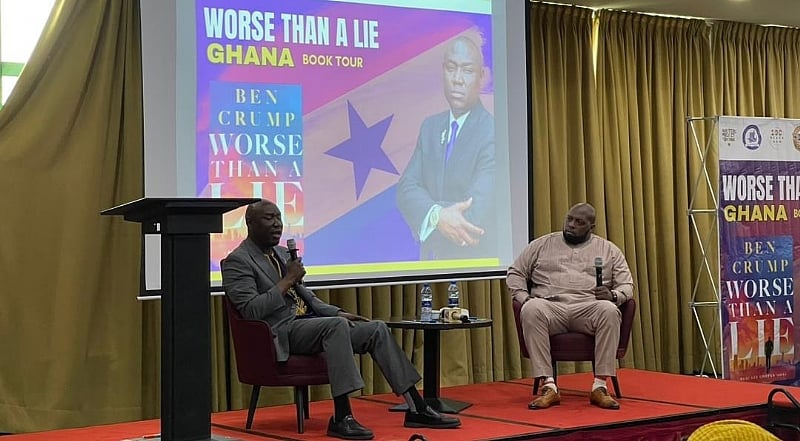
Celebrated American civil rights attorney and author Ben Crump has called on Africans and people of African descent to embrace unity, economic empowerment, and self-determination as part of efforts to strengthen Black communities globally.
Attorney Crump made the remarks during an interview held alongside the launch of his latest book, Worse Than a Lie, as part of his Ghana Book Tour.
Widely known for representing the families of George Floyd, Breonna Taylor, and Trayvon Martin in landmark cases that ignited global conversations on racial injustice and police accountability, Attorney Crump said the inspiration behind the title of his book came from advice given to him by his grandmother during childhood.
“What’s worse than a lie is to tell the truth and have nobody believe you,” he recalled.
The novel follows the story of Hollis Montrose, a man fighting for justice and survival in a system that refuses to believe his truth. Attorney Crump described the book as a legal thriller deeply rooted in Black culture and the historical realities of America’s justice system.
According to him, the book was written not only to entertain readers but also to inspire a new generation of civil rights advocates and social justice defenders.
“We need more people willing to fight for our civil rights and human rights,” he stated.
Attorney Crump explained that Ghana was an important destination on his international book tour because of the country’s growing influence within the global African movement. He disclosed that he had previously shared platforms with John Dramani Mahama at the United Nations and has engaged Ghanaian leaders on issues concerning Africa and the diaspora.
Speaking on Black empowerment, Attorney Crump stressed that the future of Black people would largely depend on how they support one another rather than relying on external systems.
“The future of Black people will depend on how we treat each other, support each other, and invest in each other,” he emphasized.
Describing himself as “an unapologetic defender of Black life, Black liberty, and Black humanity,” the renowned lawyer encouraged Black communities to intentionally support Black-owned businesses and professionals to strengthen economic independence.
“If I need a lawyer, I’m going to a Black lawyer. If I need a doctor, I’m going to a Black doctor. We have to keep our dollars in our community,” he said.
Attorney Crump also praised John Dramani Mahama and Samuel Okudzeto Ablakwa for championing conversations on reparative justice at the United Nations, describing Ghana’s leadership on the issue as historic.
“That was not just a moment for us, but a moment for our children and generations yet unborn,” he noted.
He further urged Africans in the diaspora never to disconnect from their roots, insisting that respect for Africa is essential to the respect of Black people globally.
“If they don’t respect Mother Africa, they will never respect anything that comes from Africa,” he added.
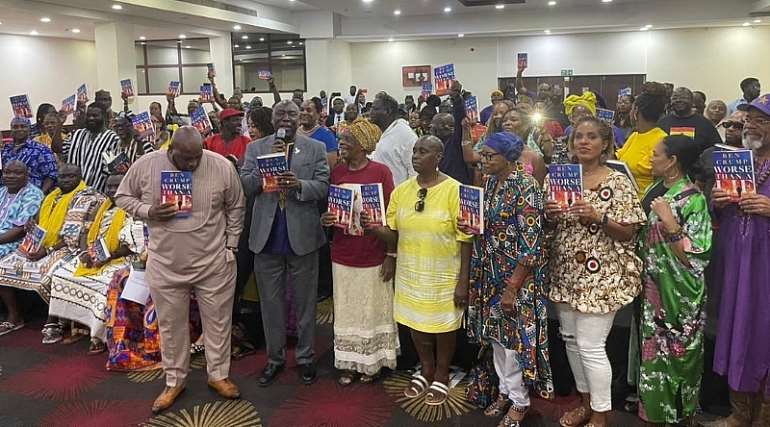
Meanwhile, the Director of Diaspora Affairs at the Office of the President, Kofi Okyere-Darko, reaffirmed Ghana’s commitment to African unity, reparative justice, and Black consciousness while condemning xenophobic attacks against Africans in South Africa.
Kofi Okyere-Darko disclosed that his relationship with Attorney Crump began in Atlanta last year during discussions on African liberation, Black identity, and racial justice, which later led to the lawyer’s participation in Ghana’s Diaspora Summit and reparative justice conversations at the United Nations.
Addressing xenophobic tensions in South Africa, he described the attacks as unfortunate and called for greater education on African solidarity and shared history.
“We are one people and we are living in an era where we are fighting towards a united Africa,” he stated.
He noted that Africans migrating to other African countries contribute positively to economic development and should not be targeted because of their success.
“There are South African companies doing very well in Ghana, and we support them. In the same way, Ghanaians living in South Africa contribute to their economy,” he added.
Kofi Okyere-Darko also cited Ghana’s visa-free policy for Africans and the presence of the African Continental Free Trade Area Secretariat as evidence of the country’s commitment to continental integration and unity.
He urged foreigners and Africans relocating to Ghana to respect the country’s laws and regulations while contributing positively to national development.
