
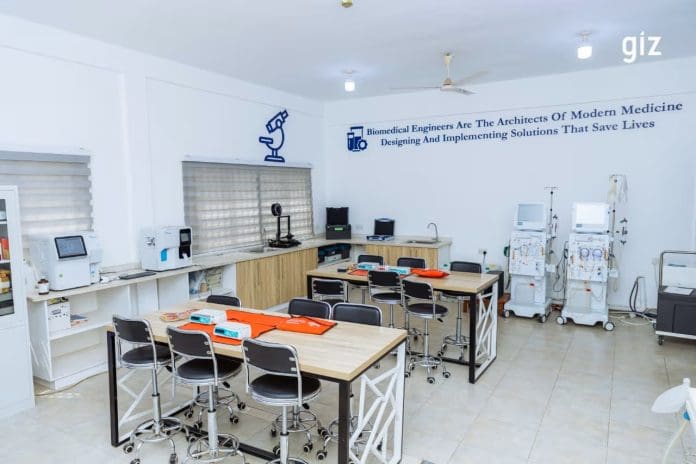

Two universities at the centre of Ghana’s biomedical engineering training pipeline now have retrofitted laboratories that replicate actual clinical environments, following the launch of upgraded bioinstrumentation facilities at the Kwame Nkrumah University of Science and Technology (KNUST) and the University of Ghana on Wednesday, February 26, 2026.
The launch, held at the University of Ghana campus in Accra under the theme “Partnership for Excellence in Biomedical Engineering,” marks the completion of a key milestone in the “Upskilling Biomedical Engineers for Ghana” project, a development partnership between Ghana and Germany implemented by Deutsche Gesellschaft für Internationale Zusammenarbeit (GIZ) on behalf of the German Federal Ministry for Economic Cooperation and Development (BMZ), and jointly funded through the develoPPP private sector engagement programme.
Five industry partners anchored the initiative: medical technology and diagnostics firms B. Braun, Dräger, Delft Imaging, and Sysmex Europe, alongside adaptive learning platform Area9 Lyceum. The companies supplied the laboratories with equipment identical to what biomedical engineers encounter in hospitals, enabling students to practise installation, maintenance, calibration, diagnostics, and therapeutics on industry-standard devices before they graduate.
Speaking at the launch, Lead Consultant and industry partner representative Professor Torsten Wagner said access to graduates already familiar with professional equipment would be transformative for the sector. He noted that the new laboratories would shorten onboarding time significantly, boost productivity for employers, and support the growth of Ghana’s local medical device industry.
Director of Allied Health at the Ministry of Health, Dr. Ignatius Awinibuno, described biomedical engineers as the true custodians of patient safety. “Professionals who can install, maintain, calibrate, troubleshoot and innovate around medical systems are the true custodians of patient safety,” he said, adding that the upgraded laboratories would also create new opportunities for research and development using locally available resources.
The project goes beyond equipment. Both KNUST and the University of Ghana have revised their biomedical engineering curricula to place significantly greater emphasis on applied, problem-solving-oriented learning aligned with Ghana’s healthcare needs. Stakeholders said the shift from theory-heavy to practice-oriented training was long overdue in a country where malfunctioning medical equipment in public hospitals remains a persistent problem affecting patient care.
The initiative targets graduating 280 students through the modernised bachelor programmes and training 100 health sector professionals through continuous professional development courses.
The launch comes at a moment when Ghana’s biomedical engineering sector is drawing growing attention. Local innovations including the first made-in-Ghana PBS Bedhead Unit and EA X-ray Viewer, developed at Bank Hospital, and artificial intelligence-driven radiology tools from MinoHealth AI Labs, signal that the country is gradually moving from dependence on imported medical equipment toward local production capacity.

