
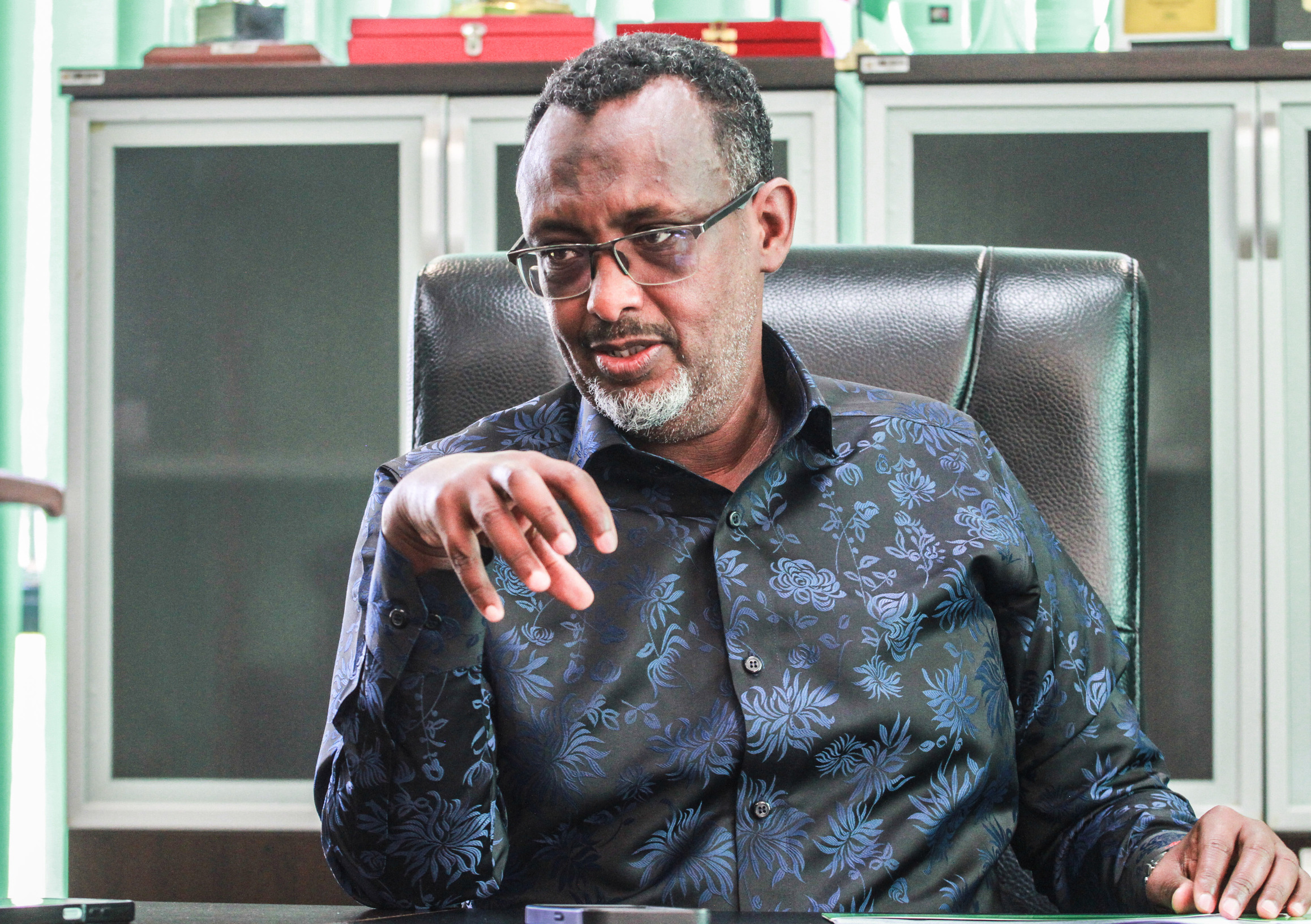
‘We rely on mature regulatory authorities like America’s FDA,
but an applicant cannot simply bring an FDA certificate and get a licence. We
follow the normal [review] process, but we do it much faster’
‘Ultimately, the government is me and you; it is the
responsibility of every Kenyan citizen to help police their health providers’
If you are wondering how medicines reach you safely before
they are sold in Kenyan pharmacies, or why some drugs take longer than others
to enter the market, this interview is for you.
The Star spoke with Dr Ahmed Mohamed, the chief executive
officer of the Pharmacy and Poisons Board, to unpack the dynamics shaping the
safety, quality and accessibility of medicines you use every day.
He explained international regulatory partnerships,
including the US-Kenya health cooperation framework, drug approval pathways,
post-market surveillance and the fight against illegal pharmaceutical practices.
The Star: You have recently taken over as CEO
of the Pharmacy and Poisons Board. What direction are you taking the institution?
Dr Ahmed Mohamed: First, I think it is important to
clearly define the mandate of the Pharmacy and Poisons Board. We essentially
serve as the watchdog for public health with regard to health products and
technologies. Our mandate is built on three pillars: ensuring the safety,
quality and effectiveness of every product.
Recently, we have undertaken several strategic reforms aimed
at strengthening our regulatory efficiency, transparency and public health
protection. This involves significant modernisation of our digital regulatory
platforms.
Our current strategy is focused squarely on the patient
rather than the commercial interests of the pharmaceutical industry, because
that is the fundamental reason for our existence.
In this process, we have expanded our human resource
capacity and are operationalising our regional offices. We are devolving our
services closer to the people so that citizens can easily access our offices,
interact with our officers and report illegal practices, such as unauthorised premises
or substandard products.
It is often surprising to note that a doctor’s prescription
is not the end of the process. If a patient takes a drug like paracetamol and
it does not cure their headache as expected, they need to know what to do next.
The patient is supposed to report this to our offices through our online
platform or via their doctor or pharmacist. You do not need to be certain that
a drug is bad; you only need to suspect it, and that is where we take over the
investigation.
Furthermore, we are strengthening our laboratories
specifically for post-market surveillance. This means that once a product is
registered and enters the market, we continue to follow up on its quality. We
identify critical products, such as antibiotics or anti-hypertensive medicines,
and sample them throughout the country for analysis in our lab.
We typically conduct these reviews three to four times a
year and share the reports with the public. Our laboratory now operates 24
hours a day to ensure continuous evaluation of product quality. Truthfully, the
issue of substandard products in the market has gone down significantly of
late.
We are also supporting local manufacturers from a regulatory
standpoint. The government’s intention is for Kenya to become a net exporter of
health products rather than a net importer. To achieve this, we have
established regulatory mechanisms to develop our local industry.
Health products and technology are a matter of national
security. We remember what happened during the Covid-19 pandemic, when
countries locked down and exports ceased. The only way to prevent such a crisis
in the future is to develop local capacity. We train manufacturers on good
manufacturing practices and quality assurance, and fast-track the registration
of their products.
How many drug
manufacturers are currently operating in the country?
Currently, we have 31 manufacturers. However, because of the
regulatory framework we have established, we are seeing about 10 new
state-of-the-art facilities coming up.
There is ongoing investment of about Sh100 billion in the
pharmaceutical sector. These are new players, separate from the original 31,
which demonstrates the growing confidence in our regulatory processes and the
protection we offer to the industry.
There is public
anxiety whenever PPB recalls medicines. How should Kenyans understand recalls?
It is important to understand that every industry has a
recall process; it is not unique to the pharmaceutical sector. You see
companies like Toyota recalling vehicles for brake issues worldwide. A recall
is a vital process to ensure the safety of products already in the market.
There are two types: Class One recalls are serious and
involve products that may cause death or severe harm. We remove those
immediately upon suspicion, sometimes based solely on visual appearance, and
notify the media immediately.
Then there are regular recalls, which involve smaller
issues, such as a slight variance in the active ingredient. For example, if a
drug is supposed to have 100 per cent of an active ingredient but is found to
have 92 per cent, it is not necessarily a critical safety risk, but it affects
efficacy. For us, the question is always whether the drug is effective. Recalls
are a normal and good practice. The public should not fear when the Pharmacy
and Poisons Board issues a recall; it means you have an active, proactive
regulatory institution that is doing its work.
How long does it
typically take for medicine to be registered and brought to the Kenyan market,
and what does that process involve?
Internationally, it takes about two to five years to
register a product. In Kenya, our service charter sets this at 24 months (two
years).
Drug registration involves many complex processes. For
example, we require “bioequivalence” data for generic drugs to ensure
they are therapeutically equivalent to the originator brand. If a company wants
to manufacture a generic version of a drug like Augmentin, they must provide
data proving that their version will have the same therapeutic effect.
We also have to verify stability data to ensure a product
remains safe for its claimed shelf life, and we must audit the manufacturing
process. This includes qualifying the equipment used and validating the entire
manufacturing process to ensure it complies with good manufacturing practices.
It is not a matter of simply sitting and approving a file; it takes time. Our
two-year timeline actually makes us one of the best and most efficient
regulators in the world.
The health agreement
Kenya signed last year with the US says a drug approval by the Food and Drug
Administration is enough for that product to enter the Kenyan market. Are we
replacing PPB’s role here and turning it into a rubber stamp?
We use a system called ‘reliance’, where we rely on mature
regulatory authorities like the US FDA, the WHO prequalification system or the
UK’s MHRA (Medicines and Healthcare products Regulatory Agency). This is
primarily done for the benefit of the public health system, so that new
molecules can reach Kenyan patients quickly.
However, reliance does not mean we do not review the
scientific documentation. It is strictly a fast-track mechanism. An applicant
cannot simply bring an FDA certificate and get a licence; they must submit the
entire dossier and every document they submitted to the FDA for our own
assessment. We follow the normal process, but we do it much faster.
At what maturity level
is the PPB currently ranked by the WHO, and what have been the barriers to
moving up?
We are currently at Maturity Level 2, and we are moving
towards Level 3. The most critical factor that delayed our move to Level 3 was
human resources. We have an establishment requirement of almost 350 staff, but
we have been operating with around 160, which is nearly a 50 per cent shortage.
Fortunately, the Ministry of Health has been very supportive. Through a World
Bank grant and Treasury approvals, we are now employing about 80 new people to
close that gap.
The higher the maturity level, the more confidence the
public can have in the system. Level 4 represents “World-Listed
Authorities”, which are the top-tier trusted systems globally.
There have been
complaints regarding the five-year renewal of marketing authorisations. Is this
process causing drug stockouts or blocking products?
Legally, under the Pharmacy and Poisons Act (Cap 244), it is
mandatory for products to be renewed every five years. If it is not renewed,
the product is no longer licensed and cannot be on the market.
We have been engaging stakeholders on this since 2022, but I
think some took it for granted. We sat down with stakeholders and agreed on
deadlines, moving the date four times. By the final cut-off of December 2025,
80 per cent of players had complied.
For the remaining 20 per cent who did not submit, it is
usually a commercial issue rather than a regulatory one. For example, a company
may have an old molecule that is no longer profitable, or there may be over-representation
in the market, say, more than 200 different brand names for the same
paracetamol molecule. Companies may decide not to renew those.
However, there is no crisis in availability. As a
government, we prioritise accessibility, and we have pathways to deal with
emergencies, such as issuing special permits for specific products based on a
doctor’s prescription.
What system gaps allow
unlicensed chemists and rogue practitioners to flourish, and how is the board
strengthening enforcement?
The biggest problem is that some pharmacy practitioners
lease their certificates to unauthorised persons.
They claim in our system that a business belongs to them to
get a licence, and then later claim they have “resigned” from their
own business. They essentially open the shop and then disappear, leaving it in
the hands of unqualified people.
To deal with this, we are bringing these individuals before
disciplinary and inquiry committees, where they may face deregistration or
suspension.
We are also targeting the distribution channel, specifically
wholesalers. Wholesalers are a high-risk area because they often sell to
unregistered premises. We have audited all wholesalers in the country to check
for compliance with safety requirements, such as proper temperature control for
medicines. If a wholesaler cannot manage the cold chain or handle a recall
process, they have no business operating. By the end of next month, we expect
to close about half of the wholesalers who do not meet these safety standards.
If a member of the
public has an issue with a practitioner or a pharmacy, is the PPB the correct
institution to report to?
Yes, we are the right institution. We are one of the most
digitalised institutions in the country, with 95 per cent of our systems being
digital. We issue licences for both the chemist and the practitioner, which
include a photograph. The public can verify these through a QR scan or an SMS
code to see if an institution is licensed.
Ultimately, the government is me and you; it is the
responsibility of every Kenyan citizen to help police their health providers.
You cannot be everywhere at once, so we rely on the public to engage with us
directly and help improve regulation in the country.
