


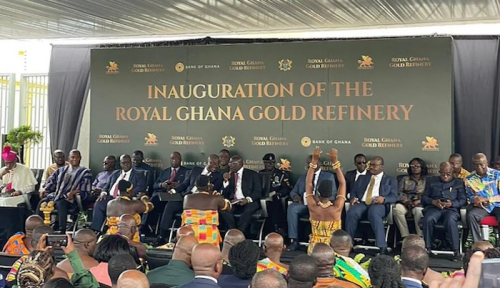
A policy analyst is urging Ghana to move beyond ceremonial celebrations of expanded gold refining capacity and address four critical questions that could determine whether the initiative succeeds or repeats past failures.
Alfred Appiah, a policy analyst, said that while the government’s efforts to expand local gold refining capacity have been greeted with optimism and national pride, uncomfortable questions remain unresolved. Finance Minister Dr Cassiel Ato Forson urged Gold Coast Refinery to work towards securing London Bullion Market Association (LBMA) certification in the near future and encouraged the Ghana Gold Board (GoldBod) to put in place measures to establish a national assay laboratory before the end of the year.
At the centre of the debate is LBMA certification, the global gold market standard. While Gold Coast Refinery is often presented as a game changer, there has been little public disclosure on the timeline for achieving certification from the London Bullion Market Association. Without it, access to premium international markets remains limited, regardless of where the gold is refined.
Through a technical and commercial partnership with South Africa’s Rand Refinery, the only LBMA-accredited gold refinery in Africa, Gold Coast Refinery is able to refine gold doré to 999.99 purity. A gold analysis laboratory certified to LBMA standards is expected to be operational by 2026.
Closely linked is the persistent challenge of illegal mining, locally known as galamsey. Appiah questions whether Ghana can realistically sell gold into top tier markets while environmental degradation and traceability concerns remain unresolved. GoldBod announced that by 2026, the Gold Board will introduce a blockchain powered track and trace system to ensure full transparency and traceability of every gram of gold purchased.
Even if gold is refined locally, buyers may still insist it pass through LBMA certified refineries abroad, raising the possibility that Ghana could end up paying refinery fees twice, eroding any supposed cost advantage. The analyst asked whether Ghana would be able to sell gold to premium markets while galamsey continues at scale, and whether locally refined gold would still need to be sent to LBMA certified refineries abroad.
Ghana’s Catholic bishops and environmental groups amplified warnings about the long term ecological damage, silted waterways, poisoned fisheries, and deforested headwaters, arguing that enforcement alone will not suffice. As of September 2024, 60 percent of Ghana’s water bodies had suffered pollution due to galamsey.
The analyst also points to a deeper structural issue that bullion refining itself offers thin margins. The real economic value, he argues, lies further downstream in jewellery manufacturing, industrial applications, and branded gold products. Yet, there is no clearly articulated public policy document outlining Ghana’s long term strategy for gold value addition beyond refining.
Appiah asked what the vision is for downstream development and where the policy document outlining Ghana’s strategy for local gold value addition can be found. He explained that the real value addition comes from jewellery and other downstream products.
Perhaps most critically, Ghana has been here before. Several past attempts at local gold refining failed to deliver sustainable outcomes. The refinery, which represents an investment of over $150 million by Euroget Group of Egypt in partnership with Ghanaian shareholders, was commissioned on 12 November 2016 by then President John Dramani Mahama. Finance Minister Cassiel Ato Forson recalled Gold Coast Refinery was commissioned in 2016 under Mahama’s administration, but remained largely underutilized after that government left office.
Appiah argues that without transparent lessons learned from these experiences, covering governance, financing, market access, and regulatory oversight, there is little assurance that the current push will end differently. He asked what lessons have been learned from past failures to ensure a different outcome this time.
Operational since February 2026, GoldBod, established in May 2025, now purchases artisanal and small scale mining (ASM) gold and entrusts it to Gold Coast Refinery, which processes one tonne per week with maximum capacity of two tonnes. The refining operations have created employment for about 162 Ghanaians and enabled the refinery to operate on a 24 hour basis, in line with the government’s 24 hour economy policy.
The questions raised do not dismiss the importance of local refining. Instead, they challenge the country to move from symbolism to strategy. As Ghana celebrates improved refinery capacity, Appiah warns that success will not be measured by ribbon cutting ceremonies, but by certification timelines, market access, downstream development, and the hard policy choices needed to make local gold refining truly transformative.
