


Ghana’s participation in the global artificial intelligence economy depends on expanding its data centre infrastructure as AI-driven computing demand reshapes digital markets worldwide.
The country is now West Africa’s largest retail colocation hub by total information technology capacity, though it currently operates approximately eight data centres at a time when global capacity requirements are accelerating sharply. Global data centre capacity is projected to reach between 171 and 219 gigawatts (GW) by 2030, growing at 19 percent to 22 percent annually, with artificial intelligence expected to account for approximately 70 percent of total capacity.
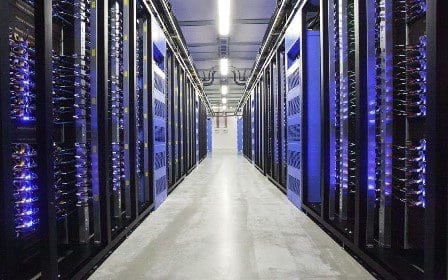
A data centre is a secure facility housing physical infrastructure needed to store, process and transmit digital information. It typically contains high-performance servers, storage systems, networking equipment, and supporting power, cooling and security systems required to maintain continuous operations. These facilities power digital services including mobile money platforms, banking systems, government portals, e-commerce sites and cloud applications. In the artificial intelligence era, they also host chips and computing clusters needed to train and run modern artificial intelligence systems.
Artificial intelligence is expected to overtake traditional workloads in 2026. Industry projections show artificial intelligence accounting for 50 percent of total data centre capacity by 2030, up from 25 percent in 2025. Artificial intelligence optimised servers are expected to account for 44 percent of total data centre power consumption by 2030, reflecting rising demand for high-performance chips such as graphics processing units (GPUs) and artificial intelligence accelerators, which draw far more electricity and generate more heat than conventional enterprise servers.
For Ghana, the implications extend beyond technology. Artificial intelligence is often discussed in terms of talent, startups and digital policy, but at scale it fundamentally requires infrastructure. Training and running modern artificial intelligence models requires stable electricity, high-density power delivery to server racks, advanced cooling systems, high-speed fibre connectivity, and redundant systems ensuring reliability. These requirements are difficult to meet outside purpose-built data centres.
Without stronger local capacity, Ghana risks remaining a downstream consumer of artificial intelligence services built and hosted elsewhere. That dependence can raise costs for businesses, increase latency for users, and weaken Ghana’s influence in debates around data governance, privacy enforcement and cybersecurity. It also limits the ability of local startups, universities and public agencies to build and scale artificial intelligence systems using Ghanaian data in ways that support domestic innovation.
West Africa has over 440 megawatts of data centre capacity in the pipeline, and Ghana is set to take a significant share. Digital Realty launched its first data centre in Ghana in December 2025, with the facility delivering carrier-neutral colocation services with an expected 1.7 megawatts of installed information technology capacity. The facility provides direct access to the 2Africa cable system and positions Ghana as a gateway to the global digital economy.
Artificial intelligence workloads require elastic computing resources. Organisations often need to scale up quickly during model training, product launches or high-traffic periods, and data centres provide environments where computing can be expanded rapidly without requiring every institution to invest upfront in expensive hardware, cooling infrastructure and dedicated power systems.
The artificial intelligence infrastructure shift is creating new market layers. Hyperscale data centres, very large industrial-scale facilities built to support massive computing workloads, are increasingly essential for high-density artificial intelligence needs including model training and large-scale enterprise deployments. Edge data centres are becoming more relevant because they reduce latency by placing computing closer to users, supporting artificial intelligence inference applications such as fraud detection, voice services and real-time analytics.
Ghana is served by multiple international submarine cables including African Coast to Europe (ACE), MainOne, GLO-1, West Africa Cable System (WACS) and South Atlantic 3 (SAT-3), positioning it as one of the best-connected nations in West Africa. Local operators are building at scale, combining technical resilience with green innovation. Facilities are running on solar power during the day, with battery systems planned to enable around-the-clock renewable operations.
Ghana’s artificial intelligence ambitions will rise or fall on infrastructure. With approximately eight data centres today, the country is starting from a relatively small base at a time when global demand is accelerating sharply and reshaping how digital economies compete. If Ghana wants to participate in serious artificial intelligence discussions and attract investment tied to the next wave of computing, it will need to prioritise well-infrastructured data centres supported by reliable power, strong connectivity and clear regulatory frameworks.
In the artificial intelligence era, data centres are no longer a backend feature of the digital economy. They are fast becoming national economic infrastructure.
