Ookla, the connectivity research company best known for its Speedtest product, has been taking a closer look at internet speed across the globe, and in particular, zeroed in on what is happening in the Middle East and Africa (MEA) region.
In its latest analysis, Ookla highlighted significant shifts in regional rankings, which were driven by major infrastructure upgrades.
Looking at the numbers, it is the Gulf Cooperation Council (GCC) countries that maintained the highest position in MEA. The UAE, Kuwait, Qatar, Saudi Arabia, Bahrain, and Oman were recorded as consistent winners, leading the MEA region in both fixed and mobile network performance. The GCC also accounted for the most in the top 10 globally for mobile throughout 2025.
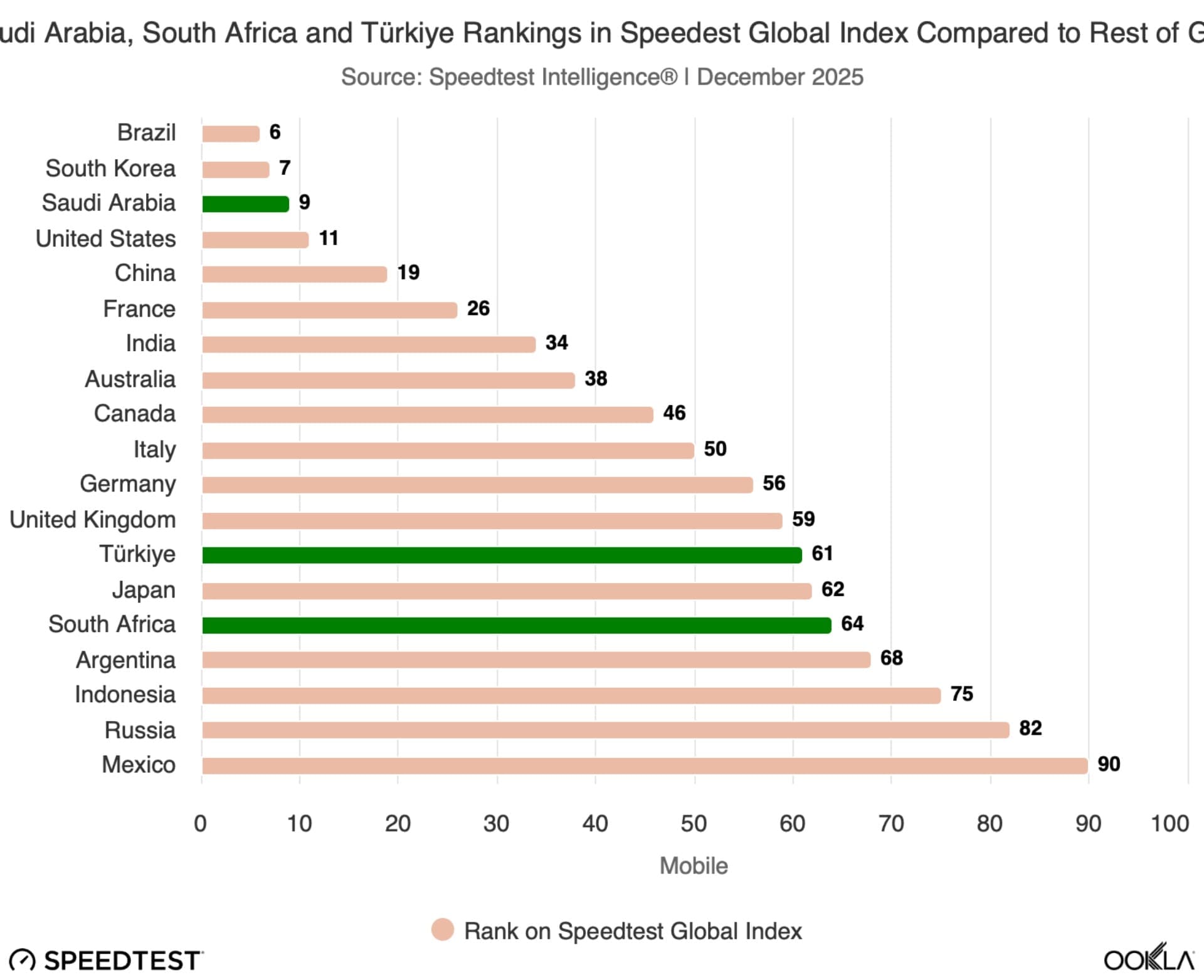
Locally, South Africa was deemed a consistent leader in the Sub-Saharan Africa (SSA) region, and is one of only three SSA countries in the global top 100 list for mobile in Q4 2025. This therefore indicates that while South Africa is well above the average on the continent, there is still plenty of work to be on par with its GCC and global counterparts.
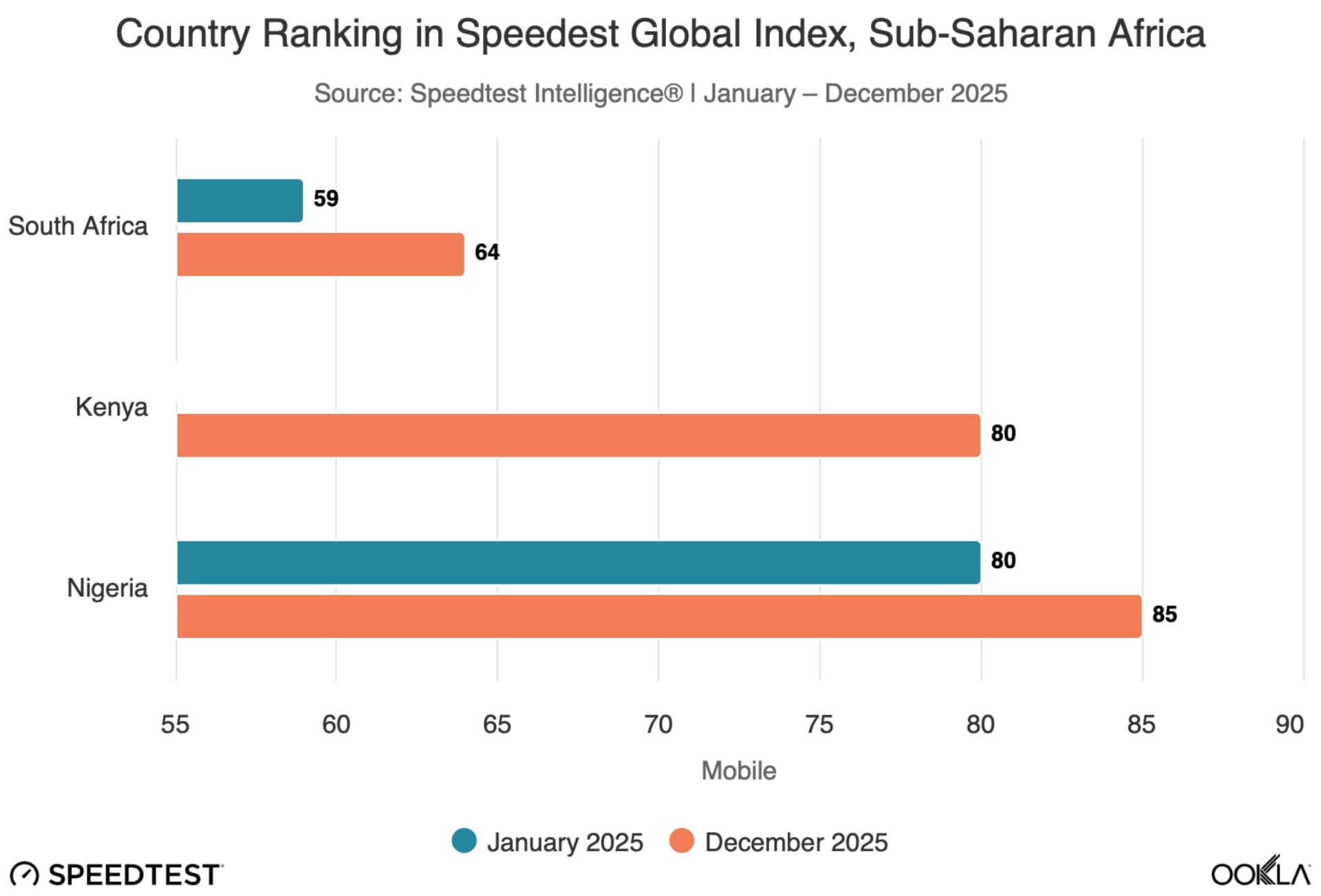
“Only South Africa (64th), Kenya (80th), and Nigeria (85th) made it to the top-100 list in December 2025,” noted Ookla in a release shared with Hypertext.
“The positions of South Africa and Nigeria dropped five and seven places, respectively, in 2025, with median download speeds of 65.7 Mbps and 44.14 Mbps by the end of the year. Kenya ranked 80th, recording a median download speed of 45.37 Mbps,” it added.
Zooming out, Ookla also noted that while the position of most MEA countries changed only slightly on the Index, there were a few significant jumps.
To that end, Morocco recorded the largest move, jumping 22 places on the mobile Index, followed by Algeria and Tunisia. The reason for this was the rollout of 5G in these countries during 2025.
“Oman also moved up five places to 18th, thanks to network investment, network refarming, and the activation of new carriers. On the fixed side, Algeria saw the largest jump, moving up 28 places, followed by Mauritania, which rose 24 places. Bahrain and Morocco improved by 16 and 11 places, respectively,” Ookla pointed out.
The company emphasised the role that 5G is playing when it comes to some traditionally slower countries leapfrogging others.
“5G and the modernization and expansion of existing infrastructure were the main levers for improving a country’s ranking in the MEA region. The North African sub-region, particularly, was a confluence of two events that shaped its performance in 2025: the launch of 5G and the continued expansion of fiber and accelerated adoption. In Bahrain, raising the minimum speed resulted in an increase in fixed median download speed,” it explained.
While the Sub-Saharan African region is falling behind others, the rollout of fibre has proved important, according to Ookla.
“On the fixed side, the picture is more diversified, reflecting the great progress made by SSA in terms of fiber deployment and adoption. Côte d’Ivoire is the highest-ranking country in SSA, taking the 103rd position in December 2025, with a median download speed of 58.17 Mbps. Omdia estimates that 10% to 15% of all country premises are covered with FTTP,” the company shared.
“While this is lower than other countries such as Senegal, South Africa, and Kenya, it outperformed them in median download speed. This could be because the user base is concentrated on relatively higher‑speed connections. In fact, Orange, the leading ISP, offers entry-level fixed broadband packages starting at 50 Mbps,” it continued.
With 5G being somewhat of a game changer in MEA last year, it looks like SSA still has work to do on that front, with only South Africa, Nigeria, and Kenya being outliers.
[Image – Photo by Jacques Nel on Unsplashacques]
Get the tech news you want to read. Take our reader survey and tell us how we can help you better.