


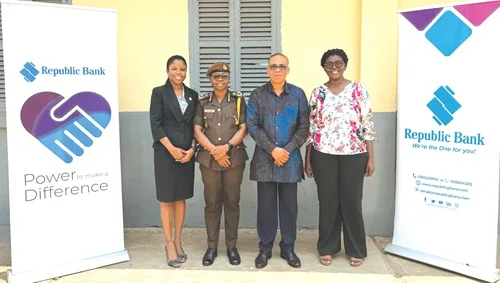
Fifty young people at the Senior Correctional Centre have completed a comprehensive financial capability programme designed to equip them with the knowledge, practical skills and resources needed to build productive and financially independent lives after their release.
The initiative, known as RESET — Rise to Economic Security, Empowerment and Transformation, was initiated by researchers from the University of North Carolina (UNC) in partnership with the University of Ghana’s Department of Social Work and the Senior Correctional Centre (SCC).
The Republic Bank (Ghana) PLC is the sole financial institution supporting the project.
Delivered through 12 structured modules, RESET combines research, rehabilitation, financial education and access to formal financial services to help participants make informed financial decisions and prepare for sustainable livelihoods.
The Lead Researcher on the project, Professor David Ansong of the University of North Carolina, said RESET addressed a critical aspect of the reintegration process.
“Successful reintegration requires more than rehabilitation within a correctional setting.
Young people also need the ability to make and act on financial decisions as they rebuild their lives after release,” he said.
That, Prof. Ansong explained, depended not only on knowledge and confidence, but also on access to financial services, resources and meaningful economic opportunities.
“RESET brings together these core elements of financial capability and asset building to help participants translate their skills and aspirations into sustainable livelihoods and greater economic independence,” he stated.
The project leadership team included a co-investigator at UNC, Emmanuel Amoako, and DSP Eugene Ohene-Tutu and CSP Helen Korkor Quarcoo, the resident project leads at the SCC, and Mrs Genevieve Aboney, the project lead at Republic Bank (Ghana) PLC.
Financial knowledge, opportunity
The programme, delivered by Republic Bank staff as volunteers, covered essential areas such as budgeting, saving, responsible borrowing, financial decision-making, entrepreneurship and planning for the future.
Beyond classroom learning, the bank opened accounts for all participating beneficiaries, providing them with formal access to financial services.
Each beneficiary will also receive seed funding to support the establishment of a small workshop or other livelihood activity upon release.
This support is intended to help participants translate the vocational skills acquired at the Senior Correctional Centre into viable income-generating ventures and sustainable livelihoods.
During an interaction with the participants upon completion, the Managing Director of Republic Bank (Ghana) PLC, Dr Benjamin Dzoboku, congratulated them on the milestone and encouraged them to apply their newly acquired knowledge as they prepared to reintegrate into society.
“RESET is fundamentally about second chances and the opportunity to begin again with purpose.
We want these young people to leave the centre not only with vocational skills, but also with the financial capability, confidence and practical support needed to build productive lives.
Their past should not define their future,” he said.
Dzoboku added that the provision of bank accounts and seed funding was critical to converting the participants’ acquired knowledge into meaningful economic activity.
“Financial inclusion must go beyond opening an account. It must empower people with the knowledge and opportunity to use financial services effectively, manage their resources responsibly and build sustainable livelihoods.”
“The seed funding will provide a practical starting point for participants to put the lessons and skills acquired through RESET into action,” he stated.
Strengthening rehabilitation, reintegration
The Officer-in-Charge of the Senior Correctional Centre, DDP Yayra Ashong-Mettle, said the initiative complemented the centre’s rehabilitation programmes by preparing participants for meaningful economic engagement after their release.
Dr Abena Ampomah of the University of Ghana’s Department of Social Work and Co-Principal Investigator of the project, highlighted the importance of translating academic research into interventions that addressed real social challenges.
“The RESET Project demonstrates how research, education and institutional collaboration can produce practical solutions for vulnerable populations.
By strengthening the financial capability of participants and connecting them to real economic opportunities, we are improving their prospects for sustainable reintegration,” she stated.
