


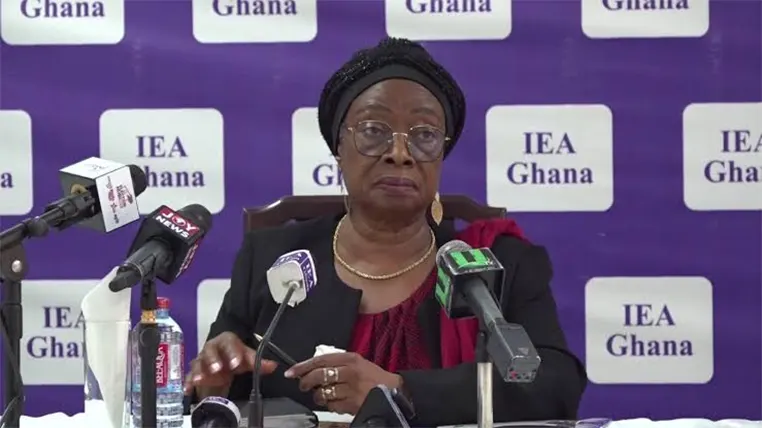
Justice Sophia Akuffo
The Institute of Economic Affairs (IEA) has rejected a proposal to extend the country’s presidential and parliamentary term from four to five years, arguing that the existing four-year mandate is adequate for elected governments to implement their programmes.
Former Chief Justice and Fellow of IEA, Justice Sophia Akuffo, made the position known in a presentation on the IEA’s views on key constitutional review proposals from the H. Kwesi Prempeh Constitution Review Committee and recommendations by the government.
She said extending the tenure of elected officials should only be considered based on “much more cogent and compelling evidence” that the current arrangement was insufficient.
“Four years is sufficient for an elected government to implement its programme, and extending the tenure of elected officials should not be undertaken without much more cogent and compelling evidence that the existing four-year mandate is inadequate,” she stated.
The IEA said any constitutional review process should be guided by a clear national vision and supported by institutional structures capable of promoting accountable, effective and democratic governance.
Removal of Judges
Touching on the removal of justices of the Superior Courts, the IEA supported the need for clearer procedures but argued that the current constitutional provisions, particularly those relating to the removal of the Chief Justice, were inadequate and could lead to political interference.
The Prempeh Committee proposed a more structured process for handling petitions, including preliminary determination of a prima facie case, suspension procedures, tribunals and timelines.
While the government agreed that greater clarity and efficiency were needed, it preferred addressing the matter through subsidiary legislation or procedural rules within the existing constitutional framework.
The IEA, however, called for a constitutional amendment to Article 146 to provide detailed procedures for the removal of Superior Court justices.
It said the process should draw lessons from international best practices, citing Kenya’s constitutional framework, where an independent Judicial Service Commission oversees the removal of judges and provides a detailed process for such action.
The Institute also recommended the introduction of intermediate disciplinary measures for judicial misconduct that may not necessarily require removal from office.
Supreme Court Composition
On the composition of the Supreme Court, the IEA supported the idea of placing a constitutional limit on the number of justices but questioned the proposed cap of 19 supported by the government.
It recommended a maximum of 15 justices, although it said any limit must be considered alongside the Court’s workload and jurisdiction.
The IEA said the size of the Court should be considered together with the volume and nature of cases it is constitutionally required to determine.
It added that a smaller number of Supreme Court justices would be reasonable if some appeals were allowed to end at the Court of Appeal, leaving the apex court to focus on constitutional matters and cases of exceptional legal importance.
MMDCEs Election
Although the IEA supported the election of all Metropolitan, Municipal and District Chief Executives (MMDCEs), it rejected the government’s proposal for candidates to be selected from five persons nominated by the President and shortlisted by a vetting committee.
The Prempeh Committee recommended a phased approach linked to the financial and administrative capacity of districts.
“The IEA supports the election of all MMDCEs but rejects presidential nomination of candidates. In the view of the IEA, all qualified citizens should be free to contest MMDCE elections in a non-partisan process.
“Local-level democracy will be strengthened when citizens, rather than the President, determine who may stand for election to lead in the district,” the Institute added.
Separation of Powers
The Institute also backed the recommendation to prevent Members of Parliament (MPs) from simultaneously serving as Ministers, Deputy Ministers or Regional Ministers.
It said separating executive and legislative roles would strengthen Parliament’s independence and oversight responsibilities.
While the government preferred addressing constitutional reforms to prevent Ministers, Deputy Ministers and MPs from serving on boards of State-Owned Enterprises (SOEs), the IEA also supported constitutional reforms to prevent such dual roles.
The Institute maintained that constitutional protection was necessary to ensure that the governance of State-Owned Enterprises was based on competence, professionalism, independence and accountability rather than political affiliation.
“The IEA’s call is for a principled, comprehensive and nationally owned constitutional reform process with the objective of creating a constitutional architecture that limits excessive executive power, strengthens Parliament and the Judiciary, deepens local-level democracy, professionalises public institutions through transparent merit-based processes, promotes continuity in national development planning and strengthens mechanisms for accountability,” it added.
By Ebenezer K. Amponsah
