



Kenya risks electricity cuts as reserve shrinks to 3.3pc
Households and businesses face the risk of electricity rationing and blackouts as consumption nears overtaking supply in what could trigger economic disruptions and costly use of diesel generators.
Kenya’s reserve margin – the extra generation capacity available above demand – has shrunk to less than 3.3 percent, which contrasts sharply to the range of between 20 percent and 35 percent that is recommended by the International Energy Agency (IEA).
This exposes the country to blackouts or power outages during maintenance of plants or during breakdowns of the electricity generators.
Kenya’s electricity demand has been rising steadily in recent months, but local generation capacity remains constrained.
Increased imports from Ethiopia and Uganda have also failed to keep pace with demand, narrowing the reserve margin from a peak of 20.73 percent in January to 3.34 percent in June, data from the Kenya National Bureau of Statistics (KNBS) shows.
Unstable supplies from wind and solar plants have also created a deficit that cannot be offset by the other plants, notably during peak evening hours.
Three wind plants, including the 310 megawatt (MW) Lake Turkana plant, and five solar plants account for 20 percent of the electricity supplied to Kenya Power.
The wind and solar plants currently lack battery storage to store electricity generated during their peak production, when wind speeds and solar radiation are highest, putting pressure on supplies during high consumption hours between 6 pm and 10 pm.
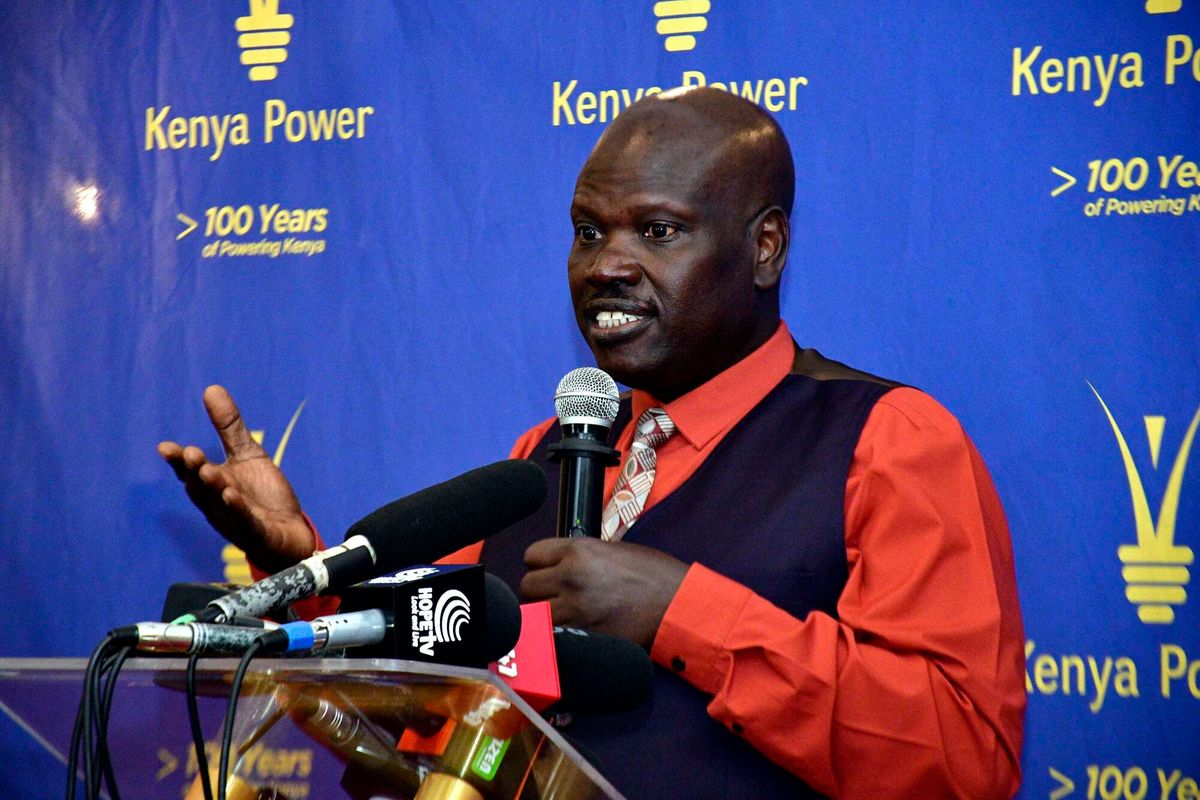
Kenya Power CEO Joseph Siror declined to comment on the trend and its implications, saying the utility was in a closed period or a period before the company publicly releases its financial results.
Energy Cabinet Secretary Opiyo Wandayi did not respond to our calls and messages by the time of going to press.
Kenya Power has on some occasions been forced to ration electricity in the wake of supply hitches from the wind and solar plants.
The forced rationing may put pressure on the government to compel wind and solar to install batteries to store excess power and when demand surges in the evening.
Restrictions on power purchase agreements (PPAs) since 2021 have also ground procurement of new power plants to a halt, forcing the country to rely on imports.
Kenya has been exchanging electricity with Uganda for decades.
The supply from Uganda is pivotal in supplying the Western region, which does not get supply from the country’s main power generation hub at Olkaria in Naivasha.
Kenya also started to import 200MW from Ethiopia in December 2022 following the signing of a PPA between their two utilities, which will double the imports from December.
Ethiopia generates surplus power from its 5,000MW Grand Ethiopian Renaissance Dam (GERD).
Power rationing increases the cost of doing business as firms and households seek generators to ease the inadequate electricity.
Economists reckon that prolonged rationing could hit growth as the electricity curbs running for hours on alternating days would squeeze productivity, triggering job cuts and pay freezes.
The country’s peak demand—the highest load on the electricity grid—has been rising over the past six years, hitting 2,316MW in the year ended June 2025 from 2,177MW a year earlier. Peak demand stood at 1,926MW six years ago.
The peak demand has continued to rise, with Kenya Power data putting the figure at 2,514 MW and 2,549 MW in June and July this year.
On December 4 last year, when demand peaked at the then high of 2,439.06MW, Kenya Power appealed for increased generation to “secure our reserve margins” as customer numbers and consumption rose.
Kenya Power’s 2025–2030 medium-term plan projects peak demand to grow at an average annual rate of five percent between 2026 and 2027, reaching 2,680 MW by 2027.
The difference between locally generated electricity and Kenya Power sales has moved from a surplus of 177.87 million kWh in January into a deficit of 21.21 million kWh and 99.85 million kWh in May and June this year, marking a rare occurrence in the country.
This underlines the importance of Ethiopia’s power for Kenya’s energy security.
Kenya Power has raised an alarm over the rapid uptake of variable renewable energy sources such as wind and solar, arguing that it was affecting the stability and reliability of the country’s electricity grid.
The utility says the share of variable renewable energy sources is more than 20 percent of total grid capacity, whereas global benchmarks recommend an upper limit of 15 percent.
During peak day demand, variable renewable energy can account for 34 percent of the energy mix, it added.
This mirrors the situation in other regions such as Europe, which have a high amount of renewable energy on the grid.
Elsewhere, operators can ask for less renewable power generation in a process called curtailment to keep the grid frequency stable and avoid transmission bottlenecks.
But under Kenya’s “take or pay” model, it has no choice but to pay for and dispatch the wind and solar.
Reported by Businessdailyafrica.
Read Original Report at businessdailyafrica.com ↗ WhatsApp
Comments (0)
No comments yet. Be the first to share your opinion!