


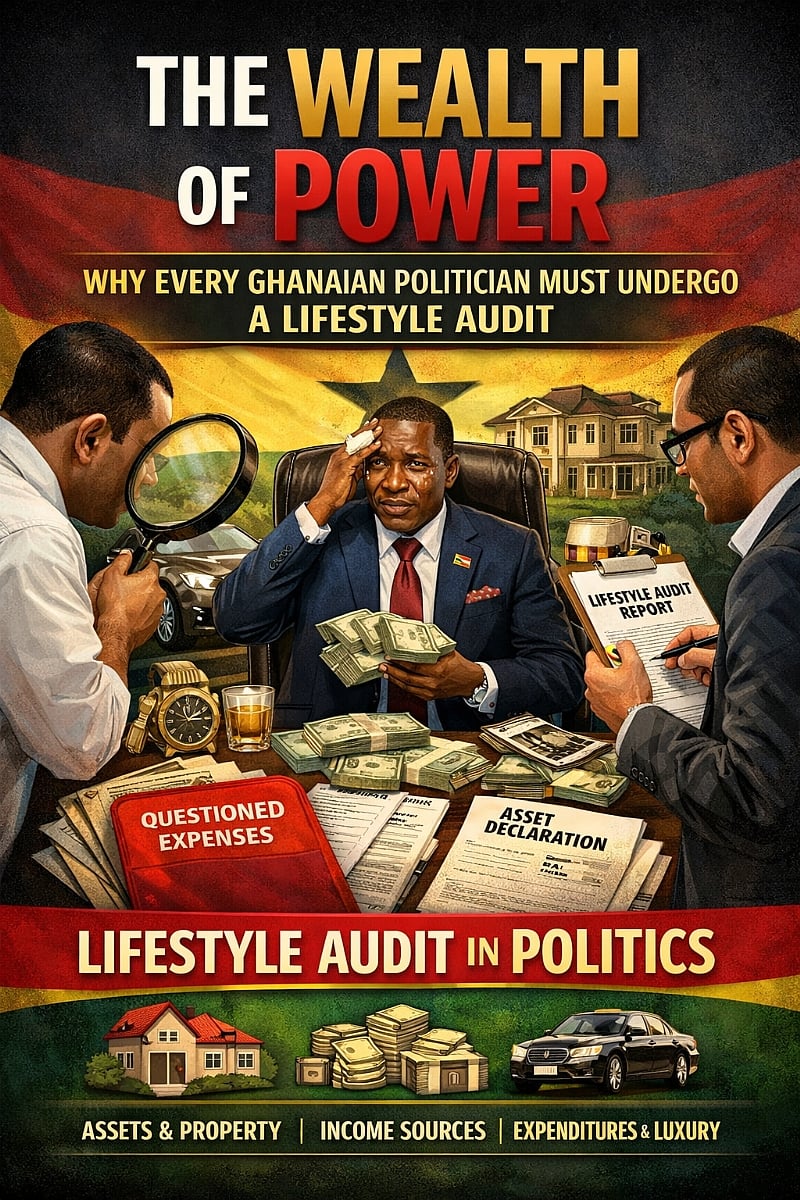
The Silent Crisis: How Public Office Became a Pathway to Unexplained Wealth
In the heart of every Ghanaian home, in the backseats of trotro vehicles, and in the late-night debates on social media, one question lingers unanswered:
How does a politician who once struggled to afford basic necessities suddenly own multiple mansions, luxury cars, and offshore accounts within a few years of taking office?
The irony is glaring: while Ghana’s citizens grapple with soaring costs of living, inadequate healthcare, crumbling infrastructure, and joblessness, a select few political leaders seem to thrive financially—often in ways that defy logic. The 2024 budget allocates billions to critical sectors like education and healthcare, yet the same politicians who oversee these funds frequently return from foreign trips in private jets, send their children to elite international schools, and own properties worth millions—all while their constituents wait for basic services.
This is not a conspiracy theory. It is a systemic failure of accountability. Ghana’s fight against corruption has historically been reactive—rooting out embezzlement after the fact—rather than proactive. But what if the solution lies not in chasing stolen funds, but in preventing their accumulation in the first place?
Enter the lifestyle audit—a rigorous, independent assessment that compares a politician’s declared assets, income, and expenditures against their public salary and official duties. Unlike traditional financial audits, which focus on institutional funds, lifestyle audits scrutinize the personal wealth trajectory of public officials, exposing the gap between their official earnings and their lavish lifestyles.
What Is a Lifestyle Audit, and Why Does Ghana Need It?
A lifestyle audit is a comprehensive, data-driven examination of a politician’s financial activities, designed to answer one critical question:
Can their wealth be reasonably explained by their legitimate income, or are there unexplained discrepancies?
This assessment goes beyond mere asset declarations. It examines:
- Income and Salary Transparency
- Verification of declared salaries, allowances, and bonuses against actual bank transactions.
-
Cross-checking with tax records to ensure no undeclared earnings.
-
Luxury Asset Acquisition
- Properties: Multiple residential and commercial properties (including overseas holdings) acquired during or after office.
- Vehicles: Private jets, luxury SUVs, and high-end cars purchased with public funds or unexplained sources.
-
[IMAGE_2] Example: A Member of Parliament (MP) earning a monthly salary of ₵10,000 declaring ownership of five properties worth over ₨5 million each.
-
Investments and Business Interests
- Sudden ownership of businesses, shares, or partnerships in companies awarded public contracts.
-
Conflicts of interest where political appointees benefit financially from decisions made in office.
-
Travel and Expenditure Patterns
- Frequent international trips on government expense, often accompanied by spouses and children.
-
Use of public funds for private vacations, luxury hotels, or exclusive dining.
-
Family and Dependents’ Wealth
- Children studying in elite foreign universities (e.g., Oxford, Harvard) despite parents’ declared incomes.
-
Spouses or relatives acquiring assets while the politician holds public office.
-
Gifts, Donations, and Undeclared Income
- Receipt of cash gifts, loans, or “donations” from businesses awarded public contracts.
-
Use of shell companies or offshore accounts to hide wealth.
-
Digital Footprint Analysis
- Social media posts, property listings, and public records showing lavish lifestyles inconsistent with official earnings.
A lifestyle audit does not assume guilt—it demands explanation. If a politician’s wealth cannot be logically justified by their salary, allowances, and declared assets, the audit triggers further investigation. This is not about punishment; it is about restoring public trust.
The Moral and Economic Cost of Unchecked Political Wealth
Ghana’s political class is not just wealthy—it is disproportionately wealthy. Studies show that in many developing nations, politicians accumulate wealth at rates far exceeding those of private-sector entrepreneurs. Yet, while business owners take risks, invest in ventures, and sometimes fail, politicians guarantee financial security through public office.
Consider these disturbing trends:
- The Mansion Paradox: Some politicians live in sprawling estates with private security, swimming pools, and gated communities while their constituents live in slums with no running water.
- The Education Divide: Children of politicians attend boarding schools in the UK or US, while Ghanaian students struggle with overcrowded classrooms and outdated textbooks.
- The Infrastructure Hypocrisy: Roads leading to a politician’s home are paved and well-lit, yet neighboring communities remain in darkness due to uncompleted electrification projects.
- The Post-Office Richness: Many politicians leave office wealthier than when they entered, despite no evidence of entrepreneurial success.
These contradictions are not isolated incidents. They are systemic, fueled by a culture where public office is treated as a personal ATM rather than a sacred trust.
Economically, the cost is devastating:
– Wasted Resources: Billions meant for healthcare, education, and agriculture are diverted into private pockets.
– Deterred Investment: Foreign and local investors hesitate to commit capital to Ghana when corruption remains unchecked.
– Stunted Development: Countries with high political corruption grow 20% slower than their peers (World Bank, 2023).
How Lifestyle Audits Can Transform Ghana’s Democracy
Lifestyle audits are not a silver bullet, but they are a necessary tool in the fight against corruption. When implemented correctly, they can:
1. Restore Public Accountability
- Politicians will think twice before misusing public funds if they know their assets are under constant scrutiny.
- Example: If an MP’s declared salary is ₨12,000/month but their bank records show ₨50,000/month deposits from unexplained sources, an audit would flag this for investigation.
2. Improve Allocation of Public Funds
- Money allocated to schools, hospitals, and roads would be less likely to disappear into private accounts.
- Transparency ensures that every kedi spent on public projects is accounted for.
3. Boost Investor Confidence
- Ghana’s credit rating and Ease of Doing Business score would improve if investors perceived the political class as accountable.
- Countries like Estonia and New Zealand, which enforce strict asset declarations, attract more foreign direct investment (FDI).
4. Rebuild Trust in Leadership
- A 2023 Afrobarometer survey revealed that only 28% of Ghanaians trust their government. Lifestyle audits would demonstrate that leaders are answerable to the people, not just the law.
5. Deter Corruption Before It Happens
- Corruption thrives in secrecy. Audits expose financial irregularities before they escalate into scandals.
- Example: If a minister’s family suddenly owns a luxury hotel in Accra, an audit would investigate whether this was funded by public contracts.
Why Some Politicians Resist Lifestyle Audits—and Why They’re Wrong
Critics of lifestyle audits often raise valid concerns, but these can be addressed with strong safeguards:
- “It’s an Invasion of Privacy.”
- Rebuttal: Public office is not private. Politicians earn their salaries from taxpayers. Their financial dealings are public business.
-
Solution: Audits should focus on publicly verifiable records (bank statements, property deeds, tax filings) rather than personal finances.
-
“It’s Politically Motivated.”
- Rebuttal: Audits should be conducted by independent institutions (e.g., a Lifestyle Audit Commission) with neutral judges.
-
Solution: Implement random audits—not targeting specific individuals but rotating across all politicians to prevent bias.
-
“Asset Declarations Already Exist.”
- Rebuttal: Current declarations are voluntary, inconsistent, and unverified. Many politicians underreport assets or submit fake documents.
-
Solution: Mandatory, real-time audits with cross-checking against global databases (e.g., Panama Papers leaks, offshore registry records).
-
“It Will Scare Away Honest Leaders.”
- Rebuttal: If a politician’s wealth is legitimately earned, they have nothing to fear. The audit becomes a badge of transparency.
- Solution: Publicize successful audits—celebrate politicians whose wealth aligns with their earnings to encourage integrity.
How Ghana Can Implement Effective Lifestyle Audits
For lifestyle audits to work, Ghana must adopt a multi-layered, technology-driven approach:
1. Pre-Office Declarations
- Before assuming office, politicians must submit:
- Bank account statements (local and offshore).
- Property ownership records (including family members).
- Business interests and shareholdings.
- Tax compliance history (past 10 years).
- Verification: Cross-check with land registry databases, tax authorities, and global financial transparency tools.
2. Real-Time Monitoring During Office
- Independent institutions (e.g., a Lifestyle Audit Agency) should track:
- Major asset purchases (properties, vehicles, investments).
- Business dealings with government contracts.
- International travel (expense reports vs. actual spending).
- Family wealth accumulation (e.g., children’s education funds).
- Automated alerts for suspicious transactions (e.g., sudden large deposits from shell companies).
3. Post-Office Exit Audits
- Within 30 days of leaving office, politicians must submit:
- Final asset declaration (comparing pre- and post-office wealth).
- Explanation for any unexplained increases.
- Penalties for non-compliance: Fines, asset forfeiture, or criminal charges for false declarations.
4. Digital Transparency Portal
- A publicly accessible database where citizens can:
- View real-time asset declarations of politicians.
- Track wealth changes over time.
- Report suspicious activities (e.g., a politician suddenly owning a yacht).
- Example: The UK’s Register of Beneficial Ownership or Singapore’s Corrupt Practices Investigation Bureau (CPIB).
5. Whistleblower Protections
- Encourage citizens and civil society to report suspicious wealth accumulation with anonymity guarantees.
- Rewards for credible tips (e.g., a percentage of recovered funds).
Global Precedents: Countries That Have Succeeded with Lifestyle Audits
Ghana is not alone in demanding accountability. Several nations have implemented lifestyle audit-like mechanisms with remarkable success:
| Country | Mechanism | Results |
|——————-|—————————————-|—————————————————————————–|
| Estonia | Digital Asset Declaration System | 98% of politicians declare assets; corruption dropped by 40% (Transparency International). |
| New Zealand | Public Officials Ethics Act | Mandatory asset declarations for MPs; no major scandals in 20 years. |
| Singapore | Corrupt Practices Investigation Bureau (CPIB) | Prosecutes politicians for unexplained wealth; zero-tolerance policy. |
| Latvia | Lifestyle Audit for Judges & MPs | 20% of audited officials faced investigations for undeclared assets. |
| Uganda | Asset Declaration & Verification | ₨1.2 billion recovered from corrupt officials since 2018. |
These examples prove that when politicians know they are being watched, corruption declines.
The Public’s Demand: Ghanaians Are Watching
The frustration among ordinary Ghanaians is palpable. In town hall meetings, social media debates, and radio discussions, citizens repeatedly ask:
- Why do politicians drive in luxury cars after campaigning in old vehicles?
- Why do their children attend foreign universities while Ghanaian students lack textbooks?
- Why are public projects abandoned while politicians build private estates?
- Why is corruption more profitable than entrepreneurship?
The answer is simple: Because they can.
But the tide is turning. Grassroots movements like #FixTheCountry, #StopTheSteal, and #AccountabilityNow are gaining traction. Ghanaians are no longer willing to accept unexplained wealth as normal.
A 2023 Ghanaian Public Opinion Poll revealed:
– 72% support mandatory lifestyle audits for politicians.
– 68% believe corruption is the biggest threat to Ghana’s development.
– 85% want stronger penalties for illicit enrichment.
The message is clear: Ghanaians want leaders who serve, not steal.
The Path Forward: A New Era of Transparency
Ghana’s journey toward true accountability must begin with three critical steps:
- Legislative Reform
- Pass a Lifestyle Audit Act mandating pre-, during-, and post-office declarations.
-
Establish an independent Lifestyle Audit Commission (not under the presidency or parliament).
-
Technological Enforcement
- Integrate AI and blockchain to automate asset tracking and detect anomalies.
-
Partner with global financial transparency organizations (e.g., Open Ownership, Transparency International).
-
Public Participation
- Launch a citizen reporting hotline for suspicious wealth.
- Publicize audit results—good and bad—to encourage competition for integrity.
The Ultimate Question: Can Ghana Develop Without Accountability?
Ghana is not poor in resources. It is poor in leadership.
- Oil, gold, and cocoa lie beneath its soil.
- Talented Ghanaians work in every sector.
- Opportunities abound for those who play by the rules.
But without accountability, these advantages are squandered. Every ₨100 million stolen from the National Health Insurance Scheme (NHIS) is a ₨100 million less for vaccines, doctors, and hospitals.
Every ₨500 million embezzled from the Education Trust Fund is a ₨500 million less for schools, teachers, and textbooks.
Lifestyle audits are not about punishing politicians. They are about protecting Ghana’s future.
If a politician’s wealth is honestly earned, they have nothing to fear. But if public office has become a pathway to unexplained riches, then every Ghanaian deserves to know.
The real question is no longer whether Ghana needs lifestyle audits.
The question is: If politicians have nothing to hide, why should they fear transparency?
Final Thought:
“A nation’s greatness is measured not by the wealth of its leaders, but by the prosperity of its people. Lifestyle audits are not a tool of suspicion—they are a tool of trust.”
