


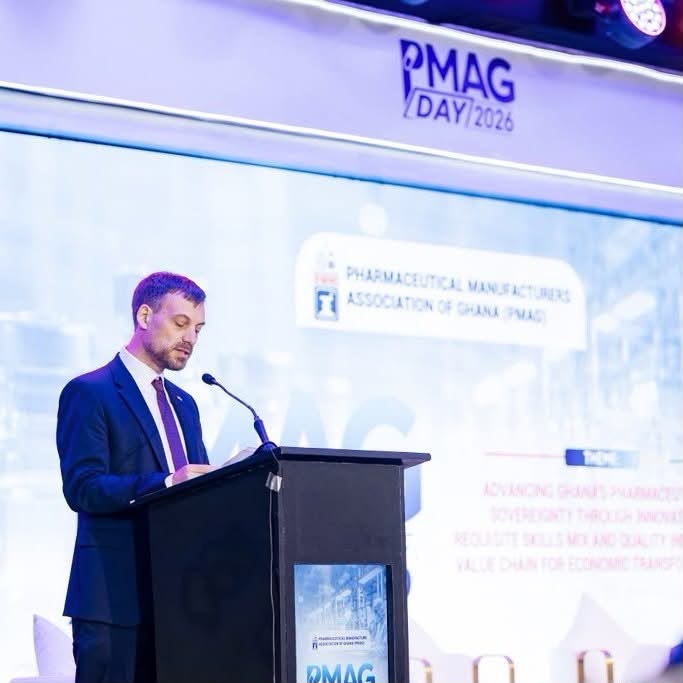
Ghana’s pharmaceutical sector is at a critical juncture, with stakeholders emphasizing the urgent need for pharmaceutical sovereignty to enhance the nation’s health security, economic resilience, and industrial growth. The 2026 Pharmaceutical Manufacturers Association of Ghana (PMAG) Day, held in Accra to commemorate the association’s 27th anniversary, served as a platform for in-depth discussions on how local drug production can transform Ghana’s healthcare landscape.
Under the thematic focus of “Building a Resilient and Competitive Pharmaceutical Industry,” the event brought together policymakers, industry leaders, researchers, and international partners to explore strategies for expanding domestic pharmaceutical manufacturing, improving innovation, and ensuring sustainable access to essential medicines. The discussions underscored the necessity of a self-reliant pharmaceutical sector as a cornerstone of Ghana’s broader economic and health security goals.
The Imperative of Pharmaceutical Sovereignty
A strong domestic pharmaceutical industry is vital for Ghana’s ability to respond to health emergencies, reduce dependency on imports, and ensure consistent supply chains. The event highlighted that reliance on foreign pharmaceutical imports exposes the country to vulnerabilities, including supply chain disruptions, price fluctuations, and geopolitical risks. By investing in local manufacturing, Ghana can achieve greater autonomy in healthcare delivery, particularly in critical areas such as vaccines, antibiotics, and chronic disease treatments.
Participants emphasized that pharmaceutical sovereignty is not merely an economic strategy but a strategic imperative for national security. The COVID-19 pandemic demonstrated how global health crises can strain healthcare systems, leading to shortages of essential drugs and medical supplies. Strengthening local production capabilities would enable Ghana to mitigate such risks and ensure that citizens have timely access to life-saving medications.
Key Strategies for a Resilient Pharmaceutical Sector
The PMAG Day discussions centered on five critical pillars for developing a competitive and innovative pharmaceutical industry:
- Enhancing Innovation and Research
- Ghana’s pharmaceutical sector must invest in research and development (R&D) to develop locally relevant medicines, particularly for neglected tropical diseases, malaria, and non-communicable diseases (NCDs).
- Strengthening collaboration between academia, research institutions, and private manufacturers can accelerate drug discovery and formulation.
-
The event called for government incentives, such as tax breaks for R&D investments and funding for clinical trials, to encourage pharmaceutical companies to innovate within Ghana.
-
Upskilling the Workforce
- A skilled pharmaceutical workforce is essential for quality manufacturing, regulatory compliance, and technological advancement.
- The discussions stressed the need for vocational training programs, certifications, and partnerships with international institutions to bridge skill gaps in areas like pharmaceutical engineering, quality control, and biotechnology.
-
Apprenticeships and industry-academia collaborations were proposed as effective ways to nurture talent and ensure a future-ready workforce.
-
Improving Quality Standards and Regulatory Frameworks
- Stringent quality control is non-negotiable in pharmaceutical manufacturing to prevent counterfeit drugs and ensure patient safety.
- The event advocated for strengthening Ghana’s regulatory bodies, such as the Food and Drugs Authority (FDA), to enforce international standards (e.g., Good Manufacturing Practices – GMP, Good Clinical Practices – GCP).
-
Third-party audits and certification programs were recommended to boost consumer confidence in locally produced medicines.
-
Attracting Investment and Public-Private Partnerships
- Foreign and domestic investment is crucial for scaling up pharmaceutical production and introducing advanced manufacturing technologies.
- The government was urged to simplify business regulations, offer tax incentives, and provide land for industrial parks to encourage pharmaceutical companies to establish operations in Ghana.
-
Public-private partnerships (PPPs) were identified as a key mechanism to leverage government funding with private sector expertise, particularly in vaccine and generic drug production.
-
Strengthening Collaboration Across the Value Chain
- A coordinated approach involving manufacturers, distributors, healthcare providers, and policymakers is essential for efficient supply chain management.
- Digital health initiatives, such as electronic medical records and real-time inventory tracking, can reduce wastage and improve distribution efficiency.
- Regional and international collaborations were highlighted as strategic opportunities to share best practices, access advanced technologies, and expand market reach.
International Support and Global Partnerships
The event featured high-level representations from development partners, including:
– Kwabena Mintah Akandoh, the Minister for Health, who reiterated the government’s commitment to prioritizing pharmaceutical manufacturing as part of Ghana’s industrialization agenda.
– Augustus Goosie Tanoh, the Presidential Advisor on the 24-Hour Economy, who stressed the need for policy alignment to support Ghana’s pharmaceutical sector within the broader economic transformation framework.
– Rune Skinnebach, the European Union Ambassador to Ghana, who underscored the EU’s long-term partnership in strengthening Ghana’s pharmaceutical ecosystem.
– Daniel Boehme, the Deputy Head of Cooperation at the German Embassy, who announced Germany’s continued support through the PharmaVax Ghana Programme, a joint initiative with the European Union implemented by GIZ (Deutsche Gesellschaft für Internationale Zusammenarbeit).
The PharmaVax Ghana Programme is a key component of the Team Europe Initiative on Manufacturing and Access to Vaccines, Medicines, and Health Technologies in Africa (MAV+). This €100 million initiative aims to:
– Expand Ghana’s vaccine and medicine production capacity.
– Strengthen regulatory frameworks to meet international standards.
– Promote innovation and technology transfer in pharmaceutical manufacturing.
– Enhance regional collaboration to boost Africa’s collective health security.
The German Embassy congratulated PMAG for facilitating this critical dialogue and reaffirmed its commitment to supporting Ghana’s journey toward pharmaceutical sovereignty. The embassy emphasized that international cooperation remains indispensable in addressing transnational health threats, such as antimicrobial resistance, pandemics, and emerging infectious diseases.
The Path Forward: A Vision for Ghana’s Pharmaceutical Future
The PMAG 2026 Day served as a call to action for all stakeholders to accelerate efforts toward a self-sufficient pharmaceutical industry. The key takeaways include:
✅ Prioritizing local manufacturing to reduce import dependency and strengthen health security.
✅ Investing in R&D and innovation to develop homegrown solutions for Ghana’s health challenges.
✅ Upskilling the workforce to ensure a competent and adaptable pharmaceutical sector.
✅ Strengthening regulatory and quality standards to guarantee safe and effective medicines.
✅ Fostering public-private partnerships to attract investment and leverage expertise.
✅ Leveraging international partnerships to access funding, technology, and best practices.
As Ghana moves toward industrialization and economic diversification, the pharmaceutical sector stands as a pillar of national development. By embracing pharmaceutical sovereignty, the country can not only secure its health future but also position itself as a regional leader in medicine production, contributing to African health security and global health equity**.
The PMAG 2026 Day was a testament to the sector’s potential, and with unified efforts, Ghana can transform its pharmaceutical landscape into a model of resilience, innovation, and self-reliance.
