


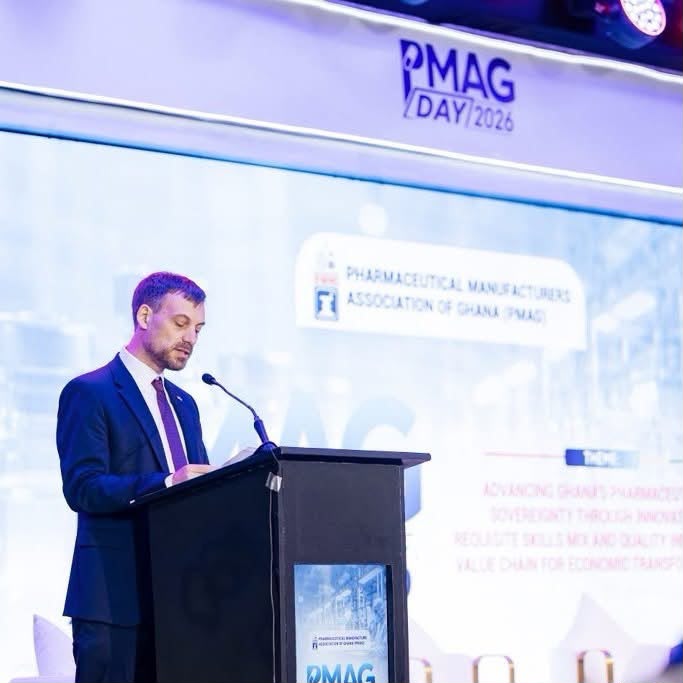
Ghana’s pharmaceutical sector is at a critical juncture, with stakeholders advocating for pharmaceutical sovereignty as a cornerstone for enhancing the nation’s health security, economic resilience, and industrial development. The 2026 Pharmaceutical Manufacturers Association of Ghana (PMAG) Day, held in Accra to commemorate the association’s 27th anniversary, served as a platform for in-depth discussions on how local drug manufacturing can address systemic challenges in medicine accessibility, quality, and national preparedness.
Under the thematic focus of “Building a Resilient and Competitive Pharmaceutical Industry,” the event brought together policymakers, industry leaders, researchers, and international partners to explore strategic interventions that could transform Ghana’s pharmaceutical landscape. Key priorities included innovation acceleration, skill development, quality assurance, foreign investment attraction, and cross-sectoral collaboration—all aimed at reducing reliance on imports and fortifying the country’s response to health crises.
A Call for Localized Pharmaceutical Production
The discussions underscored the urgent need for expanded local manufacturing of vaccines, essential medicines, and medical supplies. Currently, Ghana imports a significant portion of its pharmaceutical needs, leaving the health system vulnerable to supply chain disruptions, price fluctuations, and geopolitical tensions. By investing in domestic production, stakeholders argue, Ghana can achieve:
– Cost efficiency through reduced import dependency.
– Faster response times during emergencies, such as pandemics or outbreaks.
– Job creation and industrial diversification, aligning with Ghana’s broader economic goals.
The Minister for Health, Kwabena Mintah Akandoh, emphasized the government’s commitment to strengthening the pharmaceutical value chain, citing initiatives like the National Health Insurance Scheme (NHIS) and regulatory reforms to ensure affordable, high-quality medicines for all Ghanaians. He highlighted the need for public-private partnerships (PPPs) to bridge funding gaps and attract foreign direct investment (FDI) in the sector.
International Partnerships and Development Support
The event featured contributions from high-level diplomats and development partners, reinforcing the role of global cooperation in Ghana’s pharmaceutical journey. The European Union (EU) Ambassador to Ghana, Rune Skinnebach, and the German Embassy’s Deputy Head of Cooperation, Daniel Boehme, shared insights on ongoing initiatives designed to bolster Ghana’s pharmaceutical ecosystem.
A key highlight was the PharmaVax Ghana Programme, a joint EU-Germany venture implemented by GIZ (Deutsche Gesellschaft für Internationale Zusammenarbeit). This programme, part of the Team Europe Initiative on Manufacturing and Access to Vaccines, Medicines, and Health Technologies in Africa (MAV+), aims to:
– Strengthen Ghana’s vaccine and medicine production capacity.
– Enhance regulatory frameworks for quality control.
– Promote innovation through research and development (R&D) collaborations.
– Train local workforce in advanced pharmaceutical technologies.
The German Embassy reaffirmed its long-term commitment to supporting Ghana’s pharmaceutical sovereignty, stating that infectious diseases and health emergencies know no borders. By fostering regional and international partnerships, Ghana can leverage shared expertise, technology transfer, and financial resources to build a self-sustaining pharmaceutical industry.
Key Challenges and Pathways Forward
While the vision for a resilient pharmaceutical sector is clear, several critical challenges must be addressed:
1. Infrastructure Gaps – Limited access to modern manufacturing facilities, cold chain logistics, and energy stability hinders large-scale production.
2. Regulatory Hurdles – Stricter Good Manufacturing Practice (GMP) compliance and intellectual property (IP) protections are necessary to attract investors but require streamlined processes.
3. Human Capital Shortages – There is a critical need for specialized training in pharmaceutical engineering, clinical research, and quality assurance.
4. Market Access and Affordability – Ensuring subsidized pricing for essential medicines while maintaining profitability for local producers remains a balancing act.
5. Supply Chain Resilience – Diversifying raw material sourcing and distribution networks can mitigate risks from global disruptions.
To overcome these obstacles, stakeholders proposed:
– Government incentives such as tax holidays, grants, and low-interest loans for pharmaceutical startups.
– Public-private-academia collaborations to accelerate R&D and technology adoption.
– Regional integration through West African Health Organization (WAHO) frameworks to share best practices and bulk procurement of inputs.
– Digital transformation in pharmaceutical tracking and counterfeit prevention using blockchain and AI.
The Role of Academia and Research
Representatives from universities, research institutions, and innovation hubs stressed the importance of science-driven solutions in pharmaceutical development. Institutions like the Kwame Nkrumah University of Science and Technology (KNUST), University of Ghana, and Noguchi Memorial Institute for Medical Research were highlighted for their contributions in drug discovery, biotechnology, and clinical trials.
A notable example is the Ghana Vaccines and Immunization Programme (GVIP), which has seen local production of vaccines such as yellow fever and pneumococcal vaccines, reducing dependency on external suppliers. Expanding such initiatives could position Ghana as a regional hub for pharmaceutical innovation.
Conclusion: A Blueprint for the Future
The PMAG Day 2026 served as a call to action for all stakeholders—government, industry, academia, and international partners—to collectively advance Ghana’s pharmaceutical sovereignty. By prioritizing local manufacturing, innovation, and strategic partnerships, the country can achieve:
✔ Enhanced health security through reduced vulnerability to global shortages.
✔ Economic empowerment via job creation and industrial growth.
✔ Global leadership in African pharmaceutical development.
As the Team Europe Initiative (MAV+) and other development programs continue to provide technical and financial support, Ghana stands at the precipice of a pharmaceutical revolution. The success of this transformation, however, hinges on sustained political will, private sector engagement, and a culture of continuous improvement—ensuring that Ghana’s health system remains resilient, innovative, and self-reliant in the decades to come.
