


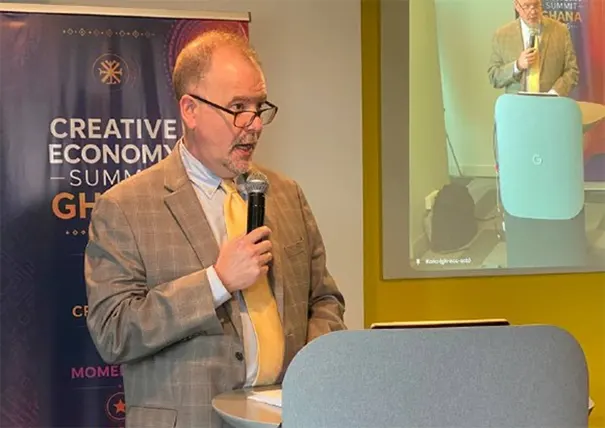
The creative sector in Ghana stands at the precipice of unprecedented growth, yet its full potential remains untapped due to systemic challenges in policy, infrastructure, and market access. At the Creative Economy Summit held at the Google AI Community Center in Accra, representatives from the U.S. Embassy in Ghana emphasized the critical role of government intervention in fostering an enabling environment for the industry. Rolf Olson, Chargé d’Affaires at the U.S. Embassy, underscored that strategic policy reforms, robust infrastructure, and international partnerships are essential for Ghana to harness the economic and cultural value of its creative industries.
The Government’s Role in Unlocking Creative Sector Potential
Olson highlighted that government policies—particularly those governing taxation, intellectual property (IP) protection, production financing, and contract enforcement—are pivotal in determining whether Ghana can maximize the revenue from its cultural exports. He stressed that without these safeguards, foreign investors, including American companies, may hesitate to engage in the market, fearing instability or inadequate legal protections for creators.
“To the government officials, you hold the pen on the policies, tax structures, IP protections, and production financing that determine whether Ghana captures the full value of its own cultural exports,” Olson stated. “Contract sanctity matters, and we need to ensure that creators are paid fairly for their work.”
The Chargé d’Affaires further warned that without strong IP laws, Ghana risks losing revenue from its creative output, as foreign platforms and distributors may exploit loopholes to avoid remunerating local talent. Similarly, tax incentives for production companies and financial support mechanisms for filmmakers, musicians, and digital content creators could stimulate investment and job creation within the sector.
Global Demand for Authentic Storytelling: Ghana’s Untapped Opportunity
The summit explored how Ghana’s rich cultural narratives—rooted in its history, traditions, and contemporary experiences—present a goldmine for global audiences. Olson cited the success of Nollywood, Africa’s largest film industry, and the growing popularity of African content on streaming platforms like Netflix, Amazon Prime, and HBO Max as proof of the sector’s potential.
“Good storytelling transcends borders—whether it’s set in Denmark, India, or Ghana, audiences worldwide connect with narratives that resonate,” Olson remarked. “The demand for authentic, culturally rich content is rising, and Ghana is uniquely positioned to capitalize on this trend.”
He noted that platforms are increasingly seeking diverse, locally inspired stories to fill gaps in global entertainment. Ghana’s music, film, fashion, and digital media industries could attract foreign investment, licensing deals, and franchise opportunities if structured correctly. However, Olson warned that without scalable infrastructure, Ghana risks missing out on these opportunities.
Empowering Creators and Investors for Long-Term Growth
Beyond policy, Olson called on creative professionals to own their narratives and advocate for fair compensation. “Insist that your story be told in your own voice,” he urged, emphasizing the importance of authenticity in content creation. He also stressed the need for early-stage investment in production facilities, digital platforms, and training programs to ensure Ghana’s creative workforce can compete globally.
“Like any other sector, the creative industry creates jobs, builds competitive advantage, attracts investment, and fosters entrepreneurship and innovation,” Olson stated. “But to sustain this growth, we need infrastructure that allows creators to work at scale—from post-production studios to distribution networks.”
The summit also highlighted the role of international collaboration in accelerating Ghana’s creative economy. The U.S. Embassy expressed a commitment to strengthening bilateral ties through cultural exchanges, investor forums, and joint ventures that could bridge gaps in funding, technology, and market access.
A Summit as a Catalyst for Change
Describing the event as a “starting point”, Olson emphasized that the discussions at the summit were meant to spark deeper engagement between Ghanaian and American creative sectors. He noted that economic opportunities abound for those who can leverage Ghana’s creative assets while ensuring fair remuneration for creators and attracting sustainable investment.
“The Embassy remains dedicated to working with the government, creatives, and investors to build a stronger relationship through the arts,” Olson concluded. “This is not just about cultural exchange—it’s about economic empowerment, job creation, and positioning Ghana as a leader in Africa’s creative revolution.”
As Ghana continues to refine its creative economy strategy, the success of initiatives like the Creative Economy Summit will depend on government commitment, private sector investment, and global partnerships—all of which must align to turn the country’s cultural wealth into economic prosperity.
