


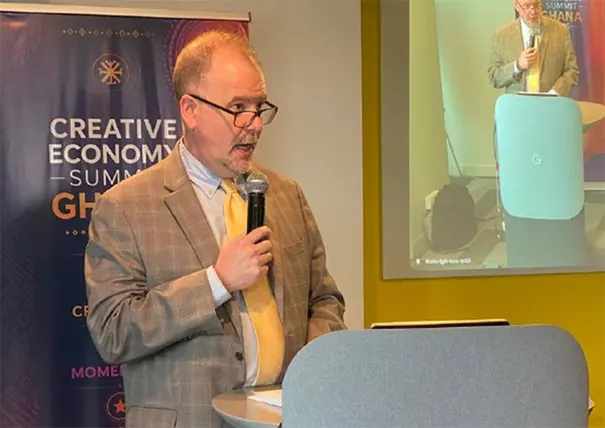
Ghana’s creative sector stands at the precipice of unprecedented growth, yet its full potential remains untapped without strategic investments in policy frameworks, infrastructure, and global market integration. At the Creative Economy Summit held at the Google AI Community Center in Accra, diplomats, policymakers, and industry leaders convened to discuss how Ghana can harness its rich cultural heritage into a thriving economic engine. Central to these discussions was the call for the government to build a robust ecosystem that fosters innovation, protects intellectual property (IP), and attracts both domestic and international investment.
The Government’s Role in Unlocking the Creative Sector’s Potential
Rolf Olson, Chargé d’Affaires of the U.S. Embassy in Ghana, emphasized that the government holds the critical keys to unlocking job creation, foreign investment, and global competitiveness within the creative industries. His remarks underscored the necessity of well-designed policies, tax incentives, IP protections, and accessible financing mechanisms to ensure Ghana captures the full economic value of its cultural exports.
“To the government officials, you hold the pen on the policies, tax structures, IP protections, and production financing that determine whether Ghana captures the full value of its own cultural exports,” Olson stated. “Contract sanctity matters, and we need to ensure that creators are paid fairly for their efforts.”
The stakes are high: without a legal and financial framework that safeguards creators’ rights and encourages investment, Ghana risks losing out on revenue streams that could otherwise fuel economic diversification. Olson’s remarks highlighted the need for clear, enforceable contracts and streamlined payment systems to prevent exploitation and ensure fair compensation for artists, writers, filmmakers, and musicians.
Global Demand for Authentic Storytelling: A Golden Opportunity
The global appetite for culturally rich, authentic storytelling has never been stronger. Platforms like Netflix, Amazon Prime, and YouTube have demonstrated the commercial viability of international content, with Nollywood—Nigeria’s film industry—serving as a prime example of how African storytelling can achieve global success.
Olson pointed to the universal appeal of compelling narratives, regardless of origin:
“Good storytelling resonates anywhere in the world… How many different countries can you end up watching a show from because it’s simply well-made and set in Denmark, India, or Ghana?”
This observation underscores a massive untapped market for Ghanaian content—whether in film, music, literature, or digital media. However, realizing this potential requires more than just talent; it demands infrastructure, funding, and a supportive regulatory environment that allows creators to produce high-quality work at scale.
Empowering Creators: Voice, Ownership, and Early Investment
Beyond policy, Olson urged creative professionals to reclaim narrative control over their work. He stressed the importance of “insisting that your story be told in your own voice”—a call for cultural authenticity in an industry often dominated by foreign interests.
Simultaneously, he appealed to investors and financial institutions to allocate capital early in the creative sector’s development. Just as tech startups require seed funding to grow, Ghana’s creative industries need infrastructure investments—such as production studios, digital platforms, and distribution networks—to enable creators to work efficiently and competitively.
“Like any other sector, this sector creates jobs, builds competitive advantage, attracts investment, and supports entrepreneurship and innovation,” Olson noted. “The time to act is now.”
A Blueprint for Bilateral Collaboration
The summit was framed as a starting point for deeper Ghana-U.S. collaboration in the creative economy. The U.S. Embassy has expressed a commitment to working alongside Ghanaian policymakers, creatives, and investors to strengthen bilateral ties through the arts, fostering an environment where innovation, entrepreneurship, and economic growth thrive.
Key areas of focus include:
– Policy alignment to protect IP and simplify tax structures for creative businesses.
– Investment facilitation to ensure early-stage funding for emerging talents.
– Market expansion through partnerships that enhance Ghanaian content’s global reach.
– Capacity building to equip creators with the skills needed for digital and international markets.
The Path Forward: Building a Sustainable Creative Ecosystem
For Ghana to fully leverage its creative sector, a multi-stakeholder approach is essential. This includes:
1. Government Initiatives – Implementing tax breaks for creative businesses, IP protection laws, and public-private partnerships to fund large-scale productions.
2. Investor Engagement – Encouraging foreign and domestic investors to allocate resources to infrastructure, training, and distribution.
3. Creator Empowerment – Providing legal support, financial literacy programs, and networking opportunities to help artists monetize their work effectively.
4. Global Market Integration – Strengthening digital platforms, co-production deals, and international distribution channels to ensure Ghanaian content reaches global audiences.
Conclusion: A Sector Poised for Transformation
Ghana’s creative industry is not just an economic opportunity—it is a cultural and national asset. With the right policies, investments, and collaborative efforts, the sector can generate millions in revenue, create thousands of jobs, and position Ghana as a leader in Africa’s creative economy.
The Creative Economy Summit served as a call to action, reinforcing that now is the time for Ghana to build the infrastructure, enforce the protections, and foster the partnerships needed to turn its creative potential into lasting economic growth. The journey has just begun, but with strategic leadership and collective commitment, Ghana’s creative sector can soar to new heights.
