


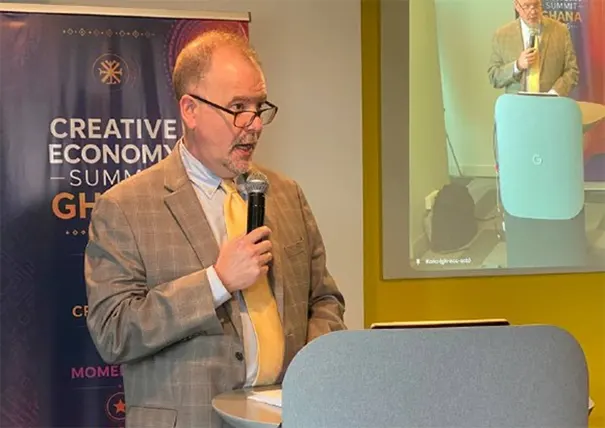
Ghana’s creative sector stands at the precipice of unprecedented growth, yet its full potential remains untapped without strategic intervention from policymakers, investors, and creatives alike. At the Creative Economy Summit held at the Google AI Community Center in Accra, diplomats and industry leaders emphasized the urgent need for a structured ecosystem—one that fosters innovation, protects intellectual property (IP), and ensures fair compensation for creators. The U.S. Embassy in Ghana, through its Chargé d’Affaires, Rolf Olson, underscored the government’s pivotal role in shaping policies, tax incentives, and financial frameworks that could transform Ghana’s creative industry into a global powerhouse, driving job creation, foreign investment, and economic competitiveness.
The Government’s Strategic Imperative: Policies and Infrastructure for Scalability
Olson’s address highlighted that policy decisions—particularly those governing taxation, intellectual property rights, and production financing—will determine whether Ghana maximizes the revenue from its cultural exports. He stressed that American companies and international investors are more likely to engage in Ghana’s creative sector if they perceive legal certainty, fair remuneration for creators, and a stable business environment.
“To the government officials, you hold the pen on the policies, tax structures, IP protections, and production financing that determine whether Ghana captures the full value of its own cultural exports.”
The Chargé d’Affaires further warned that contract sanctity—ensuring that creators are timely and fairly compensated for their work—is non-negotiable. Without robust enforcement mechanisms, Ghana risks losing both local talent and foreign capital to more supportive markets. He noted that Nollywood’s success on global platforms like Netflix proves that authentic storytelling transcends borders, but only if backed by strong institutional frameworks.
The Global Demand for Authentic Storytelling: A Window of Opportunity
The rise of streaming platforms has created an insatiable appetite for diverse, culturally rich narratives. Olson cited examples of Danish, Indian, and African content gaining international acclaim, demonstrating that high-quality storytelling—when properly marketed and financed—can generate substantial revenue for origin countries.
“Good storytelling is resonant anywhere in the world… How many different countries you can end up watching a show from because this show is really good and it’s set in Denmark or India, or wherever.”
This presents Ghana with a unique opportunity to position itself as a hub for African and global content production. However, realizing this potential requires early investment in infrastructure, including film studios, digital production facilities, and talent development programs. Olson urged investors to allocate capital proactively rather than waiting for the sector to mature, ensuring that Ghana’s creative industry can compete at scale with established markets.
Empowering Creators: Voice, Ownership, and Industry Collaboration
Beyond policy, Olson called on Ghanaian creatives to reclaim narrative control over their work. He emphasized the importance of insisting that stories are told in their own voice, free from cultural appropriation or misrepresentation. This autonomy is crucial for preserving authenticity while expanding global reach.
“Creatives must insist that your story be told in your own voice.”
He also highlighted the need for stronger industry collaboration, where filmmakers, musicians, writers, and digital creators work together to leverage collective bargaining power, negotiate better deals, and advocate for systemic change. Such unity could strengthen Ghana’s creative sector’s bargaining position with both local and international stakeholders.
The U.S.-Ghana Creative Partnership: A Blueprint for Economic Growth
The summit was framed as a starting point for deeper bilateral cooperation between Ghana and the U.S. in the creative economy. Olson described the U.S. Embassy’s commitment to fostering artistic exchange, investment, and policy alignment as a strategic priority. He noted that creative industries, like any other sector, generate jobs, foster innovation, and attract foreign direct investment (FDI)—all of which contribute to national economic resilience.
“Like any other sector, this sector creates jobs, builds competitive advantage, attracts investment, and supports entrepreneurship and innovation.”
By aligning Ghana’s creative sector policies with global best practices, the country can position itself as a preferred destination for film production, music recording, and digital content creation. This alignment would not only boost Ghana’s GDP but also enhance its soft power, making it a cultural and economic leader in Africa.
The Path Forward: A Call to Action
For Ghana’s creative sector to thrive, three critical actions must be prioritized:
- Policy Reforms – The government must simplify tax structures, strengthen IP laws, and introduce production incentives to encourage both local and foreign investment.
- Infrastructure Development – State-of-the-art studios, digital labs, and training centers must be established to support large-scale content production.
- Industry Advocacy – Creators, investors, and policymakers must collaborate to advocate for fair compensation, contract enforcement, and market access for Ghanaian talent.
The Creative Economy Summit served as a reminder that Ghana’s creative industry is not just an economic opportunity—it is a catalyst for national development. With the right strategic investments, policy support, and global partnerships, Ghana can harness its cultural wealth to drive sustainable growth, job creation, and international recognition.
As Olson concluded, the future of Ghana’s creative sector depends on collective action—one that empowers creators, attracts investors, and builds an ecosystem where innovation thrives. The time to act is now.
