


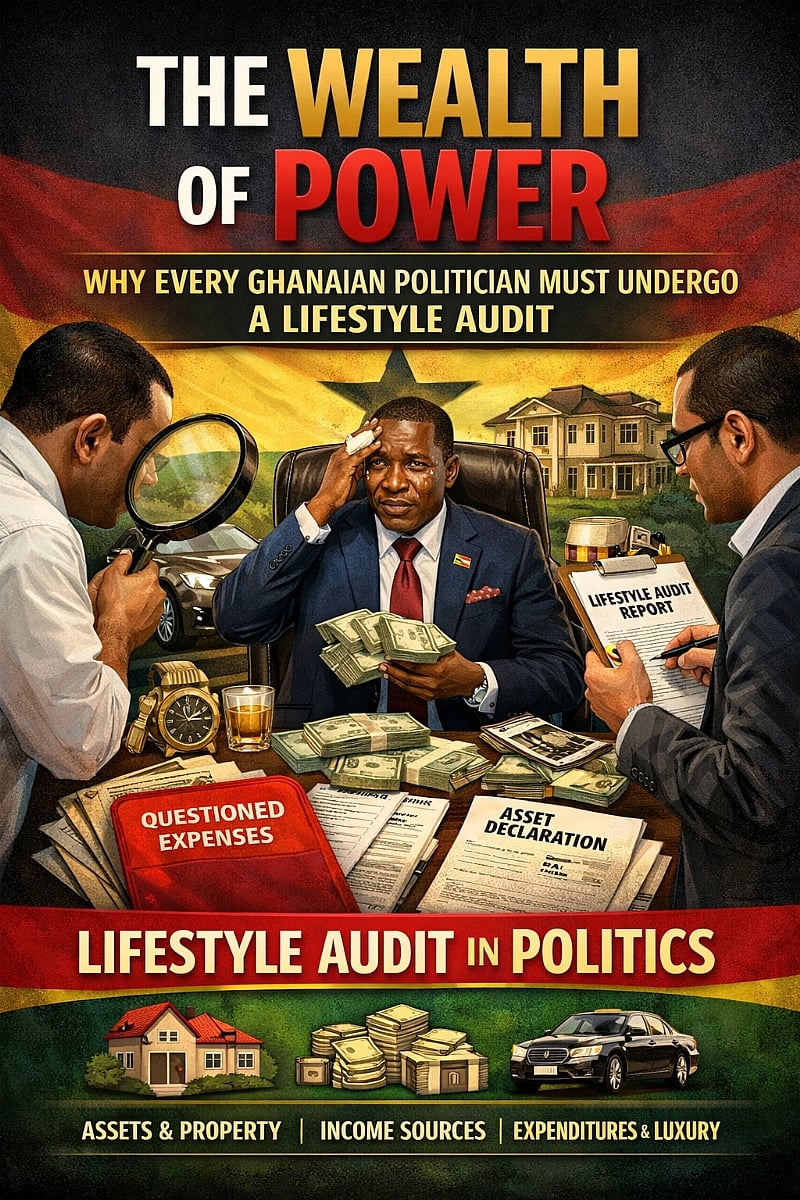
Introduction: The Silent Wealth Divide
In the heart of Ghana’s bustling cities and remote villages, a silent yet profound contradiction persists: while ordinary citizens grapple with soaring costs of living, rising unemployment, and crumbling public infrastructure, a select few politicians emerge from public office with fortunes that defy logic. The question that lingers in the minds of many—whispered in marketplaces, debated in cyber cafés, and shared in private conversations—is simple yet haunting:
How does a politician who once struggled to make ends meet suddenly own multiple mansions, luxury cars, and offshore investments within a few years of taking office?
This disparity is not merely a matter of personal ambition; it is a systemic failure of accountability that undermines Ghana’s democratic foundations. While anti-corruption agencies scramble to recover stolen funds after the fact, the real question remains unanswered: Where does the wealth come from before it disappears?
The solution? Mandatory lifestyle audits for every Ghanaian politician.
What Is a Lifestyle Audit—and Why Does Ghana Need It?
A lifestyle audit is a rigorous, independent examination of a public official’s financial activities, comparing their declared assets, income, and expenditures against the lifestyle they publicly display. Unlike traditional financial audits that focus on transactions, a lifestyle audit digs deeper:
- Income and Salary Verification: Does the politician’s declared salary align with their reported earnings?
- Asset Ownership: How many properties, vehicles, and luxury items do they possess? Are these assets proportionate to their income?
- Investments and Business Interests: Do they own businesses, shares, or other financial instruments that exceed their public earnings?
- Travel and Expenditure: Are their domestic and international travel expenses justified by their official duties?
- Family and Dependents’ Wealth: Do their spouses, children, or relatives live a lifestyle that cannot be explained by their declared income?
- Gifts and Donations: Have they received unexplained wealth transfers, including foreign donations or “gifts” while in office?
- Bank and Financial Transactions: Are there suspicious deposits, offshore accounts, or transactions that lack transparency?
At its core, a lifestyle audit asks one critical question:
Can this politician’s wealth be reasonably explained by their legitimate income?
If the answer is no, then the public has every right to demand answers.
The Uncomfortable Truth: Why Politicians Are Becoming Richer Than the Institutions They Lead
Ghana’s political landscape has long been criticized for its wealth disparity between leaders and the citizenry. While politicians campaign on promises of development—better roads, functional hospitals, and job creation—the reality often paints a different picture:
- From Struggle to Sudden Affluence: Many politicians enter politics with modest financial backgrounds. Yet, within four to eight years, some emerge as millionaires, owning multiple properties, luxury vehicles, and even international assets.
- The Mansion vs. the Pothole Paradox: While politicians build luxurious mansions in Accra and Kumasi, the roads leading to their own constituencies remain death traps due to neglect.
- Luxury Campaigns, Modest Returns: During elections, politicians often campaign in basic vehicles, yet after winning, they return in convoys of luxury SUVs—a stark contrast to the public’s economic struggles.
- The “Abroad Education” Enigma: Children of politicians frequently attend expensive foreign universities, yet their parents’ declared salaries cannot justify such expenditures.
- Public Projects Abandoned, Private Wealth Grows: Despite billions of cedis spent on public infrastructure, many projects remain unfinished or poorly executed, while political elites continue to accumulate wealth.
These contradictions are not mere coincidences. They are symptoms of a broken system where public office has become a fast track to personal enrichment rather than a platform for service.
How Lifestyle Audits Can Transform Ghana’s Development Trajectory
If implemented effectively and transparently, lifestyle audits could revolutionize Ghana’s fight against corruption and restore public trust. Here’s how:
1. Restoring Public Accountability
- Politicians would think twice before misappropriating public funds if they know their assets are under continuous scrutiny.
- Real-time monitoring of asset declarations would deter corrupt practices, as officials would fear exposure rather than prosecution.
2. Ensuring Better Use of Public Funds
- If roads, schools, and hospitals receive the allocated funds instead of being diverted into private bank accounts, development would accelerate.
- Transparency in procurement would reduce ghost contracts and overinflated tenders, ensuring resources reach their intended beneficiaries.
3. Boosting Investor Confidence
- Foreign and local investors are more likely to commit capital to Ghana if they see strong anti-corruption measures in place.
- A reputation for transparency would position Ghana as a more stable and attractive destination for business.
4. Rebuilding Public Trust
- The growing cynicism among Ghanaians toward politicians stems from unexplained wealth accumulation.
- Publicly accessible lifestyle audits would demonstrate that leaders are accountable to the people, not just to themselves.
5. Reducing Opportunities for Corruption
While lifestyle audits cannot eliminate corruption entirely, they would significantly reduce opportunities for:
– Bribery (if officials know their assets are being monitored)
– Procurement fraud (through transparent bidding processes)
– Embezzlement (due to stricter financial controls)
– Money laundering (via better tracking of wealth flows)
– Conflict of interest (by requiring full disclosure of business dealings)
Corruption thrives in secrecy. Lifestyle audits expose secrecy, making illicit enrichment far more difficult.
Should Lifestyle Audits Be Public? The Case for Transparency
One of the most contentious debates surrounding lifestyle audits is whether they should be made public. The answer is absolutely yes—for several compelling reasons:
- Public Office = Public Trust
- Politicians are paid by taxpayers. If citizens fund their salaries, they have the right to know how those funds are used.
-
Transparency strengthens democracy by ensuring leaders remain accountable to the people, not just to themselves.
-
Deterrence Through Exposure
- When a politician’s unexplained wealth becomes public knowledge, it acts as a deterrent against future misconduct.
-
Citizens can hold leaders accountable through social media, protests, or legal action.
-
Preventing “Legal Loopholes”
- Some politicians argue that asset declarations are already required. However, without public scrutiny, these declarations become meaningless documents.
-
Public audits ensure that no wealth goes unchecked, whether declared or hidden.
-
Empowering Citizens
- Ghanaians deserve to know:
- What assets a politician owned before taking office.
- What they acquired while in power.
- What remains in their possession after leaving office.
- Knowledge is power—and in this case, it is the power to demand better leadership.
How Can Ghana Implement Effective Lifestyle Audits?
For lifestyle audits to be successful, they must be structured, independent, and technologically supported. Here’s a step-by-step framework for implementation:
1. Before Assuming Office: The Pre-Entry Audit
- Mandatory Disclosure:
- Politicians must declare:
- Bank accounts (local and foreign)
- Properties (landed and undeveloped)
- Vehicles and luxury assets
- Business interests and investments
- Liabilities and debts
- Background Checks:
- Independent agencies should verify these declarations to ensure no underreporting.
2. During Office: Real-Time Monitoring
- Continuous Asset Tracking:
- Independent institutions (such as the Election Commission, Anti-Corruption Bureau, or a dedicated Lifestyle Audit Agency) should monitor:
- Major acquisitions (e.g., sudden property purchases)
- Procurement relationships (to detect conflicts of interest)
- Financial disclosures (quarterly or annual updates)
- Tax compliance (to ensure no tax evasion)
- Business dealings (especially those involving public contracts)
- Digital Transparency:
- A publicly accessible portal should allow citizens to:
- Track changes in a politician’s wealth over time.
- View public contracts awarded to their relatives or associates.
- Compare declared salaries with reported assets.
3. After Leaving Office: The Exit Audit
- Final Asset Declaration:
- Politicians must re-declare their assets upon leaving office.
- Any unexplained increase in wealth should trigger further investigation.
- Post-Office Monitoring:
- Even after leaving politics, officials should be subject to periodic audits to prevent retirement wealth accumulation.
4. The Role of Technology in Combating Corruption
Ghana can leverage digital innovation to make lifestyle audits more efficient and transparent:
– Blockchain for Asset Tracking:
– A decentralized ledger could record all asset declarations, making tampering nearly impossible.
– AI-Powered Anomaly Detection:
– Artificial intelligence could flag suspicious transactions, such as:
– Sudden large deposits with no clear source.
– Offshore account openings shortly after taking office.
– Unusual business partnerships with shell companies.
– Citizen Reporting Platforms:
– A whistleblower-friendly system where citizens can anonymously report suspected corruption.
What Are Ghanaians Saying? The Growing Demand for Accountability
The frustration among ordinary Ghanaians is palpable. In radio talk shows, social media debates, and public forums, citizens repeatedly express the same concerns:
- “Why do politicians seem immune to economic hardship while the rest of us struggle?”
- “Why are public services (like healthcare and education) failing despite government spending?”
- “Why do corruption scandals keep emerging, yet no one is held truly accountable?”
- “Is politics really about serving Ghana, or has it become the most profitable business?”
The demand for change is clear:
“If you want to serve the people, prove that you are serving—not stealing.”
Ghanaians are no longer willing to accept excuses. They want:
✅ Stronger anti-corruption laws
✅ Greater financial transparency
✅ Meaningful consequences for illicit enrichment
What Are Politicians Saying? The Pushback and Counterarguments
Not all politicians support lifestyle audits. Some strongly oppose the idea, citing concerns such as:
- “Lifestyle audits could be politically motivated.”
-
Counterpoint: If conducted independently and professionally, audits should focus on facts, not politics. The goal is accountability, not persecution.
-
“They violate privacy rights.”
-
Counterpoint: Public officials voluntarily enter public service, which inherently means sacrificing some privacy for transparency. Their wealth is not private—it is publicly funded.
-
“Asset declarations are already required under existing laws.”
-
Counterpoint: Existing laws are often ignored or poorly enforced. Lifestyle audits provide real-time monitoring, not just paperwork.
-
“Anti-corruption institutions should be strengthened instead.”
- Counterpoint: While stronger institutions are necessary, preventive measures (like audits) are equally critical. Waiting for corruption to happen is reactive, not proactive.
The real issue is not whether lifestyle audits are feasible—it is whether Ghana is willing to prioritize transparency over secrecy.
What Is the Government Doing? Progress and Gaps
Successive Ghanaian governments have taken steps toward financial transparency, including:
– Asset Declaration Requirements (for politicians and public officials)
– Strengthening of Anti-Corruption Agencies (such as the Election Commission and Anti-Corruption Bureau)
– Procurement Regulations (to reduce corruption in public contracts)
– Public Financial Management Reforms (to improve accountability in spending)
However, public confidence remains low because:
❌ Implementation is inconsistent—many declarations go unverified.
❌ Corruption investigations take years—some cases never see justice.
❌ Political interference often weakens enforcement.
The result? Corruption persists, and public trust erodes further.
The Vision of a New Ghana: What Could Be
Imagine a Ghana where:
✔ Every minister, MP, and public official undergoes a mandatory lifestyle audit.
✔ Citizens can access a public portal to see:
– What a politician owned before taking office.
– What they acquired while in power.
– What remains after leaving office.
✔ Unexplained wealth automatically triggers investigations.
✔ Corruption becomes more difficult than honesty.
In such a system:
– Fewer people would contest elections for money.
– Public projects would finally get completed.
– Hospitals would receive proper funding.
– Schools would improve.
– Youth would have job opportunities.
– Ghana would develop at the pace we all desire.
Final Thoughts: Accountability or Anarchy?
Ghana is not lacking in resources. It is not lacking in brilliant minds. It is not lacking in opportunities.
What Ghana often lacks is accountability.
The greatest tragedy of corruption is not just the money stolen—it is the dreams stolen from millions of citizens who continue to struggle because public resources are diverted into private pockets.
Lifestyle audits are not about embarrassing politicians. They are about:
✅ Protecting democracy
✅ Preserving public trust
✅ Ensuring leadership remains a sacred responsibility, not a lucrative business
If a politician’s wealth is honestly earned, then a lifestyle audit becomes a badge of honor.
But if public office has become a pathway to unexplained riches, then every Ghanaian deserves to know.
The question is no longer “Can Ghana afford lifestyle audits?”
The real question is:
If politicians have nothing to hide, why should they fear transparency?
By: [Author Name]
(Contact: [Email] | [Phone])
