


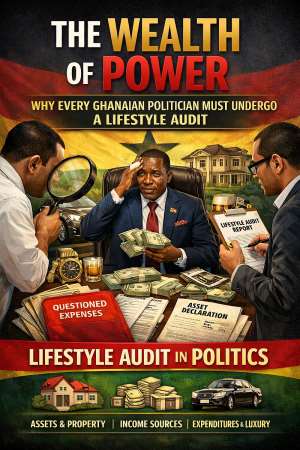
In the heart of Ghana’s bustling cities and quiet villages, a silent yet profound question lingers: How does a politician who once struggled to afford basic necessities suddenly own mansions, luxury cars, and offshore accounts within a few years of taking office? The disparity between the wealth of Ghana’s political elite and the economic struggles of ordinary citizens has become a glaring contradiction that demands urgent attention.
While corruption investigations often focus on exposing stolen funds after the fact, the real question remains unanswered: Where does the wealth come from before it disappears? This is where lifestyle audits—a rigorous, independent assessment of a politician’s financial dealings—emerge as a critical tool for transparency, accountability, and national development.
What Is a Lifestyle Audit? A Closer Look at the Mechanism
A lifestyle audit is not merely a cursory check of a politician’s bank statements. It is a comprehensive, evidence-based evaluation that compares their declared assets, income, and financial activities against the lifestyle they publicly exhibit. The audit examines:
- Income and Salary Verification
- Does the politician’s declared salary align with their financial transactions?
-
Are there unexplained income sources, such as undeclared businesses or foreign remittances?
-
Real Estate and Landed Assets
- How many properties does the politician own? Are they all legally acquired?
-
Do they own multiple homes in Ghana and abroad, far exceeding their declared wealth?
-
Luxury Vehicles and High-End Purchases
- Why do some politicians drive Rolls-Royces, Bentleys, or private jets while public transportation remains inadequate?
-
Are these vehicles purchased through legitimate means, or are they financed by illicit funds?
-
Investments and Business Interests
- Do politicians own stakes in private companies, banks, or foreign enterprises?
-
Are these investments declared, or do they operate through shell companies?
-
Travel and Expenditure Patterns
- How often do politicians travel internationally? Are these trips for official duties or personal luxury?
-
Are their travel expenses consistent with their declared income?
-
Bank Accounts and Financial Transactions
- Are there multiple accounts, including offshore ones, that remain unaccounted for?
-
Do transactions align with their stated financial disclosures?
-
Family and Associated Wealth
- Do spouses, children, or relatives own properties, businesses, or assets that cannot be reasonably explained?
-
Are gifts, donations, or “family loans” properly documented?
-
Public Contracts and Procurement Links
- Do politicians have financial ties to companies awarded government contracts?
- Are there conflicts of interest in procurement decisions?
At its core, a lifestyle audit asks one fundamental question:
“Can this politician’s wealth be logically explained by their legitimate income, or are there suspicious gaps that require investigation?”
If the answer is the latter, Ghanaians have the right to demand answers.
Why Lifestyle Audits Are Non-Negotiable for Ghana’s Development
The idea that politics should be a path to personal enrichment rather than public service is not just morally bankrupt—it is a direct threat to Ghana’s progress. Yet, the evidence is undeniable:
- Politicians entering office with modest means suddenly become millionaires within a few years.
- Children of public officials attend elite foreign universities while Ghana’s education system remains underfunded.
- Public infrastructure crumbles while politicians build private estates in the same communities.
- Corruption scandals emerge repeatedly, yet accountability mechanisms fail to deliver justice.
Lifestyle audits are not about punishing politicians—they are about restoring trust in democracy. When implemented effectively, they can:
1. Strengthen Public Accountability
Politicians will hesitate to embezzle public funds if they know their assets are continuously monitored. The fear of exposure acts as a deterrent against corruption.
2. Ensure Better Use of Public Resources
If every kobo allocated for schools, hospitals, roads, and youth employment is transparently accounted for, funds will reach their intended beneficiaries instead of lining private pockets.
3. Boost Investor Confidence
Foreign and local investors prefer countries with low corruption. When Ghana demonstrates commitment to transparency, it becomes a more attractive destination for business and development partnerships.
4. Rebuild Public Trust
The growing cynicism among Ghanaians stems from unexplained wealth among leaders. Lifestyle audits would prove that public office holders are accountable to the people, not just to themselves.
5. Expose Corruption Before It Happens
Corruption thrives in secrecy. Lifestyle audits shine a light on suspicious financial activities, making it far harder to launder money, bribe officials, or abuse office for personal gain.
The Myths and Misconceptions Around Lifestyle Audits
Despite their obvious benefits, lifestyle audits face skepticism and resistance. Some common arguments include:
1. “Lifestyle Audits Are Politically Motivated”
- Reality: A well-structured audit should be independent, professional, and data-driven. It should not be used for political persecution but for ensuring fairness and transparency.
2. “They Violate Privacy Rights”
- Reality: Politicians volunteer for public office—they surrender certain privacy rights in exchange for the trust of the people. If they misuse public funds, their privacy should not be protected at the expense of the nation.
3. “Asset Declarations Already Exist—Why More?”
- Reality: Current asset declaration systems are often weak, poorly enforced, or manipulated. Lifestyle audits go beyond declarations by verifying claims with real-world financial data.
4. “Corruption Will Still Happen”
- Reality: While no system is 100% foolproof, lifestyle audits significantly reduce opportunities for corruption by making illicit wealth harder to hide.
How Ghana Can Implement Effective Lifestyle Audits
For lifestyle audits to be successful, they must be structured, transparent, and enforced consistently. Here’s how Ghana can adopt and refine this system:
1. Before Assuming Office: Pre-Entry Audits
- Politicians must declare all assets, liabilities, and income sources before taking office.
- Independent bodies (such as the Anti-Corruption Commission or a dedicated Financial Integrity Agency) should verify these declarations against public records, property databases, and financial institutions.
2. During Office: Continuous Monitoring
- Real-time tracking of:
- Major asset purchases (properties, vehicles, investments).
- Procurement decisions (are contracts awarded to related parties?).
- Travel expenses (are international trips justified?).
- Tax compliance (are all income sources properly taxed?).
- Annual financial disclosures should be publicly accessible on a dedicated government portal.
3. After Leaving Office: Exit Audits
- Politicians must declare their assets again upon leaving office.
- Independent investigations should compare pre-office and post-office wealth to detect unexplained enrichment.
- Penalties for non-compliance should be strict and enforceable.
4. Leveraging Technology for Transparency
Ghana can create a digital platform where citizens can:
– View declared assets of politicians in real time.
– Track changes in wealth over their tenure.
– Access procurement records to detect conflicts of interest.
– Report suspicious activities anonymously.
Example: A public dashboard could show:
– “Minister A declared GH₵50,000 monthly salary but owns GH₵5 million in properties within 3 years—where did the rest come from?”
The Global Precedent: Countries That Have Succeeded with Lifestyle Audits
Several nations have already implemented similar systems with mixed but largely positive results:
- Uganda – Mandatory asset declarations for public officials, with publicly accessible records.
- South Africa – The Public Protector’s office conducts lifestyle audits on high-ranking officials, leading to high-profile corruption cases.
- India – The Lokpal (Anti-Corruption Ombudsman) investigates unexplained wealth of politicians and bureaucrats.
- Singapore – Strict financial disclosure laws and asset verification help maintain low corruption levels.
These examples prove that when implemented fairly, lifestyle audits work.
What Ghanaians Are Saying: A Call for Action
Across town halls, social media, and public forums, Ghanaians are united in their frustration:
- “Why do politicians drive luxury cars while our roads are potholed?”
- “Why do our children study abroad while schools lack textbooks?”
- “Why do corruption scandals keep emerging, yet no one is held accountable?”
- “If you want to serve, prove it—don’t just take our money and run.”
The demand for transparency is growing. Citizens are no longer willing to accept excuses—they want action.
What Politicians Are Saying: The Pushback and Counterarguments
While some politicians support stronger accountability measures, others resist change, citing:
- “Lifestyle audits are too intrusive.”
- “They could be used for political witch-hunts.”
- “We already have asset declarations—this is unnecessary.”
However, the reality is:
– If a politician has nothing to hide, they should welcome transparency.
– If they fear exposure, it suggests they have something to conceal.
The real question is not whether lifestyle audits are necessary—it’s whether Ghana’s leaders are willing to serve without stealing.****
What Is the Government Doing? The Current State of Affairs
Successive Ghanaian governments have taken steps toward anti-corruption reforms, including:
✅ Asset Declaration Laws – Politicians must declare assets, but enforcement is weak.
✅ Anti-Corruption Agencies – Institutions like the ACC and EFCC exist but lack resources and political will.
✅ Procurement Regulations – Some transparency measures are in place, but loopholes remain.
✅ Financial Auditing – Audits are conducted, but many cases drag on for years without resolution.
The problem? Implementation is inconsistent, and public trust remains low.
The Vision of a Corruption-Free Ghana: What Could Be
Imagine a Ghana where:
✔ Every minister, MP, and CEO of a public institution undergoes a mandatory lifestyle audit.
✔ Citizens can publicly track how their leaders’ wealth changes over time.
✔ Unexplained wealth triggers automatic investigations—no more delays.
✔ Public projects are completed on time because funds are not diverted.
✔ Hospitals are well-equipped, schools are functional, and youth have jobs.
This is not a fantasy—it’s a possibility if Ghana commits to real accountability.
Final Thoughts: The Choice Before Ghana
Ghana is not lacking in resources, talent, or ambition. What it lacks is accountability.
The real tragedy of corruption is not just the money stolen—it’s the dream stolen from millions who struggle daily while their leaders hoard wealth.
Lifestyle audits are not about shaming politicians. They are about:
✅ Protecting democracy.
✅ Restoring public trust.
✅ Ensuring leadership remains a sacred responsibility, not a lucrative business.****
If a politician’s wealth is honestly earned, then a lifestyle audit proves their integrity.
If public office has become a pathway to unexplained riches, then every Ghanaian deserves to know.
The real question is no longer if Ghana needs lifestyle audits.
The question is: If politicians have nothing to hide, why should they fear transparency?
Ghana’s future depends on one simple truth:
A nation’s wealth is not measured in mansions and bank accounts—it is measured in the lives it uplifts.
By: [Author Name]
(Contact: [Email] | [Phone])
