


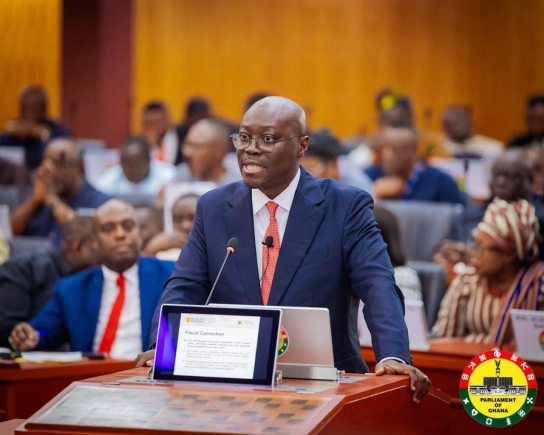
In a highly anticipated address to the nation, Finance Minister Ato Forson presented the 2026 Mid-Year Budget Review (MYBR), a critical assessment of Ghana’s economic trajectory amid persistent fiscal pressures. The review, delivered under the backdrop of ongoing debates over the Debt-to-Domestic-Economy-Proportion (DDEP), underscored the government’s commitment to fiscal discipline while acknowledging the need for urgent reforms to address structural challenges. Critics, however, argue that the postponement of DDEP-related solutions risks further delaying much-needed economic stability.
Key Highlights of the 2026 Mid-Year Budget Review
1. Fiscal Consolidation and Revenue Mobilization
Forson emphasized the government’s efforts to strengthen revenue collection as a cornerstone of its fiscal strategy. The review highlighted a 12.3% increase in domestic revenue compared to the same period in 2025, driven by enhanced tax compliance measures and the expansion of the VAT (Value-Added Tax) base. However, the minister acknowledged that non-oil revenue growth remains sluggish, particularly in sectors such as mining and manufacturing, where evasion and avoidance persist.
To mitigate this, the government has introduced digital tax enforcement tools, including AI-driven fraud detection systems, aimed at reducing tax gaps. Additionally, the Excise Duty on selected luxury items has been adjusted upward to curb consumption-driven spending, a move critics argue may disproportionately affect low-income earners.
Finance Minister Ato Forson addresses the nation during the 2026 Mid-Year Budget Review presentation.
2. Debt Management and the DDEP Controversy
One of the most contentious aspects of the review was the delay in implementing the DDEP framework, a policy designed to cap domestic debt at 70% of GDP to prevent economic instability. While the government had initially planned to introduce DDEP in 2025, Forson cited technical challenges and the need for broader stakeholder consultations as reasons for the postponement.
Opposition parties and economic analysts have criticized the delay, arguing that Ghana’s debt-to-GDP ratio now stands at 82.7%, a figure that continues to rise despite austerity measures. The International Monetary Fund (IMF) has also expressed concerns, urging Ghana to accelerate debt restructuring to avoid a potential sovereign default.
Forson, however, defended the postponement, stating that the government is finalizing a comprehensive debt sustainability plan that includes:
– Debt swaps with commercial creditors to extend repayment periods.
– Austerity measures in non-essential government spending.
– Privatization of state-owned enterprises (SOEs) to generate revenue.
3. Social Sector Investments Amid Fiscal Constraints
Despite the economic challenges, the review allocated 30% of the budget to social sector spending, reflecting the government’s priority on healthcare, education, and social protection. Key initiatives include:
– Expansion of the Free SHS (Senior High School) program, with plans to extend it to Junior High Schools (JHS) in 2027.
– Increased funding for the National Health Insurance Scheme (NHIS), aimed at reducing out-of-pocket healthcare expenses.
– A new conditional cash transfer program for vulnerable households, modeled after successful schemes in neighboring countries.
However, economists warn that rising debt servicing costs—which now consume 60% of the national budget—may limit the government’s ability to sustain these social investments without further tax increases or spending cuts.
4. Infrastructure and Productivity Boosts
To stimulate economic growth, the review outlined N10 billion ($1.2 billion) in infrastructure investments, focusing on:
– Road and rail connectivity in the Northern and Upper West Regions, critical for agricultural export hubs.
– Digital infrastructure expansion, including 5G rollouts in major cities to support remote work and e-commerce.
– Renewable energy projects, with plans to double Ghana’s solar and wind capacity by 2028.
Forson also announced a tax holiday for manufacturing firms investing in automation and green technology, aiming to attract foreign direct investment (FDI) and boost productivity.
5. Challenges and Way Forward
While the MYBR presents a cautiously optimistic outlook, several structural challenges remain:
– High unemployment, particularly among youth, stands at 12.8%.
– Inflation remains stubbornly high at 18.2%, eroding purchasing power.
– Corruption and inefficiencies in public procurement continue to drain resources.
To address these, Forson proposed:
– A public-private partnership (PPP) framework to accelerate infrastructure projects.
– Stricter anti-corruption measures, including real-time procurement tracking.
– Vocational training programs in collaboration with private sector firms to align skills with labor market demands.
Reactions and Criticisms
The presentation sparked diverse reactions across political and economic circles:
– Opposition Leader, John Mahama, criticized the lack of transparency in debt negotiations, calling for an independent audit of government borrowing.
– The Ghana Chamber of Commerce praised the tax incentives for manufacturers but urged the government to reduce bureaucracy hindering business operations.
– Economic analysts warned that postponing DDEP risks further market instability, particularly if creditors perceive Ghana as unreliable.
Conclusion: A Balancing Act
Ato Forson’s 2026 Mid-Year Budget Review underscores Ghana’s delicate economic balancing act—navigating between fiscal responsibility and social welfare demands while grappling with rising debt and inflation. While the government’s revenue mobilization efforts and infrastructure investments offer a glimmer of hope, the postponement of DDEP and persistent structural issues raise concerns about long-term sustainability.
As Ghana moves forward, the success of these measures will hinge on transparency, accountability, and sustained political will—critical factors that will determine whether the nation can escape its current economic quagmire or face further instability in the coming years.
Note: For the most accurate and up-to-date financial figures, refer to the Bank of Ghana’s latest economic reports and the Ministry of Finance’s official budget documents.
