


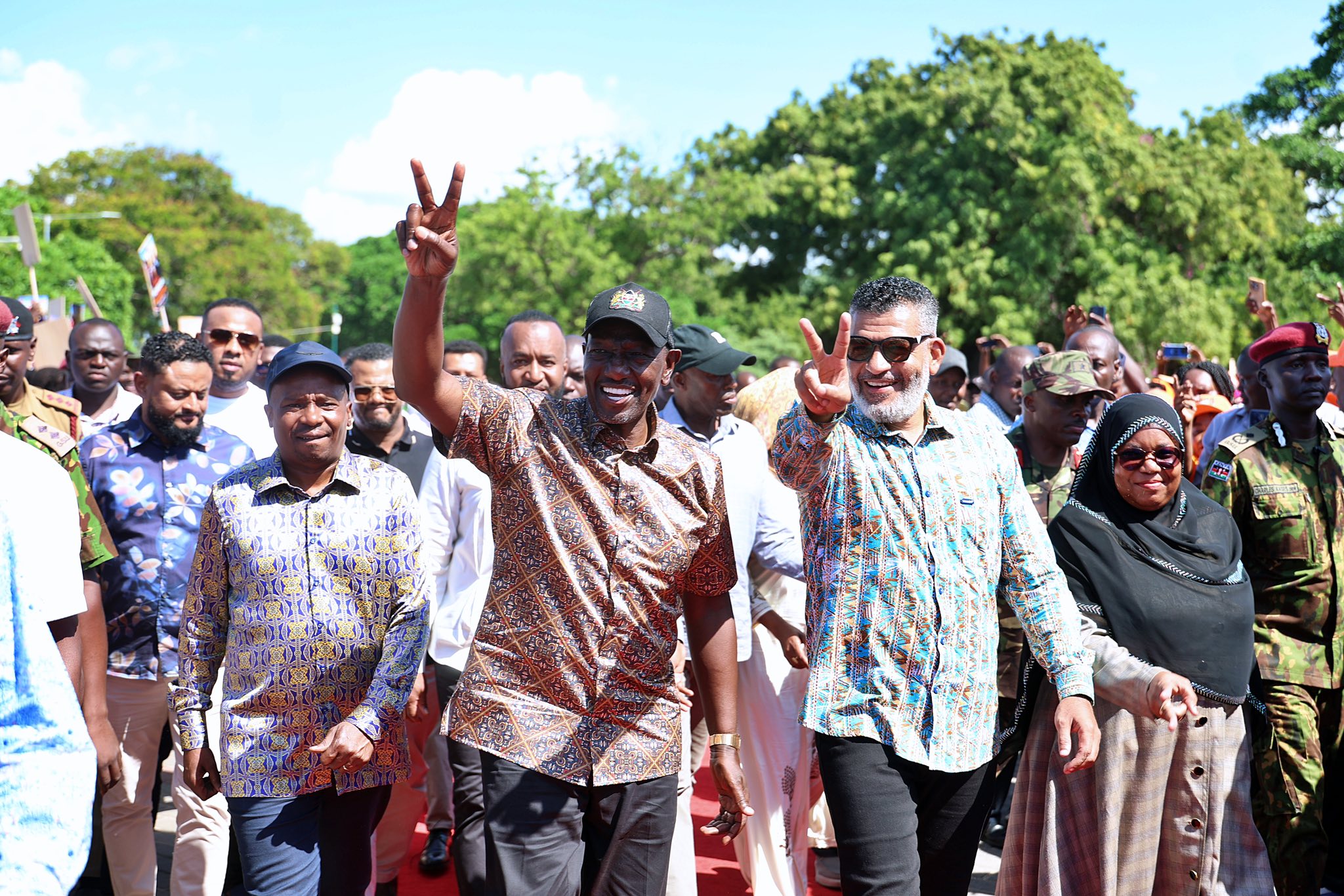
 President William Ruto alongside Deputy president Kithure Kindiki and ODM deputy party leader Abdulswamad Nassir during a title deed issuance event in Mombasa on May 21, 2026/ HANDOUT
ODM deputy leader Abdulswamad Nassir has slammed internal critics of the party’s partnership with the ruling UDA, accusing them of betraying Raila Odinga’s political ideals.
Speaking during title deed issuance in Mombasa on
Thursday, the ODM deputy party leader defended the broad-based cooperation, saying it was founded on shared reform goals, particularly
land reforms that had formed part of Raila’s long political struggle.
Nassir said the partnership between the two parties was
aimed at solving long-standing problems affecting ordinary Kenyans rather than
advancing political interests.
“In Raila Odinga’s manifesto, land reforms were clearly part
of the agenda. In your manifesto, land reforms were also included. Today,
despite our colours being orange and yellow, we have united to find solutions
for our people,” Nassir said.
The governor took direct aim at leaders criticising the
arrangement, accusing them of distorting Raila’s legacy while ignoring the
issues he fought for over decades.
“Those calling others betrayers are the real betrayers of
Raila Odinga’s cause,” Nassir said.
He said Raila endured detention, political persecution
and personal sacrifices while fighting for reforms, including land rights and
social justice.
“Raila shed blood, shed tears and even went to jail because
of the struggle for land justice and the rights of Kenyans,” he said.
Nassir also praised President William Ruto for implementing
some of the reforms that ODM had pushed for while in opposition.
“Today it is President William Ruto who is delivering on
promises that Raila Odinga fought for and sacrificed his political comfort to
pursue,” he said.
The remarks come amid deepening divisions within ODM over
the party’s working relationship with the Kenya Kwanza administration under the
broad-based government arrangement.
The divisions have largely split the party into two informal
camps the “Linda Ground” faction that supports engagement with government
and the “Linda Mwananchi” wing that insists ODM should remain firmly in
opposition.
Leaders allied to the pro-engagement camp have argued that
working with the government has accelerated development projects and allowed
ODM to push reforms from within.
They have particularly cited cooperation on
land reforms, economic recovery programmes and infrastructure development.
However, critics within the party have warned that the
arrangement risks weakening ODM’s identity as an opposition movement and could
dilute accountability against the government.
The dispute has played out publicly in recent months, with
rival camps exchanging accusations over the future direction of the party ahead
of the 2027 General Election.
Some ODM leaders opposed to the arrangement have accused
sections of the party leadership of abandoning the opposition’s watchdog role,
while supporters of the deal argue that Raila has historically embraced
dialogue and bipartisan engagement to secure reforms.
Nassir appeared to lean heavily on that argument, saying the
focus should remain on solving citizens’ problems instead of sustaining
political hostility.
He also urged leaders not to forget the historical struggles
behind land reforms at the Coast, where thousands of residents have lived for
years without ownership documents due to unresolved adjudication disputes,
absentee landlords and historical injustices.
Land ownership remains one of the most politically sensitive
issues in the Coast region and has featured prominently in ODM’s campaigns over
the years.
The latest title deed issuance programme forms part of
ongoing government efforts to address historical land grievances even as
political cooperation between former rivals continues to reshape the country’s
political landscape.
