

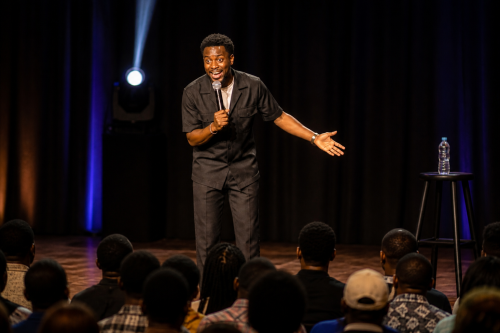
For years, the unspoken rule in Ghana’s live entertainment industry was simple: if you wanted a packed auditorium, you booked a Nigerian comedian. Names like Basketmouth and Bovi were the guaranteed draws, the headline acts that unlocked corporate sponsorships and shifted tickets in bulk. Ghanaian comedians, however talented, were largely cast as warm-up acts in their own country, confined to campus stages and intimate venues where audience numbers rarely climbed beyond a few hundred.
That rule is being broken, visibly and consistently, by a generation of Ghanaian performers who have spent years building what their predecessors lacked: loyal audiences, polished production, and commercial credibility.
The sold-out show that Parrout Mouth delivered at the University of Professional Studies, Accra (UPSA) auditorium is among the most recent proof of this shift. Filling a venue of that scale as a headliner, without a foreign marquee name at the top of the bill, would have been considered a significant commercial risk just five years ago. Today, it reads as confirmation of a trend rather than an exception to one.
Parrout Mouth is not alone. Comedians including OB Amponsah, Lekzy DeComic, and Foster Romanus have steadily built audiences that stretch beyond niche fan bases, consistently selling out mid-sized venues and commanding appearances at corporate events, brand activations, and increasingly large concert-style shows. Their comedy draws on observational humor, social commentary, and specifically Ghanaian cultural reference points that resonate with local audiences and travel well to diasporan viewers through digital platforms.
The role of social media in this transformation is not incidental. Short-form video content on platforms including TikTok and Instagram has fundamentally changed how Ghanaian comedians build and monetize their audiences. Rather than depending on traditional gatekeepers such as television networks and event promoters to grant access to visibility, performers can now test material, build loyal followings, and convert online popularity directly into ticket sales and brand deals. This direct-to-audience model has compressed the timeline from emerging talent to commercially viable act and created revenue streams that were simply unavailable to the previous generation.
The financial rewards for those who reach the upper tier of the industry are now significant enough to change the conversation about comedy as a profession. Jeneral Ntatia, one of Ghana’s most established comedians, revealed during an interview on Joy Prime on April 29, 2026, that the highest he had earned from a single stand-up engagement was GH₵40,000 for a 30-minute corporate performance. That figure, drawn from one night’s work, positions top-tier Ghanaian comedy as a genuinely lucrative career for those who can sustain demand at that level.
However, Ntatia was equally candid about the structural conditions that make reaching and maintaining that level difficult for most. Speaking separately to TV3 on the same date, he described producing a comedy show in Ghana as a financially punishing exercise. Comedians bear the full costs of venue rental, billboard promotion, logistics, and production, often without any guarantee of recouping those investments through ticket revenue alone. He noted that high taxation applied to production companies after expenses had already been paid placed an additional burden on an industry that already operated without a reliable sponsorship ecosystem.
“The challenges we are facing in the industry are lack of sponsorship and high taxation,” Ntatia said. “If you want to put up a show, you have to put up billboards across town, rent an auditorium and everything. No support from anywhere, and then when you finish you have to be taxed. It’s not easy.”
His comments draw a sharp contrast with the picture painted by sold-out venues. Ghana’s comedy industry is, at this moment, experiencing its most commercially promising period. But the conditions underneath that momentum are fragile. Unlike Ghana’s music industry, which has benefited from the global expansion of streaming platforms and international touring, comedy remains almost entirely dependent on live performances for income. There are no meaningful streaming royalties for stand-up specials, no established comedy club circuit to provide regular work for developing acts, and no structured touring infrastructure to help comedians build audiences beyond the Greater Accra Region.
This concentration of risk makes the industry vulnerable to external disruptions and limits the pace at which new talent can develop. A comedian who might thrive within a circuit of dedicated performance venues has no real equivalent of that structure in Ghana. The path from performing at campus events to headlining a major auditorium is still largely self-funded, self-managed, and built on personal resilience rather than institutional support.
Veteran broadcaster and comedian Kwaku Sintim-Misa, widely known as KSM, has in past interviews argued that comedy in Ghana requires the same investment in writing, production, and professional discipline as music and film if it is to sustain commercial relevance. The current wave of performers appears to have absorbed that lesson. What is still missing is the external infrastructure that would amplify their efforts, the comedy clubs, dedicated circuits, institutional investment, and tax frameworks that recognize the creative industries as an employment sector worth nurturing rather than simply taxing.
The opportunity is clearly visible. Large-scale comedy events now attract media partnerships and begin to generate merchandising possibilities. Corporate event budgets are increasingly directing fees toward established comedians. The audience appetite is real and growing. All of that represents the foundation of a viable industry.
The question confronting Ghana’s comedy ecosystem in 2026 is not whether audiences will support local talent. They demonstrably will. The question is whether producers, policymakers, and corporate sponsors will close the gap between the industry’s current momentum and the structural conditions it needs to sustain and scale that momentum.
Without dedicated venues, a more equitable tax framework for creative production, and consistent corporate investment in local comedy events, Ghana risks building its most talented generation of comedians on an infrastructure that was never designed to support them.
The auditoriums are filling up. The harder work is building the industry around them.

