


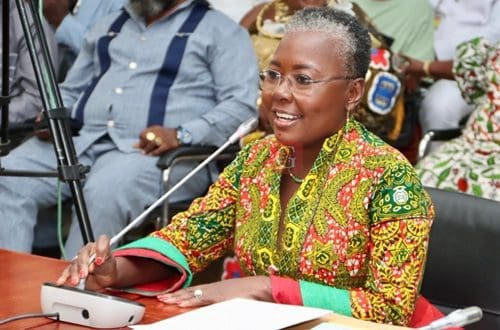
Minister of Fisheries and Aquaculture Emelia Arthur has called on stakeholders across Ghana’s fisheries sector to urgently modernise their data systems, warning that much of the information currently shaping government and donor decisions was collected decades ago and no longer reflects the realities of the country’s marine and aquatic ecosystems.
Speaking at a multi-stakeholder engagement workshop on the Blue Ventures Conservation Programme in Ghana, the Minister was direct in her assessment. “We must re-examine our data. Some of the figures we continue to rely on are no longer relevant to the changes we are seeing today,” she said.
The workshop followed the signing of a Memorandum of Understanding between the Ministry and Blue Ventures Conservation, an international non-governmental organisation working on sustainable fisheries management. Under the agreement, both parties will collaborate on strengthening policy, legal and institutional frameworks, improving fisheries enforcement, building capacity through training, advancing scientific research, and supporting coastal community livelihoods.
Blue Ventures is working with four Ghanaian partners to implement its programmes in coastal areas: the Centre for Coastal Management at the University of Cape Coast, the Global Fisheries and Resilience Alliance, the Ghana National Canoe and Fishermen Council, and the Canoe and Fishing Gear Owners Association of Ghana.
Chief Executive Officer of Blue Ventures Ebrima Saidy said the organisation’s work would align closely with Ghana’s national priorities, particularly efforts to rebuild fish stocks. He commended Ghana for establishing the Greater Cape Three Points Marine Protected Area as a sign of genuine commitment to marine conservation. Saidy also highlighted the pressures facing small-scale fishers along the coast, including shrinking catches, crowded nearshore waters, and mounting environmental strain. “These challenges are already impacting food security, incomes and the resilience of coastal communities,” he said.
Professor Berchie Asiedu, Deputy Executive Director of the Fisheries Commission, reinforced the data call with a regional dimension, arguing that because fish populations cross national boundaries, Ghana cannot address stock management in isolation. He called for structured cooperation with neighbouring countries to enable information sharing and coordinated resource management, noting that meaningful fisheries governance at sea requires joint effort on land.
The engagement reflects the Mahama administration’s broader push to reposition the fisheries sector around evidence-based policymaking, with Ghana also having signed fisheries partnership agreements with Italy and China earlier in 2026.
