
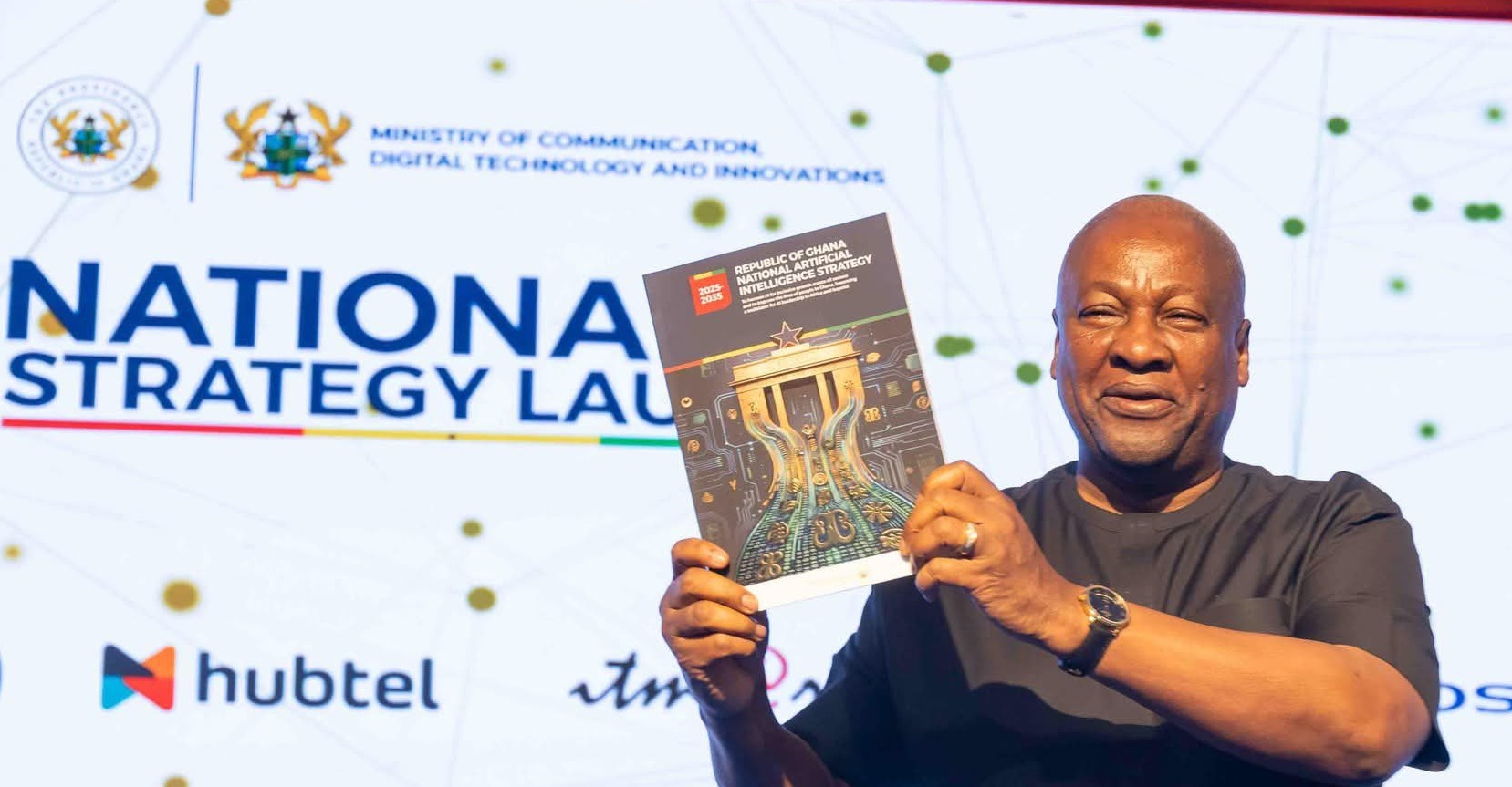
Ghana now has a National Artificial Intelligence (AI) strategy expected to be a guiding document for how the country approaches the use of and adoption of AI across all sectors of national life.
On Friday, April 24, 2026, the Ministry of Communication, Digital Technology and Innovations launched the 84-paged National AI Strategy 2025–2035 (download the document here).
It details the government’s ambition to harness the potential of AI’s application to accelerate socioeconomic development, and to also mitigate the risks associated with AI adoption and use in the short, medium and long term.
A National AI Fund
To support the implementation of the strategy, there will be the creation of a five-year National AI Fund, which will first take off with GH¢5 billion from 2025 to 2030 and then upscaled to GH¢15 billion from 2030 to 2035.
“In addition, we will attract a total of 200 billion Ghanaian cedis in foreign direct investment (FDI) and local private sector investment towards growing the AI ecosystem in Ghana by 2035. By 2030, AI should be contributing 200 billion Ghanaian cedis to Ghana’s GDP, and by 2035, it should be contributing 500 billion Ghanaian cedis to Ghana’s GDP,” parts of the 84-page document stated.
The National AI Strategy has 8 pillars and 73 corresponding key policy recommendations, 8 target sectors, an action plan, and an office responsible for the implementation of the strategy.
Eight pillars of the AI strategy
The strategy has been anchored on eight pillars, designed to foster a responsible and inclusive AI ecosystem. They include;
- Expand AI Education: Prioritizes integrating AI skills into national curricula and launching “AI Ready Ghana” programmes to train students and the general public.
- Empower Youth for Jobs of the Future: Focuses on remote work opportunities, internships, and reskilling programs to ensure the workforce remains competitive.
- Deepen Digital Infrastructure & Inclusion: Aims to provide affordable access to world-class computing power and high-speed internet, especially in rural and underserved areas.
- Facilitate Data Access & Governance: Involves rolling out the Ghana Open Data Initiative (GODI) and establishing clear data-sharing and privacy guidelines.
- Coordinate a Robust AI Community Ecosystem: Focuses on building innovation hubs, convening a national AI community, and reversing the “brain drain” by engaging the Ghanaian diaspora.
- Accelerate AI Adoption Across Sectors: Supports pilot projects in key sectors like healthcare and agriculture, and provides incentives such as tax breaks for AI startups.
- Invest in Applied AI Research: Establishes specialized initiatives like a Natural Language Processing (NLP) Centre of Excellence and a National Deep Science Institute.
- Promote AI Adoption in the Public Sector: Includes training civil servants and developing “GhanaChat”, a private large language model for government use to improve productivity and service delivery.

Implementation and Governance
The document recommends that a Responsible AI Authority (RAI Authority) be established within the first year to lead the execution of the Ghana National AI Strategy.
The Authority will be mandated to implement the National AI Strategy by coordinating institutional stakeholders in the deployment of artificial intelligence. The office will also oversee ongoing monitoring and evaluation of the progress of Ghana’s AI efforts.
“The RAI Authority will be established as an independent, well-resourced institution tasked with driving implementation. This office is modelled on the Singapore National AI Office (NAIO), the Egypt National AI Council, and the United Kingdom’s Office for AI,” the document notes.
Under the strategy also, eight sectors have been targeted for AI adoption in Ghana. These include healthcare, transportation, agriculture, energy, financial services, culture, lands and natural resources, the environment and circular economy.
Financing for AI infrastructure
At the launch on Friday, President Mahama said Ghana will invest $250 million for an AI computing center. This was also announced last month by the communications minister, who noted that Cabinet had given the greenlight.
The proposed AI computing center will serve as a nerve center for research, innovation and enterprise, the president said.
“I’m aware that the rapid advancement of AI also raises legitimate concerns particularly about jobs and employment… As a responsible government, we take these concerns seriously. A simple principle will therefore guide our approach. AI must enhance human capability and not diminish human dignity.
“We will pursue a human and inclusive model of adoption, consistent with the values of industry… We will invest in upscaling and rescaling our public sector workforce… to adapt and thrive in this new era. We do not intend to surrender our people to technological disruptions,” the president added.

Speaker of Parliament, Alban Bagbin – Poorly governed AI can weaken social trust
The Speaker, who was the chairman of the occasion noted that the deployment of AI must ensure that human dignity is protected and that the technology is developed in an ethical way. He further stated that Parliament is ready to support the government in the area of legislation for AI use.
“Artificial Intelligence can unlock productivity, improve public service delivery, enhance scientific discovery, and expand economic opportunities. At the same time, if left unchecked, or poorly governed, it can deepen inequality, weaken social trust, threaten privacy, and marginalised the most vulnerable among us.
“It is therefore not enough to be technologically advanced, we must also be morally grounded. It is our constitutional and ethical obligation to ensure that AI is developed and deployed in a manner that unlives the Ghanaian spirit, protects human dignity, safeguards our democracy and expands opportunities for all…
“Parliament stands ready to play its part by providing the necessary legislative framework to guide this emerging ecosystem,” he said.
Chief Justice Paul Baffoe-Bonnie – AI should be subject to the rule of law
Chief Justice, Paul Baffoe-Bonnie, who was the guest speaker at the event, raised critical concerns about biases built into AI systems. He noted further that technology in any form must be subject to the law.
“The potential of artificial intelligence is considerable… At the same time, it would be unwise to ignore the questions that accompany these possibilities. Who designs these systems, what assumptions or biases might be built into them. How did they arrive at their conclusions and ultimately who bears responsibility for the outcomes they produce.
“From the perspective of the judiciary that I head, this is a moment that calls for perfect reflection… We must be clear from the outset that no matter how advanced a technology may be and no matter how efficient it appears, it must remain subject to the rule of law,” he said.

