


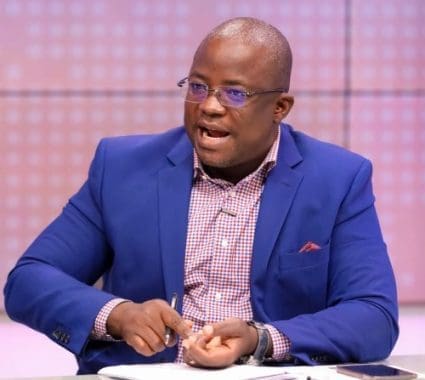
A political scientist at the University of Ghana is warning that Ghana’s anti-corruption crisis runs deeper than any court ruling, arguing that the country’s political leadership has failed to demonstrate the public commitment needed to preserve the Office of the Special Prosecutor (OSP) as an independent institution.
Dr. Joshua Zaato, a Senior Lecturer in the Department of Political Science at the University of Ghana, made the remarks across multiple television appearances this week as the OSP crisis sharpened following a High Court ruling delivered on 15 April 2026 by Justice John Nyante Nyadu. The court held, on a petition by private citizen Peter Archibold Hyde, that the OSP cannot initiate or conduct criminal prosecutions without prior authorisation from Attorney-General Dr. Dominic Akuritinga Ayine, and directed that all ongoing cases be transferred to the Attorney-General’s Department. The OSP, led by Special Prosecutor Kissi Agyebeng, has disputed the ruling and is pursuing an appeal, insisting that its prosecutorial mandate under the Office of the Special Prosecutor Act, 2017 (Act 959) remains valid until the Supreme Court delivers a definitive ruling.
Dr. Zaato said the legal dispute has exposed a broader failure of political will. Speaking on New Day on TV3, he argued that President John Dramani Mahama must take a visible and unambiguous public position in defence of the OSP while the Supreme Court process unfolds. “You want the president to be bold,” he said, adding that his own position remained firm. “I stand with the Special Prosecutor’s Office.”
The academic warned that the High Court ruling, if left to stand, risks unravelling accountability gains made under the institution and could even affect past convictions. “That completely breaks accountability in our fight against corruption,” he said.
On 3News, Dr. Zaato argued that the pressure being applied to the OSP is driven not by legal principle but by self-interest among powerful actors who fear investigation. He suggested that those most eager to see the OSP weakened or its cases transferred are precisely those who stand to benefit from that outcome. “Powerful people in government are afraid of the OSP,” he said. “They believe it may come for them.”
He also drew a pointed historical comparison, warning that the OSP risks following the same trajectory as the Commission on Human Rights and Administrative Justice (CHRAJ), an institution he said has been gradually stripped of its effectiveness through sustained political pressure. “Policy makers have increasingly rendered CHRAJ a toothless bulldog,” he said. “The same thing is what they are trying to now do to the OSP.”
Dr. Zaato acknowledged the OSP’s imperfections but insisted that institutional effectiveness rather than institutional perfection should be the standard. “Perfection is not the solution, effectiveness is what you are looking for,” he stated.
Amid the legal and political uncertainty, the academic directed particular praise at civil society organisations that have filed legal support actions backing the OSP’s appeal. He described these groups as the most consequential actors in the current standoff, noting that their intervention will be remembered as a moment of institutional defence. “History will remember that when people tried to dismantle a strong institution, you stood up,” he said.
Dr. Zaato also cautioned that the ongoing siege on the OSP is not only a domestic governance failure but a reputational risk internationally, noting that Ghana’s standing in global corruption perception indices could worsen if the institution continues to face what he described as coordinated efforts to undermine it.
The case is now before the Supreme Court of Ghana, where a final determination on the OSP’s prosecutorial independence is expected to shape the future of anti-corruption enforcement in the country.
