

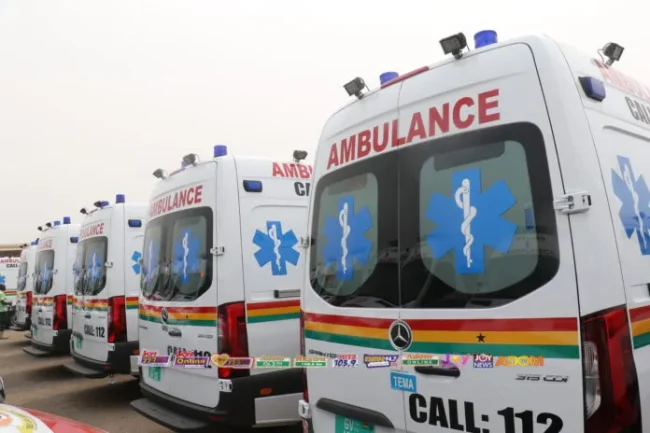
The National Ambulance Service (NAS) has announced plans to procure 400 new ambulances and 500 medical motorbikes, but the announcement has renewed long-standing questions about whether Ghana can sustain the fleet it already owns, after prior procurement drives left dozens of vehicles grounded within years of commissioning.
Chief Executive Officer of the NAS, Dr. George Kojo Owusu, confirmed at a press conference in Accra on March 2 that procurement processes had reached the decision-making stage. He said the new fleet would include paediatric ambulances, Basic Life Support (BLS) vehicles, Advanced Life Support (ALS) vehicles, critical care units, and Intensive Care Unit (ICU) ambulances. The 500 medical motorbikes are intended to navigate traffic congestion in urban areas where larger vehicles are routinely delayed during emergencies.
Dr. Owusu acknowledged existing operational challenges while maintaining that the service is functional and not in crisis. He appealed for what he described as balanced public discourse about the institution’s performance.
The announcement comes against a difficult backdrop. Ghana’s 2019 commissioning of 307 ambulances under the “One Constituency, One Ambulance” initiative, which cost the state approximately $54.3 million according to the Auditor General’s 2022 performance audit, was followed within four years by widespread fleet deterioration. By late 2023, multiple reports indicated that as many as 91 of the 307 vehicles were already non-functional, while separate accounts from NAS officials at the time suggested that of roughly 155 ambulances tracked in some regions, only around 50 remained active.
Academic data from a peer-reviewed study tracking NAS operations from 2004 to 2023, published in the African Journal of Emergency Medicine, shows the service grew from nine ambulances and 64 Emergency Medical Technicians (EMTs) to 356 ambulances and 3,473 EMTs over two decades, and now maintains at least one station in each of Ghana’s 261 districts. However, the same study noted repeated service interruptions caused by financial constraints, with patient transport volumes falling by more than half between 2017 and 2019 compared to the prior peak.
Health analysts and civil society groups have consistently argued that Ghana’s emergency medical challenge is less about fleet size and more about lifecycle planning. Routine servicing, spare parts supply chains, trained mechanics, and predictable maintenance funding have repeatedly been treated as afterthoughts in a procurement culture that prioritises the commissioning event over the years of upkeep that follow. The Auditor General’s 2022 report found that the unit cost of ambulances procured under the 2019 initiative was significantly inflated relative to prevailing market prices, suggesting that governance weaknesses have affected value for money at both the purchase and maintenance stages.
Dr. Owusu did not provide a timeline for the new procurement, stating that negotiations and approvals of this scale require careful management and that specific dates would be communicated once confirmed.
Public health advocates have called on the government to publish an auditable, publicly accessible fleet inventory before the new procurement advances, showing how many vehicles from prior batches are currently operational, how many are grounded and why, and what maintenance expenditure has been committed over the life of the existing fleet. Parliament’s Health Committee is expected to request a briefing from the NAS in the coming weeks.

