
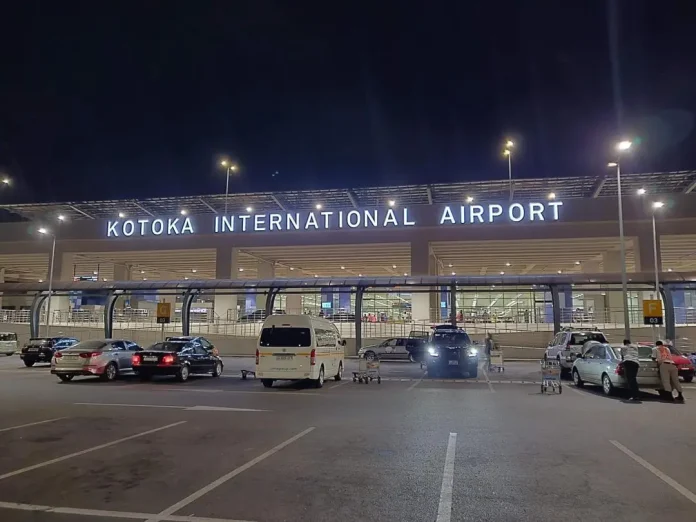

Ghana’s renewed debate over renaming Kotoka International Airport has evolved beyond cultural and historical considerations into a question of economic priorities, opportunity costs, and how the country allocates limited political attention during a period of fiscal restraint and economic recovery.
The proposal to revert Kotoka International Airport to its original designation, Accra International Airport, emerges at a time when Ghana continues navigating debt restructuring, an International Monetary Fund (IMF) supported programme, rising youth unemployment, and persistent pressure on the cedi. Development economist Dr George Domfe has cautioned that symbolic debates risk diverting focus from urgent economic challenges facing the nation.
Speaking on Channel One TV’s The Big Issue on Saturday, February 7, 2026, Dr Domfe criticized the timing of the renaming discussion, stating that Ghana faces fundamental economic problems requiring immediate attention. He argued that the government should prioritize economic stabilization rather than expending energy on symbolic infrastructure changes.
Kotoka International Airport serves as Ghana’s most valuable aviation asset and critical gateway for trade, tourism, diplomacy, and investment. According to Ghana Airports Company Limited (GACL), the facility handles over three million passengers annually and operates as a major hub connecting West Africa to Europe, North America, and the Middle East. Industry observers note that any decision affecting this asset, even symbolically, carries economic and reputational implications.
Supporters of the renaming argue that Lieutenant General Emmanuel Kwasi Kotoka’s role in the 1966 coup that overthrew Dr Kwame Nkrumah makes his continued commemoration on a national monument inappropriate. This position aligns with Ghana’s constitutional rejection of unconstitutional changes of government. Article 3 of the 1992 Constitution explicitly condemns coups and safeguards democratic rule, providing a legal and moral foundation for the argument.
The economic dimension of the debate extends beyond symbolism. Renaming an international airport involves changes to aviation databases, international flight schedules, insurance documentation, airport codes in global systems, branding materials, signage, bilateral aviation agreements, and commercial contracts. While Ghana’s International Civil Aviation Organisation (ICAO) code ACC would remain unchanged, local advertising and branding experts estimate the administrative exercise could cost between two million and five million United States dollars.
At a time when the government urges fiscal discipline and asks citizens to bear economic hardship, public sensitivity to perceived non essential expenditure remains high. Economists have consistently warned that policy focus matters as much as policy content during periods of economic transition.
Dr Domfe’s comments reflect broader concerns about policy bandwidth allocation. International investors and airlines value predictability and stability in operating environments. Frequent institutional renaming, reversals, and rebranding can create impressions of policy inconsistency, even when intentions address legitimate historical grievances.
Ghana has experienced repeated cycles of renaming over the years, from Flagstaff House and Jubilee House to tertiary institutions and school systems. Each cycle reopens political debates without necessarily delivering measurable developmental gains, according to governance analysts.
A broader aviation economics question has resurfaced alongside the renaming debate. Ghana currently does not operate a functional national carrier following the collapse of Ghana Airways in 2004 and the suspension of subsequent revival efforts, including Ghana International Airlines. As a result, the country relies almost entirely on foreign airlines to move passengers, cargo, and tourism traffic through Kotoka International Airport.
Industry analysts have pointed out that this dependence means a significant share of ticket revenue, cargo earnings, and ancillary aviation income generated in Ghana is repatriated abroad. According to the International Air Transport Association (IATA), airlines operating in Africa remit billions of dollars annually to their home countries, strengthening national carriers in countries with robust state owned aviation companies.
Ethiopian Airlines, fully state owned, reported revenues of 7.6 billion dollars in its 2024/2025 fiscal year ended July 7, 2025, representing an eight percent year on year increase despite global challenges including conflicts in Sudan, the Middle East, and the Democratic Republic of Congo. The carrier transported 19.1 million passengers during the period, comprising 15.2 million international and 3.9 million domestic travelers, while carrying approximately 785,000 tonnes of cargo.
Ethiopian Airlines now ranks among Africa’s most profitable and expansive airlines, leveraging its hub model to retain aviation value within Ethiopia’s economy. The carrier serves 144 destinations worldwide, including 66 in Africa, and operates 70 freighter destinations across five continents. For the first half of the 2025/2026 fiscal year, Ethiopian Airlines reported revenue of 4.4 billion dollars, exceeding its target by two percent.
For some observers, the renewed focus on symbolic renaming contrasts sharply with the absence of a coherent national airline strategy that could retain aviation revenue, create skilled jobs, and strengthen Ghana’s position as a regional air transport hub. The debate raises questions about whether Ghana’s political leadership remains sufficiently focused on structural economic transformation.
Many countries have opted for historical contextualisation rather than deletion when confronting difficult chapters of their past. In the United Kingdom, Oliver Cromwell remains commemorated in statues, street names, and institutions despite leading a military overthrow that resulted in the execution of King Charles I. Britain has largely chosen to confront Cromwell’s contradictions through public education rather than removal.
Transport Minister Joseph Bukari Nikpe is expected to present the renaming bill to Parliament during the current eight week session for debate and approval. The government has indicated that the proposed change forms part of its broader resetting agenda to restore historical and cultural identities. Officials argue that naming the airport after the Ga people, who are the original custodians of the land, would address a historical injustice.
The proposal has sparked national debate. Some Ghanaians support the move, arguing that naming the airport after a figure associated with overthrowing a democratically elected government contradicts Ghana’s constitutional commitment to democracy. Others have called for the airport to be named after Dr Kwame Nkrumah instead, noting that he was responsible for its construction and served as the nation’s founding father.
Charles Bawaduah, Member of Parliament for Bongo, stated during a television interview on Saturday that renaming the airport would help project Ghana’s democratic credentials internationally. He argued that major airports worldwide are typically named after national heroes who played key roles in independence struggles or democratic development, not coup leaders.
Anti corruption advocate Vitus Azeem has urged the government to amend the bill to name the airport after Nkrumah rather than reverting to Accra International Airport. Speaking to Citi News on Sunday, Mr Azeem said that many African countries have named their main international airports after founding leaders who fought for and secured independence.
As Parliament prepares to debate the proposed renaming, the decision will serve as an indicator of Ghana’s governance priorities during a critical period of economic recovery. For many Ghanaians, the name displayed on an airport façade carries less urgency than the price of fuel, availability of jobs, cost of food, and strength of the cedi.
Roads, ports, energy reliability, logistics efficiency, and skills development remain the foundations upon which national competitiveness is built. While historical reckoning holds legitimate value, economists caution that there exists a difference between addressing historical grievances and allowing symbolic debates to distract from structural economic challenges requiring immediate policy attention.

