

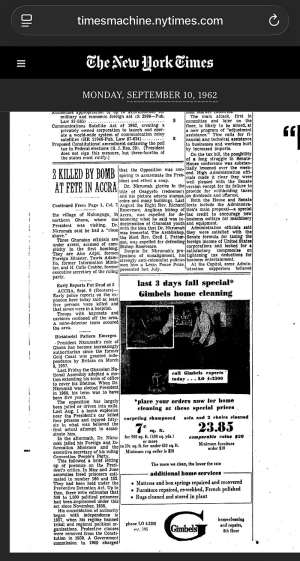
The first explosive ordnance directed at the constitutionally elected leader of the Gold Coast colony, Dr. Kwame Nkrumah, was detonated at his home in Accra New Town on November 10, 1955. This fact is important because Kwame Nkrumah had done nothing dictatorial or arbitrary at this point in his leadership of the Gold Coast as he pushed toward total freedom from British rule. His party, the Convention People’s Party (CPP), had won elections in 1952 and 1954, and would win again in 1956—finally overriding the objections of the disloyal opposition to “self-government now.”
As early as 1958, J.B. Danquah, Reginald Reynolds Amponsah, Modesto Apaloo, Joe Appiah, Kofi Busia, and Victor Owusu, along with Major Awhiatey, were implicated in a coup plot. This directly led to the enactment of the Preventive Detention Act.
A great disservice has been done to the younger generations of Ghanaians, who have no memory of Africa’s “Man of the Millennium” as a living person. Indeed, the number of people who remember him personally within Ghana continues to diminish by the day. He is vilified by the political descendants of the murderous, bomb‑throwing opposition whose activities led to the deaths of countless Ghanaians and injuries to many more. This vilification stems from the fact that he held a constitutional referendum—in which the opposition participated—to decide whether our country should become a one‑party state, since the other party no longer relied on ballots but on bullets and bombs.
I am yet to understand how being a one‑party state has undermined China’s rise to become the economic powerhouse that it is, or how this phenomenon of a one‑party dominant state, which was what Ghana was then, adversely affected Singapore’s rapid development.
The absurdity of describing Lieutenant General Kotoka, the architect of the CIA‑sponsored 1966 coup, as a “liberator” is unconscionable. The actions of this man and those associated with him irreparably derailed Ghana’s development from a Third World country to a potential First World country in the shortest possible time. Sadly, this great nation and its proud people have been reduced to the status of a poster boy for neocolonialism. How paradoxical.
Then I hear arguments about the cost of changing the name of the airport back to its original name, Accra International Airport—coming from the very people who dug the most expensive hole in the ground in Ghana’s history in the name of God.
There is also the constant cacophony of falsehoods about Nkrumah’s finance minister allegedly fleeing the country before the coup. If they are referring to former finance minister Mr. Gbedemah, he had, of course, fled after embezzling government funds and being forced to resign.
Then comes the most despicable argument: the ethnic one. The ethnicity of General Kotoka is irrelevant in this matter. What is at issue is what he represented politically in the evolution of the country.
As a country, we continue to struggle with the fundamental idea that individuals who do wrong must be held accountable and punished.
After all the elections that Nkrumah won transparently, openly, and legally, the opposition party was relentless in its refusal to accept defeat. As a result, they mounted a bombing and assassination campaign that started in 1955 and continued until they successfully and illegally overthrew the government. The conduct of the opposition can only be described as a campaign of domestic terrorism against a people who had made their choice known again and again and again. This bombing campaign killed over 20 people and injured and maimed more than 400 people. Responding to this, and to the assassination attempts against him, by using all legal means at his disposal, earned Nkrumah the descriptor of “dictator.”
The political descendants of these criminals continue to enter public spaces without shame to equate the so‑called heroism of Lt. General Emmanuel Kotoka with the iconic stature of Kwame Nkrumah—one of the greatest Africans to have ever lived. When they make these claims, they conveniently omit the $50,000 or so that the CIA paid the coup makers for their colossal betrayal of their country. This information is openly available in declassified American documents. The NLC was described in those CIA records as “pathetically pro‑Western.” Why such a person’s name remains on the proverbial gateway to West Africa is something only they can understand or rationalize.
Anyone who travels with or meets visitors at our airport is always embarrassed by having to explain who General Kotoka was, and then must travel across the city to the Nkrumah Mausoleum. This embarrassing contradiction has been a painful scar on the psyche of the nation for far too long.
Thank God, it will no longer oppress us by day and night. It is time for truth to stand and for the nation to heal.
“Ghanaians are not timid people as has been suggested in the foreign press. Far from it. They may be slow to anger, and may take time to organise and act. But once they are ready, they strike and strike hard. It pays more to tamper with Ghanaian freedom and dignity.” – Kwame Nkrumah
Thaddeus Ulzen is National Chairman of the Progressive Alliance for Ghana (PAG) a neo-Nkrumaist political party.
He is the author of Java Hill: An African Journey – A Historiography of Ghana
@thaddeusulzen
[email protected]
By Prof (Med) T. P. Manus Ulzen

