

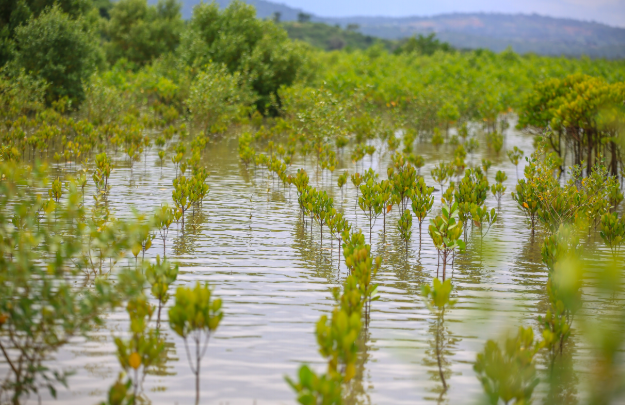
The 50 hectares of mangroves that have been planted by Bidii Creek Conservancy in Jomvu with the assistance of KPC on July 22, 2025/John Chesoli
Kenya stands to reap substantial benefits from investing in mangroves and seagrass, a new study shows.
The study, ‘Delivering the ocean climate actions: Building a robust information base to facilitate and enhance the incorporation of blue carbon solutions into Kenya’s climate commitments’, says mangroves and seagrass hold immense potential for carbon sequestration and climate resilience.
Despite their importance, the study found these ecosystems are declining at worrying rates.
“Results from this study show that Kenya’s blue carbon ecosystems, particularly mangroves and seagrasses, are declining at alarming annual rates of 0.57 per cent and 0.26 per cent, respectively,” the study says. It adds that projections show that, without intervention, mangrove cover could decrease by 15.8 per cent by 2050, releasing about 55.3 MtCO₂e.
The study, which has since been published in the Marine Policy journal and spotlights the role of blue carbon solutions in strengthening Kenya’s climate action efforts, was conducted by the Kenya Marine and Fisheries Research Institute (KMFRI).
It aimed to gather data and identify information gaps to ascertain and collate the knowledge required to strengthen the full integration of blue carbon ecosystems into Kenya’s climate commitments.
The research was conducted along Kenya’s 600km coastline, stretching from the Kenya–Somalia border at Ishakani in the north to the Kenya–Tanzania border at Vanga in the south.
The study calls for urgent management interventions, stronger science-driven data and robust policy frameworks to ensure meaningful integration of blue carbon into national climate strategies.
It says such interventions could mitigate losses, boosting mangrove cover by four per cent above 2020 levels and reducing carbon losses by 67 per cent compared with a business-as-usual scenario.
“Furthermore, these interventions yield substantial economic returns—up to five times the cost for mangroves and three times for seagrasses — highlighting the economic and environmental imperative of these measures.”
To fully realise these benefits, comprehensive data-readiness assessments and improved policy support are essential for effectively embedding blue carbon ecosystems within Kenya’s climate commitments.
In its updated Nationally Determined Contributions, Kenya increased its ambition for greenhouse gas emissions abatement from 30 per cent to 32 per cent by 2030.
The study comes at a time when a separate assessment showed more than half of the world’s mangrove ecosystems are at risk of collapse by 2050.
The assessment was conducted under the International Union for Conservation of Nature’s (IUCN) Red List of Ecosystems, a global standard for measuring ecosystem health.
The findings show 50 per cent of mangrove ecosystems are classified as vulnerable or critically endangered.
Mangroves are salt-tolerant trees and shrubs found in the intertidal regions of tropical and subtropical coastlines.
They thrive where fresh water mixes with seawater.
In Kenya, mangroves are found in Lamu, Tana River, Kilifi, Mombasa and Kwale counties.
They occur in tidal estuaries, creeks and protected bays.
Lamu has the largest mangrove forests at 92,293 acres, followed by Kilifi (21,092 acres), Kwale (20,643 acres), Mombasa (9,318 acres) and Tana River (eight acres).
Mangroves are threatened by deforestation, development, pollution and dam construction.
However, risks to these ecosystems are increasing due to rising sea levels and the greater frequency of severe storms associated with climate change.
Climate change threatens one-third (33 per cent) of mangrove ecosystems worldwide.

