


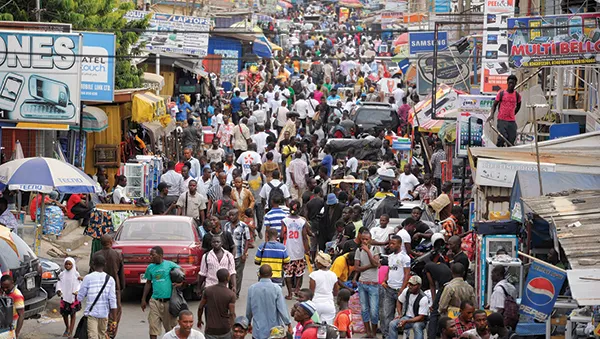
Ghana enters 2026 with its strongest macroeconomic position in years, yet economists warn the country’s ability to translate stability into lasting transformation will determine whether recent gains prove temporary or mark a genuine turning point.
The economy recorded 3.8 percent expansion in October 2025, reflecting gradual momentum across services and industry sectors. Government statistician Alhassan Iddrisu presented the provisional data, emphasizing that services contributed nearly three quarters of total growth while industry showed meaningful recovery after subdued performance throughout 2024.
International financial institutions project Ghana’s gross domestic product will grow between 4 percent and 5 percent in 2026. The International Monetary Fund estimates 4 percent expansion while Fitch Solutions forecasts 5 percent growth, driven by declining inflation, anticipated monetary easing, and increased government spending as the country’s IMF (International Monetary Fund) program approaches completion.
The optimistic projections reflect substantial macroeconomic improvements achieved over the past year. Inflation fell to 8.1 percent in October 2025, returning to single digits for the first time since early 2022 and landing within the Bank of Ghana’s medium term target band. Public debt declined from above 90 percent of gross domestic product in 2022 to approximately 45 percent by late 2025, aided by domestic debt restructuring operations and reduced external borrowing.
Currency stability has reinforced confidence. The cedi depreciation rate slowed dramatically from 60 percent in 2022 to 17 percent in 2023, with further stabilization evident throughout 2025 as foreign exchange reserves strengthened. Treasury bill rates dropped from around 25 percent earlier in the year to 10.6 percent by October, while the monetary policy rate declined to 21.5 percent in November.
The 2026 budget allocates 357 billion cedis toward government operations and development priorities under the theme Resetting for Growth, Jobs and Economic Transformation. Finance Minister Cassiel Ato Forson emphasized that appropriations mark a transition from stabilization toward growth acceleration anchored by revenue mobilization, expenditure discipline, and targeted productive sector investments.
Major allocations include 33.3 billion cedis for the Ministry of Education, 30 billion cedis for the Big Push Infrastructure Programme focusing on roads and bridges, 6.9 billion cedis for oil palm development financing, and 4.2 billion cedis for free secondary education. The government also committed 2 billion cedis toward rural electrification expansion and 200 million dollars to the Buffer Stock Company for agricultural produce purchases.
However, several economists caution that budget execution capacity will determine whether ambitious spending plans deliver promised results. Ghana historically struggles with capital expenditure implementation, often failing to complete projects within allocated timeframes or cutting infrastructure spending when revenue shortfalls emerge.
Revenue volatility presents another concern. The budget introduces tax reforms including Value Added Tax adjustments and threshold increases intended to ease business burdens, but these changes carry short term revenue risks. Government expects stronger domestic resource mobilization through improved tax administration and compliance to offset potential shortfalls, though success is not automatic.
State owned enterprise exposures remain a core fragility threatening fiscal gains. Legacy arrears, energy sector tariff under recovery, and governance weaknesses in government corporations could erode recent progress if not addressed decisively. The administration negotiated power purchase agreements saving over 250 million dollars and restructuring 1.1 billion dollars in obligations, yet monitoring will prove essential to prevent new arrears accumulation.
External shocks pose additional risks to the outlook. Ghana’s economic trajectory remains vulnerable to commodity price swings affecting gold and cocoa markets, global financing conditions, and potential trade disruptions. The September 2025 expiration of the African Growth and Opportunity Act threatens duty free access to United States markets for eligible countries unless the program receives congressional renewal.
Agriculture sector performance particularly concerns analysts given its marginal contribution to recent growth despite employing the largest share of the workforce. The sector recorded just 0.9 percent expansion in October, contributing approximately 0.05 percentage points to overall economic activity. Uneven growth patterns mean headline expansion figures do not automatically translate into improved living standards for most Ghanaians concentrated in informal agriculture.
The central bank argues that Ghana’s negative output gap is narrowing based on composite indices tracking industrial production, trade activity, private credit, and consumption. Confidence surveys conducted in October showed more optimistic expectations about current and future economic conditions supported by purchasing managers reporting increased new orders.
Analysts emphasize that converting stability into opportunity requires addressing structural constraints beyond fiscal management. Poor rural road networks limit farmers’ market access and undermine value addition strategies. Manufacturing struggles to achieve consistent momentum despite government support. Per capita income growth projections of roughly 2 percent annually remain insufficient to create jobs matching labor force expansion.
The World Bank projects Sub Saharan Africa will grow 4.3 percent in 2026, up from an estimated 4 percent in 2025, though performance diverges sharply across the 48 countries comprising the region. Ghana’s projected growth aligns with continental trends but trails high performers including Guinea at 9.3 percent, Rwanda at 7.2 percent, and Tanzania at 6.2 percent.
Political pressures add uncertainty to the outlook. Standard and Poor’s noted that reform effectiveness will face testing through economic and electoral cycles, warning that political incentives could tempt relaxation of fiscal discipline. Ghana historically experiences spending increases and policy reversals during election periods, though current IMF program commitments may constrain such tendencies.
For businesses, the improved macroeconomic environment offers opportunities but demands adaptation. Sectors tied to essential services, logistics, food systems, and digital solutions show relative resilience while consumer facing enterprises must navigate price sensitive markets where purchasing power remains constrained despite moderating inflation.
Household finances continue adjusting to elevated cost of living baselines even as inflation declines. Wages and incomes, particularly in the informal sector where most Ghanaians work, have not fully recovered from the sharp price increases experienced between 2022 and 2024. Rising food prices, transport fares, rent, utilities, and healthcare costs have redefined daily budgeting for millions of families.
Climate change adds urgency to economic transformation efforts. Erratic rainfall patterns and temperature increases threaten agricultural yields, particularly for rain dependent farming systems that dominate Ghana’s landscape. Cocoa production has suffered notably from adverse weather and disease pressures, constraining a historically crucial export earner.
The government’s ambitious infrastructure plans aim to address supply side constraints that have limited private investment and productivity growth for decades. Success implementing projects such as the 1,200 megawatt power plant, rural electrification reaching underserved communities, and strategic road corridors connecting production zones to markets will determine whether Ghana can transition from consumption driven expansion toward more balanced, productive growth.
Economists stress that 2026 represents a pivotal year. The macroeconomic stabilization achieved through difficult adjustments has created a foundation, but converting that platform into sustained prosperity depends on execution quality, institutional strengthening, and maintaining reform discipline when political pressures mount. Ghana’s economic story over the coming year will be written not by headline growth figures alone but by how effectively stability translates into jobs, rising incomes, and expanding opportunities for ordinary citizens.
